
Teen Homework Procrastination: How to Break the Cycle Without Constant Nagging
If your teenager can spend an hour scrolling, chatting, or reorganizing a playlist but somehow cannot begin a 30-minute homework assignment until 10:47 p.m., it is easy to assume the problem is laziness. Usually, that explanation is too simple.
Homework procrastination is often a starting problem, not a caring problem. A teen may genuinely want good grades and still avoid the first uncomfortable minutes of a task. Research on academic procrastination repeatedly connects delay with self-regulation, emotion, planning, and the ability to turn an intention into action. That distinction matters because constant reminders may create more conflict without teaching the skill your teen actually needs.
This guide shows parents how to reduce last-minute homework battles without becoming a full-time monitor. The goal is not to eliminate every delay. It is to help your teenager build a repeatable system for starting, focusing, recovering from distraction, and gradually taking ownership.
Table of Contents
- Why teens procrastinate on homework
- Why “lazy” is often the wrong diagnosis
- Why constant nagging can backfire
- Identify your teen’s procrastination pattern
- A practical homework-start system
- How to handle phones without a nightly war
- What to do when the work feels overwhelming
- Build a routine that survives real life
- What parents can say instead of nagging
- When to involve the school
- When procrastination may signal a bigger problem
- A seven-day reset plan
- Research sources
Why Teens Procrastinate on Homework
Procrastination is not simply “doing nothing.” It is delaying an intended action even when we expect that the delay will make things worse. For a teenager, the immediate reward of avoiding a difficult worksheet can feel stronger than the distant reward of finishing early.
The homework may trigger boredom, uncertainty, frustration, fear of getting the answer wrong, or the feeling that the assignment is too large. Avoiding it produces short-term relief. Unfortunately, that relief teaches the brain a powerful lesson: when work feels uncomfortable, escape makes me feel better.
This is one reason a teen can appear perfectly motivated in conversation and still fail to start. Intention and execution are different skills. Research on self-regulated learning describes the importance of translating goals into specific actions: deciding what to do, when to begin, how to work, and what to do when attention drifts.
Adolescence also comes with increasing academic demands and increasing independence at the same time. Parents and teachers expect more planning just as schedules, friendships, extracurricular activities, digital distractions, and sleep pressures become more complicated.
Why “Lazy” Is Often the Wrong Diagnosis
Calling a teenager lazy may describe what the behavior looks like from the outside, but it rarely tells you what to do next. Two teens can both delay homework for completely different reasons.
One does not understand the assignment. Another understands it but feels overwhelmed by its size. A third waits because perfectionism makes starting risky: if the work is never started, it cannot yet be judged. Another has developed a habit of using urgency as fuel and believes, “I work better under pressure.” A fifth is simply exhausted.
Ask a more useful question: What makes starting this task harder than it needs to be?
Look for clues. Does procrastination happen mainly in one subject? After particularly long school days? Only when the phone is nearby? With open-ended projects but not short worksheets? Does your teen sit at the desk but avoid the work, or never approach the desk at all? Patterns tell you more than labels.
Why Constant Nagging Can Backfire
Repeated reminders can work in the short term. A parent says, “Start your homework,” five times, the teen eventually starts, and the assignment gets done. But the system may quietly teach the wrong lesson: I do not have to notice the time or initiate the task because someone else will keep reminding me.
It can also turn homework into a relationship battle. The parent feels ignored and becomes more forceful. The teen feels controlled and becomes defensive. Soon the argument is no longer about algebra; it is about autonomy, respect, and who gets the last word.
The alternative is not to stop caring. It is to move from repeated prompting to shared planning plus predictable accountability.
Instead of asking every 15 minutes whether homework has started, agree on the plan once: when the start time is, where the phone goes, what the first task is, and when you will check in. Then allow your teen some space to execute it.
Identify Your Teen’s Procrastination Pattern
Before changing the routine, spend several days observing. Most homework procrastination falls into a few overlapping patterns.
1. The overwhelmed starter
This teen sees “study for science” as one enormous task. The solution is not more pressure but a smaller entry point: open the notes, list the three topics, review the first page.
2. The distracted starter
The teen intends to work but notifications, videos, games, tabs, or conversations repeatedly interrupt the first 20 minutes. Here, the environment matters as much as motivation.
3. The perfectionistic starter
This teen may spend too long planning, choosing a topic, rewriting an introduction, or waiting to feel ready. A deliberately imperfect first draft can be more useful than another motivational speech.
4. The exhausted starter
If your teenager is consistently beginning homework late because afternoons are overloaded, the schedule itself may be the problem. A system cannot compensate indefinitely for chronic exhaustion.
5. The urgency-dependent starter
Some teens have learned that panic creates enough stimulation to begin. They may even point to past success as evidence that last-minute work “works.” Help them compare not only the final grade but also sleep, stress, quality, forgotten work, and how the next day feels.
6. The confused starter
A student who does not know what the teacher expects may avoid revealing that confusion. Ask, “What part is unclear?” rather than “Why haven’t you started?”
A Practical Homework-Start System
The best system is usually boring, visible, and easy to repeat. It should reduce the number of decisions your teen has to make at the moment when avoidance is most tempting.
Step 1: Choose a realistic start window
Do not automatically demand homework the minute your teen enters the house. Some students need food, movement, a shower, conversation, or a genuine mental break. The key is that the break has an end.
“After school” is vague. “Snack and downtime until 5:00, then start” is concrete. If extracurricular activities make every day different, create two or three standard routines rather than improvising nightly.
Step 2: Define the first physical action
“Do your homework” is a category, not an action. Make the first step almost too easy to resist:
- Put the math book on the desk.
- Open the school portal.
- Write the assignment list.
- Read the first question.
- Set a 10-minute timer.
Starting creates information. Once the assignment is open, your teen can see whether it is easy, difficult, short, confusing, or something that requires help.
Step 3: Use a short launch block
For a teen who resists starting, asking for “two hours of study” can trigger avoidance before the work begins. Try a 10- or 15-minute launch block. The agreement is simple: work genuinely for that block, then decide what comes next.
This is not a trick. If the teen truly needs a brief break after the block, allow it. The purpose is to practice initiation. Over time, many students discover that continuing is easier than starting.
Step 4: Make the workload visible
Have your teen turn assignments into a short list with estimated times. For example:
- Math problems 1–12 — 25 minutes
- Read history pages 44–51 — 20 minutes
- English paragraph draft — 30 minutes
- Pack bag and submit files — 10 minutes
The estimates will not always be accurate. That is fine. Estimating is itself a planning skill, and comparing estimates with actual time helps your teen improve it.
Step 5: Decide the stopping point
A routine needs an end as well as a beginning. If homework expands endlessly into the night, teens may learn to dread starting because starting seems to mean losing the entire evening. Set reasonable expectations around breaks and bedtime, while addressing chronic workload problems with the school when necessary.
How to Handle Phones Without a Nightly War
Phones are not the sole cause of procrastination, but they can make an already difficult start much harder. If digital habits are part of the struggle, see our guide to teenagers and social media. Current guidance from the American Academy of Pediatrics emphasizes protecting homework, sleep, movement, and family time rather than relying only on a universal number of screen-time hours.
A useful rule is to make the environment do some of the work. During a focused homework block, the phone can charge in a nearby shared location, sit out of reach, or use Focus/Do Not Disturb settings. The AAP also recommends phone-free times and spaces around activities such as homework and bedtime.
Whenever possible, create the rule with your teen rather than suddenly confiscating the device. Try:
“I’m not trying to take your phone away. We’re trying to make the first 25 minutes easier. Where could the phone stay so you’re not fighting notifications while you work?”
There is an important exception: sometimes the phone is legitimately part of the homework process. Students may need authentication, class groups, calculators, photos of assignments, or educational apps. In that case, reduce irrelevant interruptions rather than pretending the device has no academic use.
Parents should also look at their own behavior. A family rule is easier to accept when adults are willing to put their phones down during agreed focus or family periods too.

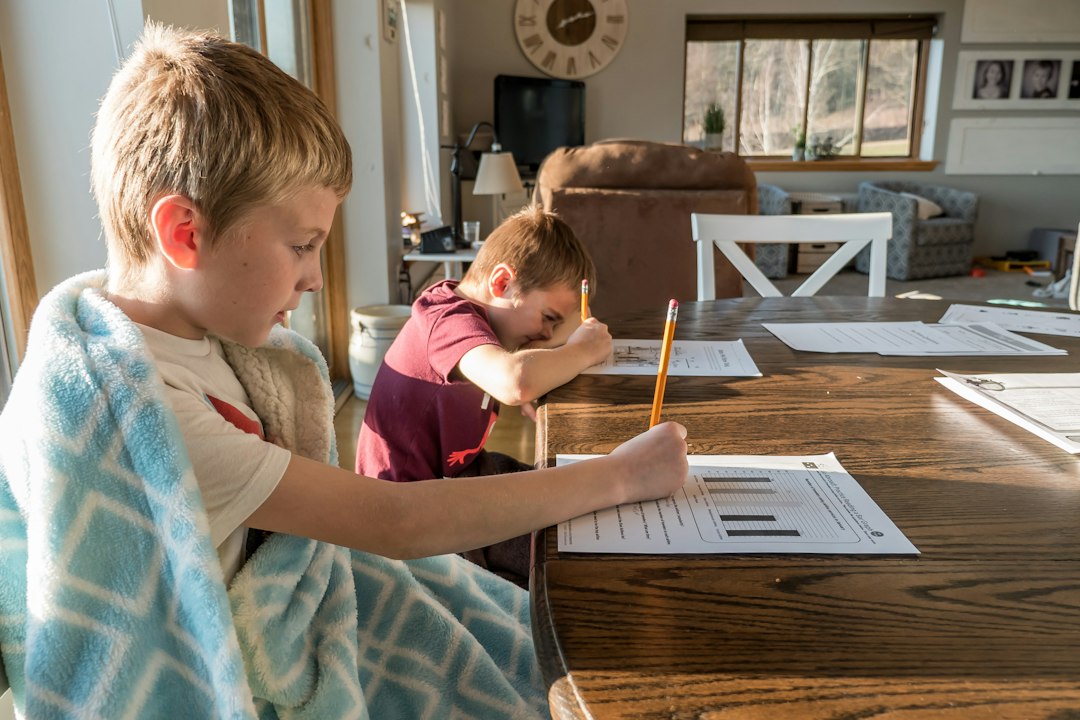
Photo by Tim Mossholder on Unsplash.
What to Do When the Work Feels Overwhelming
When your teen says, “I can’t do this,” resist the urge to immediately explain the entire assignment. First determine what “this” means.
Ask:
- “Is the problem understanding it or getting started?”
- “Show me the first point where you get stuck.”
- “What is the smallest part you could do without help?”
- “Do you need an explanation, a plan, or just someone nearby for five minutes?”
This preserves ownership. You are helping diagnose the obstacle, not taking over the task.
For large projects, work backward from the deadline. A presentation due Friday might become: choose topic Monday, gather sources Tuesday, outline Wednesday, build slides Thursday, final check Friday morning. Breaking work into visible stages reduces the emotional weight of “finish project.”
For perfectionism, establish a “bad first version” rule. The first paragraph may be rough. The first set of notes may be incomplete. Starting badly is often more productive than waiting for confidence.
Build a Routine That Survives Real Life
A perfect schedule that collapses after two days is less useful than a modest routine your family can repeat for months.
A sustainable homework routine usually answers six questions:
- When is the normal start window?
- Where does the work happen?
- Where does the phone go during focus blocks?
- How will assignments be listed and prioritized?
- What happens when the teen gets stuck?
- When does the parent check in?
Write the answers down for a week. This reduces nightly negotiation.
Also distinguish a routine from a rigid clock. If practice ends late on Tuesdays, Tuesday can have a different start time. Consistency means the process is predictable, not that every weekday must look identical.
Protect sleep from the homework cycle
Last-minute homework often creates a vicious circle: procrastination leads to late work, late work reduces sleep, fatigue makes concentration and self-control harder the next day, and the next homework session becomes more difficult. Our detailed guide to teen sleep explains why this pattern can be especially difficult during adolescence. The AAP has repeatedly emphasized the importance of protecting adolescent sleep and reducing media interference around bedtime.
If your teen is routinely working deep into the night despite a reasonable start time and focused effort, treat that as a workload or learning issue—not as proof that the teen needs even stricter discipline.
What Parents Can Say Instead of Nagging
Small changes in language can shift the interaction from control to problem-solving.
Instead of “How many times do I have to tell you to start?”, try: “What time did you decide you were starting?”
Instead of “You’re wasting the whole evening again.”, try: “What is making the first step difficult tonight?”
Instead of “Give me your phone. You obviously can’t control yourself.”, try: “What phone setup would give you 25 uninterrupted minutes?”
Instead of “You never plan ahead.”, try: “Let’s split the project into the next three actions.”
Instead of “Have you finished? Have you finished? Have you finished?”, try: “I’ll check back with you at 7:30. Tell me then what you completed and where you got stuck.”
The wording is not magic. Your teenager may still complain. The difference is that the conversation focuses on behavior and systems rather than character.
When to Involve the School
Parents sometimes spend months fighting about homework when important information is sitting at school.
Contact the teacher or relevant school professional when you see a persistent pattern such as missing assignments that your teen says were never assigned, hours of work that classmates complete much faster, repeated confusion about instructions, a sharp change in performance, avoidance concentrated in one subject, or difficulty organizing materials across classes.
Keep the message factual. Rather than “My child is lazy and refuses to work,” describe what you observe: “He sits down at 6:00 but often cannot identify what to do first and spends more than two hours on assignments listed as 45 minutes.” Specific observations make collaboration easier.
Ask what the teacher sees in class, how long the homework is expected to take, whether assignments are consistently posted in one place, and whether there are missing foundational skills.
When Procrastination May Signal a Bigger Problem
Occasional procrastination is common. Persistent, severe difficulty starting or completing schoolwork can sometimes occur alongside attention difficulties, anxiety, depression, learning problems, sleep problems, or significant stress. A blog article cannot determine which, if any, applies to your teenager.
Pay closer attention when procrastination represents a major change from previous functioning, affects several areas of life rather than homework alone, causes substantial distress, repeatedly destroys sleep, or continues despite reasonable structure and support.
In those situations, begin with your teen rather than a diagnosis:
“I’ve noticed that schoolwork has become much harder to start lately, and you seem stressed by it. I don’t want to assume why. I want us to understand what is making it difficult.”
Depending on what you observe, talking with teachers, a school counselor, your teen’s healthcare professional, or another qualified professional may help clarify what support is appropriate.
A Seven-Day Homework Reset
If evenings have already become a battleground, do not introduce ten new rules at once. Try a one-week experiment.
Day 1: Observe
Do not lecture. Note when your teen intended to start, when they actually started, the biggest distraction, and when the work ended.
Day 2: Find the bottleneck
Have a calm 10-minute conversation. Ask which part is hardest: remembering, starting, understanding, staying focused, estimating time, or finishing.
Day 3: Choose one start time and one first action
Agree on a realistic start window and define the first action in advance.
Day 4: Change the environment
Test one distraction-reduction strategy: phone outside reach, notifications silenced, fewer browser tabs, or a different study location.
Day 5: Break one assignment into pieces
Choose the assignment most likely to be delayed and turn it into three to five actions. Let your teen do as much of the planning as possible.
Day 6: Reduce parental prompting
Agree on one check-in time. Unless something urgent changes, do not repeatedly remind before that time.
Day 7: Review the experiment
Ask three questions: What made starting easier? What still got in the way? What one part should we keep next week?
Do not judge the week only by whether every assignment was completed perfectly. Look for improvements in initiation, conflict, planning, focus, and sleep. Those are the skills that make future independence possible.
The Long-Term Goal: Replace Parental Pressure With Teen Ownership
Your job is not to make your teenager feel motivated every afternoon. If your teen is also using generative tools for assignments, our guide to AI homework help for teens can help you set boundaries without outsourcing the thinking. Motivation changes. A stronger goal is to help them build a system that still works when motivation is low.
That means gradually transferring responsibility. At first, you may help choose the start time. Later, your teen proposes it. At first, you may help divide a project. Later, you ask to see their plan. At first, you may remind them where the phone goes. Eventually, they notice for themselves that notifications make starting harder.
Progress will not be linear. There will be late assignments, stressful weeks, exams, forgotten books, and nights when the routine falls apart. When a disappointing result does happen, the way parents respond matters; see what to say when your teenager fails. A useful system is one your teen knows how to return to.
The central question is not, “How do I make my teenager obey me tonight?” It is, “What skill does my teenager need in order to manage this without me later?”
What Not to Do When Your Teen Is Procrastinating
A good homework system can be undermined by a few understandable parental reactions. Avoid turning every unfinished assignment into a character judgment. Words such as “lazy,” “irresponsible,” or “you never care” may increase shame without revealing the obstacle. Avoid doing the assignment for your teen, too. Helping with a confusing instruction is different from taking over the thinking, writing, or planning.
Also avoid changing the rules in the middle of an argument. If the agreed start time is 6:00, do not suddenly announce at 5:45 that all screens are banned for the rest of the week. Consequences work better when they are predictable and connected to the problem. Finally, do not measure success only by grades. A teenager who begins independently, asks for help earlier, estimates time more accurately, or stops sacrificing sleep is building skills that matter beyond one report card.
If a strategy fails, treat that as information. Ask what got in the way, adjust one variable, and test the routine again. The aim is not a perfectly compliant teenager; it is a young person who increasingly knows how to begin difficult work without needing an adult to create urgency.
Research Sources and Further Reading
- American Academy of Pediatrics. Digital Ecosystems, Children, and Adolescents: Policy Statement. Pediatrics, 2026.
- American Academy of Pediatrics. Tips to Manage Social Media Use for Teens. Center of Excellence on Social Media and Youth Mental Health.
- Minguez-Minguez L.A. et al. Effects of academic self-regulation on procrastination, academic stress and anxiety, resilience and academic performance in a sample of Spanish secondary school students. Frontiers in Psychology, 2023.
- Svartdal F. et al. How Study Environments Foster Academic Procrastination: Overview and Recommendations. Frontiers in Psychology, 2020.
- Wu Z. et al. Impact of adolescent internet addiction on academic procrastination: the serial mediating role of self-control and anxiety. Frontiers in Psychology, 2025.
About the Author
Younes Kahhal is an educator, pedagogical director, school coach, and life coach with more than 20 years of experience working with children, families, teachers, and schools. Through ParentingAssist, he shares practical, research-informed guidance designed to help parents understand everyday challenges and respond with greater clarity and confidence.
This article is for educational purposes and is not a substitute for individualized medical, psychological, or educational assessment.