
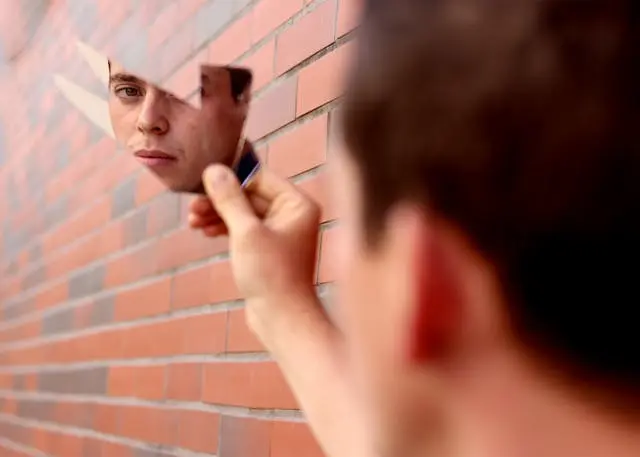
My Teenager Hates How They Look — How to Help Without Making It Worse
She stood in front of the mirror for a long time before school. Not admiringly — this was not vanity. This was something quieter and harder to watch. She pulled at her shirt, looked at her face from one angle and then another, made a small sound of dissatisfaction, and turned away. On the way out the door she said, almost to herself: “I hate the way I look.”
You wanted to say something. Something helpful. Something that would dissolve whatever she was seeing in that mirror. You said she looked beautiful. She did not believe you — you could tell from the way she barely registered it, the way the words slid off her without leaving any impression at all.
If you have witnessed a version of this scene with your teenager, you know the particular helplessness of it. The love you have for them is absolute and the pain they are in is real, and the gap between those two things is enormous. What do you say? What do you do? How do you help someone who cannot seem to receive the reassurance you are offering?
This guide is about understanding what is actually happening when a teenager struggles with body image and self-esteem — because the understanding completely changes the response — and about what the research genuinely shows helps, including some things that are significantly more effective than telling your teenager they look beautiful.
Table of Contents
How Common Is This — And Why Now?
Body image concerns in teenagers are not new. But their scale and intensity in 2026 represent something genuinely different from what previous generations faced — and understanding why matters for understanding how to help.
Studies show that 44% of girls feel unhappy with their body image, with this often driven by social media comparison. And while body image issues have traditionally been discussed primarily in the context of girls, 25% of boys report significant body dissatisfaction — primarily around muscularity, athleticism, and physical size — a proportion that has been rising consistently with social media use.
The specific mechanism that makes body image in 2026 different from what it was a generation ago is exposure. Previous generations compared themselves to magazine images, to film stars, to the handful of peers they encountered in school. Today’s teenagers are exposed — for hours per day — to algorithmically curated images of idealized bodies, filtered and edited to a standard of perfection that does not exist in real life. The comparison is constant, involuntary, and deeply personal in a way that passive media consumption never was.
As we explored in our article on what research says about teenagers and social media, girls often see content promoting impossible beauty standards. The social media environment does not just reflect cultural standards — it amplifies them, personalizes them, and delivers them directly to the most vulnerable developmental moment in a person’s relationship with their body: adolescence.
What Is Actually Happening: The Developmental Reality
Adolescence is, by its nature, a period of intense body awareness. The body is changing rapidly and visibly — in ways the teenager did not choose and cannot control. The social world has suddenly become intensely focused on appearance, status, and peer evaluation. And the brain’s reward and threat-detection systems are both operating at heightened sensitivity, making every social comparison feel more consequential than it would to an adult with a more settled sense of self.
The teenage years are a period where young individuals are expected to develop physically, emotionally, and mentally. Two of the issues that are rarely spoken about in regard to teenagers’ mental health are self-esteem and body image. An unhealthy body image happens when a teen feels stuck in negative thoughts about their appearance — feelings that can become so critical of what they see in the mirror that it undermines their whole sense of self.
What makes this particularly complex is that self-esteem and body image are not the same thing — though they are deeply connected. Self-esteem refers to the value individuals place on themselves — their overall sense of worth and adequacy as a person. Body image refers to their perception of their physical appearance specifically. A teenager with low body satisfaction is not necessarily a teenager with globally low self-esteem — but the two are closely related, and in adolescence, when identity is being actively constructed, a negative body image consistently threatens the broader sense of self-worth in ways it does not in more established adult identities.
The Consequences That Make This Worth Taking Seriously
Body image concerns in teenagers are sometimes treated as a normal, inevitable, and essentially harmless aspect of growing up — something everyone goes through and everyone eventually gets past. The research does not support this relaxed view.
Poor self-esteem and negative body image can lead to depression, anxiety, extreme dieting, social isolation, substance abuse, and poor academic performance. Low self-esteem and poor body confidence can heavily impact a teenager’s life, leading to poor academic performance, social isolation, mental health challenges, and eating disorders.
The eating disorder dimension deserves particular attention. Body dissatisfaction is one of the strongest predictors of eating disorder development — and eating disorders carry the highest mortality rate of any mental health condition. A teenager who regularly expresses extreme dissatisfaction with their body, who has begun restricting eating, over-exercising, or talking about food in ways that feel disordered, needs professional evaluation promptly. This is not territory for watching and waiting.
For most teenagers, body image concerns will not progress to an eating disorder — but they will affect daily life in ways that parents often underestimate. The teenager who avoids the pool because of how they look in a swimsuit is limiting their world. The one who cannot enjoy a meal with friends because they are counting what they eat is not fully present in their own life. The one whose morning routine is dominated by anxious scrutiny of the mirror is starting every day from a place of self-criticism. These are not small costs.
What Does Not Help — and Why
Before we talk about what works, it is worth being honest about what does not — because several of the most instinctive parental responses to a teenager’s body image struggles are either ineffective or actively counterproductive.
Automatic Reassurance About Appearance
The most instinctive response to “I hate the way I look” is “You look beautiful.” This response is loving and entirely natural. It is also, for most teenagers, completely ineffective — and for good reason. The teenager who is struggling with body image is not struggling because they lack information about their appearance. They are struggling because the way they see themselves is filtered through an emotional lens that parental reassurance does not reach. Telling them they look fine or beautiful bounces off that lens without penetrating it.
Even worse, the repeated experience of offering reassurance that does not register can create distance — the teenager stops mentioning how they feel because the conversation always ends the same way, with an adult saying something that does not help and clearly does not understand the depth of what they are experiencing.
Focusing Conversations on Appearance — Even Positively
A parent who frequently compliments their teenager’s appearance — even warmly, even genuinely — is inadvertently reinforcing the message that appearance is an important metric of value. The teenager who is already over-focused on how they look does not need more conversations about how they look. They need conversations that point toward what they are, what they do, and who they are becoming.
Commenting on Anyone’s Body — Including Your Own
This is the intervention that research identifies as most significant and most consistently overlooked: the language parents use about their own body, and about other people’s bodies, in the ordinary flow of daily family life.
Not complaining about how you feel about your own body — even on days when you don’t feel great about it — is one of the most important things a parent can do for a teenager’s body image. A parent who regularly comments negatively on their own body — “I look fat in this,” “I need to lose weight before the summer,” “I hate my arms” — is modeling body criticism as a normal and appropriate response to one’s physical self. A teenager watching this is learning, without any explicit instruction, that bodies are things to be evaluated and found wanting.
The same is true for comments about other people’s bodies — the celebrity whose weight has visibly changed, the neighbor who has “let themselves go,” the relative who “looks great because she’s lost weight.” Every one of these comments, however casual, teaches the teenager listening that bodies are public property to be assessed, and that appearance is a legitimate measure of worth.

Pushing Exercise or Diet as a Response to Body Concerns
A parent who responds to a teenager’s body image concerns with suggestions about diet or exercise is — regardless of intention — confirming that the teenager’s body is indeed something that needs changing. This is not the message that helps. For a teenager who may already be restricting eating or over-exercising as a response to body dissatisfaction, it can be genuinely dangerous.
What Actually Helps: Evidence-Based Strategies
1. Listen Before You Respond — Genuinely and Without Fixing
When your teenager expresses dissatisfaction with their appearance, the most valuable thing you can do first is listen — without immediately offering a counter-narrative, without rushing to reassure, without problem-solving. Instead of saying “you look fine,” try “I hear that you’re feeling uncomfortable, let’s talk about it.”
This shift — from response to reception — communicates something that automatic reassurance does not: that you are genuinely interested in their experience, not just in making the discomfort go away. And for a teenager who has perhaps expected dismissal, the experience of being genuinely heard can itself begin to shift the experience of the conversation.
Ask open questions with genuine curiosity: “What is it about how you look that you find difficult?” “How long have you been feeling this way?” “What do you think started it?” These questions do not validate the negative self-perception — they invite the teenager to articulate and examine it, which is often more useful than any reassurance you could offer.
2. Shift the Focus From Appearance to Function and Character
The most durable protection against negative body image is a sense of self-worth that is not primarily located in appearance. While it’s okay to compliment a child’s outward appearance, it’s crucial for a teenager to hear praise about who they are and know they are celebrated for who they are, not what they look like.
This means deliberately and consistently building a narrative around your teenager that has nothing to do with how they look. Praise specific qualities: their curiosity, their loyalty, their humor, their persistence, their creativity. Celebrate their accomplishments — not just the impressive ones, but the ones that reflect character. Notice the specific, character-revealing things they do in ordinary life. “I noticed how patient you were with your younger sibling today.” “The way you handled that situation with your friend showed real emotional intelligence.”
Build confidence by supporting your child’s passions and interests, and focusing on positive reinforcement rather than criticism. A teenager who has a strong sense of competence — who knows they are genuinely good at something, who has experienced real effort and real mastery — has a source of self-worth that is not dependent on the mirror or on other people’s assessment of their appearance.
3. Help Them Understand What They Are Actually Seeing Online
Media literacy — the ability to critically evaluate what they are consuming — is one of the most practical tools parents can build in a teenager struggling with body image. This does not mean a formal lesson. It means the ongoing, casual, curious conversations about what they are seeing on social media and in popular culture.
Encourage media awareness: help them recognize how filters, editing, and curated content can distort reality. Many teenagers know intellectually that images are filtered and edited — but knowing something intellectually and feeling its emotional impact are different things. Helping a teenager see specific examples of how even professional images are constructed — the lighting, the angles, the editing software, the fact that even the person in the image looks nothing like the image in ordinary lighting — can shift the emotional impact of those images from “this is how people look” to “this is a constructed artifact.”
Have honest conversations about what they are seeing on social media, in popular culture, and in advertising. Not lectures — conversations. “What do you think about the way this app tends to show bodies?” “Have you noticed what kinds of photos get the most likes?” “What do you think about what that sends as a message?” Treating your teenager as a capable critical thinker about media — rather than someone who simply needs to be protected from it — is itself confidence-building.
4. Model the Relationship With Your Body You Want Your Teenager to Have
This is the intervention with the longest reach — and the one that requires the most of the parent. Model healthy behaviors: teenagers notice how adults speak about their own bodies. Show acceptance and kindness toward yourself.
Model self-acceptance, respect for your own body, and the functional rather than appearance-focused view of the body. Your body carries you through the world. It allows you to walk, to hold people you love, to create things, to experience the physical world. These are not consolation prizes for imperfect appearance — they are the actual point of having a body. A parent who talks about their body in these terms, who models gratitude for what their body does rather than criticism of what it looks like, is giving their teenager a framework for their own body that is profoundly protective against appearance-based distress.
And if you are having your own struggles with self-esteem and body image, practice self-compassion visibly. Not performative positivity — genuine, imperfect self-kindness. “I’m feeling a bit self-conscious today, but I’m going to do it anyway.” That modeling of managing body-related discomfort without being derailed by it is exactly what a struggling teenager needs to see.
5. Create the Home as a Body-Safe Space
Make home a place where the teenager feels accepted, supported, and free to express themselves. This means actively removing from the home environment the language, behaviors, and media that feed body criticism.
No diet talk at the table — not about your diet, not about other people’s diets, not about what celebrities or influencers are eating. No body commentary — not about your body, not about other people’s bodies, not about what the teenager is eating or how they look. No weight-focused conversation. These are not small adjustments — for many families, they require deliberate and sustained effort. But the home that is genuinely free of body-critical language is one of the most protective environments available to a teenager whose body image is fragile.
6. Uphold Connection Through This Period
A teenager whose body image is suffering needs — above all else — the experience of being unconditionally valued by the people who know them best. Not valued because of how they look. Not valued because of what they achieve. Simply valued: as a person, as themselves, as your child.
The way you maintain this connection matters. As we have explored in our article on what to do when your teenager stops talking to you, teenagers open up most readily in low-pressure, side-by-side contexts rather than face-to-face conversations that feel like assessments. A walk together. Cooking a meal side by side. Watching something they love. These are the contexts in which the conversations that actually matter — including conversations about body image — are most likely to happen organically. Create those contexts regularly and trust the conversations to find their way in.
7. Pay Attention to What Goes Into the Body — Without Making It About Weight
Physical wellbeing genuinely affects how teenagers feel about themselves — not because of weight, but because of how the body functions. Adequate sleep, regular movement that is enjoyable rather than punitive, and consistent nourishment all directly affect mood, energy, and self-perception. A teenager who is chronically sleep-deprived, sedentary, and under-eating is a teenager whose brain is operating in a state that amplifies negative self-perception.
Support these things — not by making them about appearance, but by connecting them to how the teenager feels and functions. “I notice you seem to feel better on the days you’ve slept well.” “Physical activity that you actually enjoy tends to make the week feel more manageable — what would that look like for you?” This is not diet culture. It is care for the body as the instrument through which the teenager experiences their entire life.
8. Know When to Involve a Professional
Most teenage body image concerns — while genuinely painful — do not require clinical intervention. But there are signs that warrant professional evaluation promptly:
- Significant restriction of food intake, or evidence of purging behaviors
- Compulsive or punitive exercise — exercising through illness or injury, becoming highly distressed when unable to exercise
- Body image concerns that are significantly affecting daily functioning — social withdrawal, inability to attend school or social events
- Expressions of deep shame or hopelessness about appearance that do not lift
- Signs of depression or anxiety that appear connected to body image concerns
- Any concern that the teenager may be developing a clinically significant eating disorder
A therapist who works with adolescents — and who has specific training in body image and eating concerns — can provide support that parental strategies alone cannot offer. Early professional involvement when the warning signs are present is consistently associated with better outcomes than waiting until the problem has become severe.
A Different Kind of Beautiful
I want to close with something that goes beyond strategy — because the most important thing a parent can give a teenager who is struggling with body image is not a technique. It is a reframe.
We live in a culture that has defined beauty very narrowly and very specifically — and then sold that narrow definition back to teenagers through every screen and surface available. The teenager standing in front of the mirror with dissatisfaction is not lacking accurate self-perception. They are accurately perceiving the gap between who they are and who the culture has told them they should be. The problem is not their perception. The problem is the standard.
Your job, as a parent, is not to convince your teenager that they meet the standard. It is to help them question the standard — to see it for what it is, which is an artificial, commercially constructed, algorithmically amplified fiction that has never had anything to do with what actually makes a person worth knowing or worth loving.
That reframe takes time. It is built not in a single conversation but in hundreds of small moments over years — in the language you use about your own body, in the qualities you celebrate in them, in the media you invite critical thinking about, in the way you love them unconditionally and visibly, regardless of what the mirror says on any given morning.
It is not a quick fix. It is the long, patient, consistent work of raising a person who knows — in their bones, not just in their head — that their worth is not housed in their appearance. That is the work. And it is the most important work there is.
Summary: What To Remember
- Body image concerns affect the majority of teenagers — 44% of girls and 25% of boys report significant dissatisfaction. Social media has intensified both the exposure and the impact.
- Poor body image has real consequences: depression, anxiety, social withdrawal, eating disorders, and academic difficulties. It is not something to dismiss as normal teenage behavior.
- Automatic reassurance about appearance does not help — it does not reach the emotional reality of what the teenager is experiencing, and it narrows the conversation.
- Model the body relationship you want your teenager to have — no body criticism of yourself or others, no diet talk, no appearance-focused commentary in the home.
- Shift praise from appearance to character, ability, and effort — build a sense of self-worth that is not located in the mirror.
- Build media literacy — help your teenager critically evaluate what they are seeing online, casually and consistently.
- Listen first, genuinely and without fixing — the experience of being heard is itself therapeutic.
- Create the home as a body-safe space — free of body commentary, diet talk, and appearance-focused evaluation.
- Maintain unconditional connection — a teenager who feels genuinely valued by the people who know them best is significantly more resilient to external appearance pressures.
- Seek professional support promptly if there are signs of eating disorder behavior, significant functional impairment, or deepening depression connected to body image.
Younes Kehal is an educational director, certified school coach, and certified life coach with 20 years of experience working directly with children, adolescents, families, and educational institutions. The guidance published on Parenting Assist is rooted in real field experience and evidence-based developmental science.