
Screen Time and Children’s Health: Eyes, Sleep, Posture, and Activity
We have been having the wrong conversation about screen time. For years, the debate in most households has focused almost entirely on content — what children are watching, what games they are playing, who they are talking to online, whether the videos are educational or just entertainment. And while those conversations matter, they have largely distracted us from a set of quieter but increasingly documented health effects that have nothing to do with what is on the screen and everything to do with the physical reality of how children are using it.
I am talking about what screens are doing to children’s eyes. To their posture. To their sleep. To the development of their brains. And I am talking about effects that are happening right now, in ordinary households, in children who have perfectly safe and well-monitored screen time, because the health costs of screens are not primarily about content — they are about time, posture, light, and proximity.
Screen use is now a routine part of childhood, but a single daily-hour figure does not tell the whole story. This article focuses specifically on eyes, sleep, posture, and physical activity. For the broader evidence on screen time and development, see our guide to what research actually says about screen time. If your family needs a practical reset, use our digital detox guide for kids.
Table of Contents
The Eyes: What Is Actually Happening
Let us start with what is most visible and most immediately concerning to most parents: what screens are doing to children’s eyesight. And the answer — from pediatric optometrists and from a growing body of research — is more specific and more serious than most parents realize.
Digital Eye Strain — Already Affecting Millions of Children
Eye fatigue — called asthenopia by optometrists — is characterized by eye discomfort, dimness of vision, and headache. It is the most common immediate health effect of screen use in children, and it is extraordinarily common. Children spending hours looking at screens are performing continuous, intensive near-focus work — the eye muscles responsible for focusing on close objects are in sustained contraction for hours at a time, without the relaxation that distance viewing provides.
Compounding this is the blinking problem. When people are focused on a screen, their blink rate drops significantly — from the normal 15 to 20 blinks per minute to as few as 5 to 7. Each blink moistens the eye surface and clears debris. Reduced blinking produces dry, irritated, uncomfortable eyes — and children may not be able to articulate this experience clearly, instead presenting with complaints of headache, tired eyes, blurred vision, or an inexplicable reluctance to continue reading or doing homework that the parent interprets as avoidance.
Digital eye strain is temporary and resolves with good habits. But in households where screen use is high and breaks are infrequent, it can become a chronic daily experience that affects concentration, reading comfort, and the child’s overall relationship with visually demanding tasks.
The Myopia Epidemic — and the Screen Connection
This is the finding that has most alarmed pediatric ophthalmologists in recent years: myopia — nearsightedness — is increasing in children at rates that represent one of the most dramatic shifts in childhood eye health ever documented. Rates of myopia in children and young people have roughly doubled in the past generation in many countries, with the steepest increases in urban populations where outdoor time is lowest and screen use is highest.
The mechanism involves two factors working together. First, intensive near work — sustained focus on close objects, including screens — appears to promote elongation of the eyeball during the developmental years when the eye is still growing. An eyeball that grows slightly too long focuses images in front of the retina rather than on it, producing myopia. Second — and this is the part that most parents do not know — outdoor light plays a direct protective role against myopia development. The brightness of outdoor light appears to stimulate the release of dopamine in the retina, which inhibits abnormal eye growth. Children who spend more time outdoors have significantly lower rates of myopia, independent of how much near work they do.
The practical implication of this research is striking: the most effective intervention for reducing myopia risk in children is not limiting near work — it is increasing outdoor time. More outdoor time is consistently associated with lower myopia risk, but major pediatric guidance does not set one universal daily target for every child. As we explored in our article on why outdoor play matters for child development, the developmental benefits of outdoor time are multiple and significant — the eye health benefit is one of the most medically concrete, and one of the most powerful arguments for prioritizing outdoor time in a child’s daily schedule.
Myopia is not merely an inconvenience requiring glasses. High myopia — which develops when the condition is severe and progressive — significantly increases the risk of retinal detachment, glaucoma, and other serious eye conditions later in life. Getting this right in childhood has genuine long-term health significance.
The Body: Posture, Pain, and Physical Development
The posture in which children use screens is one of the most consistently neglected aspects of this conversation — and the physical consequences are already showing up in clinical settings in children who would previously have been far too young to present with musculoskeletal complaints.
Text Neck and Forward Head Posture
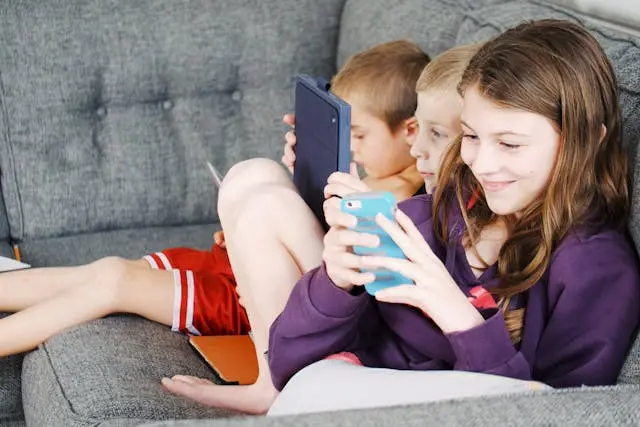
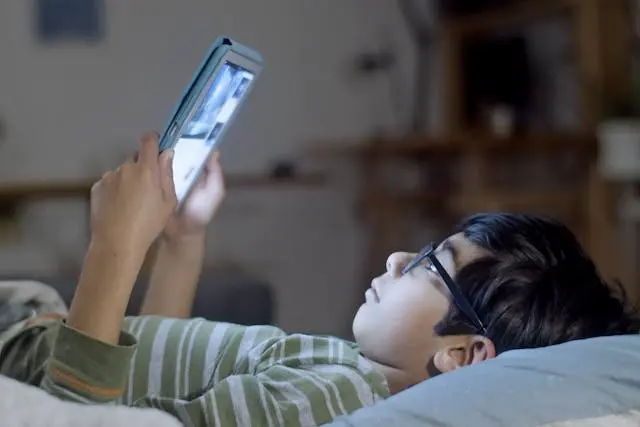
Children slouched over phones or hunched at laptops are placing strain on young spines and shoulders. This poor posture can cause muscle stiffness, pain, and long-term alignment problems that may persist into adulthood.
The physics of this problem are straightforward. The head of an average child weighs approximately 4 to 5 kilograms in neutral posture. For every degree that the head tilts forward — toward a screen in the lap or a phone held below eye level — the effective weight on the cervical spine increases substantially. At a 60-degree forward tilt — which is a typical phone-use posture — the effective load on the neck is equivalent to carrying a weight that would not be appropriate for a child that age. This sustained loading, for hours per day during the years of skeletal development, produces real changes in cervical alignment that are visible on clinical examination in children as young as seven or eight.
A scoping review examining the effects of prolonged screen time on postural health in children found that reported consequences included musculoskeletal pain, especially in the cervical and lumbar regions, and that these effects were becoming more prevalent in younger populations. Children who were previously too young to present with neck and back complaints are increasingly presenting with exactly these symptoms — directly correlated with their device use patterns.
Reduced Physical Activity and Its Consequences
Screen time and physical activity are, in most children’s daily schedules, in direct competition. Time spent on screens is time not spent moving. Research conducted during COVID lockdowns found that children aged 6 to 10 years increased their leisure screen time more than any other age group — and that this increase had measurable impacts on diet, physical activity, weight, and musculoskeletal health. The study found significant associations between increased screen time and intensified sleep disorders, weight gain, and unhealthy eating patterns.
Physical inactivity in childhood is not simply a fitness concern. Movement is essential for bone development, cardiovascular health, coordination development, and the regulation of mood and sleep. A child who is sedentary for five hours of daily screen time and sleeping for ten is spending the majority of their waking life without meaningful movement — with health consequences that are not theoretical but documented and measurable.
Sleep: The Most Documented and Most Damaging Effect
Of all the physical health effects of screen time on children, the impact on sleep is the most extensively researched, the most consistently documented, and arguably the most consequential — because the downstream effects of disrupted sleep touch every aspect of a child’s health, development, and daily functioning.
There are two distinct mechanisms through which screens disrupt sleep in children, and understanding both helps parents design more effective limits.
Blue Light and the Melatonin Suppression Effect
Research from Children’s Hospital of Philadelphia confirms what has been replicated across multiple studies: when computers and similar devices are used in the evening, the blue light they emit alters the brain’s sleep rhythms. The brain reads the screen light as “daytime” and shifts the body’s circadian rhythm.
Melatonin — the hormone that signals to the body that it is time to sleep — is suppressed by blue light exposure. A child who has been using a screen for an hour before bedtime is not simply stimulated and alert — their melatonin secretion has been measurably delayed, meaning their body has been neurologically told that it is daytime. The resulting difficulty falling asleep, and the poor sleep quality when sleep eventually comes, has cumulative effects on mood, cognition, physical health, and immune function.
As we explored in detail in our article on why children won’t sleep and what actually helps, the device-free period of at least one hour before bed is not a suggestion — it is a physiological requirement for the melatonin system to prepare the body for sleep. No other single screen habit change produces more measurable improvement in children’s sleep than this one.
The Stimulation Effect
Beyond the blue light mechanism, the content and engagement patterns of screen use before bed produce neurological arousal that independently delays sleep. A child who has been playing an engaging video game, watching fast-paced content, or interacting on social media in the hour before bed has a brain that is activated rather than calmed — regardless of the lighting effects. The cognitive engagement, the emotional activation, the anticipation of notifications and responses — all of these maintain the arousal state that sleep requires the nervous system to exit.
The combination of blue light melatonin suppression and content-induced arousal makes the hour before bed the highest-impact period for screen-related sleep disruption — and the most important period for families to protect.
Brain Development: The Findings That Should Concern Every Parent
The research on screens and brain development is the area where the science is most recent and where the findings are most sobering — because they point toward effects that are not immediately visible but that may have the longest reach.
One study suggests that kids who use screens for seven or more hours a day show thinning in the brain’s cortex — the part responsible for thinking, reasoning, and memory. While more data is needed, early findings raise valid concerns about how this could impact cognitive function later in life. A comprehensive review in NCBI examining the impact of screen time on pediatric health found associations between excessive screen use and metabolic disorders, sleep disturbances, dietary changes, and ophthalmological problems — and identified need for further research into the neurodevelopmental consequences that are harder to measure but increasingly documented.
What the research most consistently identifies is the opportunity cost of screen time: the developmental experiences that do not happen because the child is on a screen. Language development that happens through conversation rather than through passive viewing. Motor development that happens through physical play rather than sedentary device use. Social skill development that happens through face-to-face interaction rather than through digital communication. The brain development that happens through outdoor exploration, through boredom-driven creativity, through the physical and sensory engagement with the world that screens simply cannot replicate.
The concern is not primarily that screens produce direct neurological damage — the research on direct effects is still emerging. The concern is that the hours consumed by screen use are hours that are not available for the kinds of experience that build the brain most effectively in the developmental years.
The Guidelines — and What They Actually Mean
The World Health Organization has made specific recommendations on screen time for children, and the American Academy of Pediatrics has done the same. Here is what they actually say — and what the research behind them means practically.
| Age | Recommended Limits | The Research Behind It |
|---|---|---|
| Under 18 months | Avoid screen use except for video calls | Language development requires responsive human interaction; passive screen viewing displaces it |
| 18–24 months | Limited high-quality content, always with parental co-viewing and discussion | Toddlers learn from screens only when an adult mediates and discusses the content |
| 2–5 years | Maximum 1 hour per day of high-quality programming | Physical play, outdoor time, and face-to-face interaction are critical developmental priorities at this stage |
| 6–12 years | Consistent limits ensuring adequate sleep, physical activity, and face-to-face interaction | Total screen time is less important than what it displaces — sleep, activity, outdoor time, and human connection |
| 13+ | No phones in bedrooms at night; device-free meals and homework time; modeling by parents | Sleep disruption, attention impairment, and social media’s mental health effects are most documented in this age group |
The most important thing to understand about these guidelines is that the number of hours is less important than the context of use. Passive consumption of fast-paced content for an hour before bed is more harmful than two hours of interactive creative use earlier in the day. The key questions are not simply “how much?” but “when?”, “what kind?”, and “what does it displace?”
What You Can Do: Practical Strategies That Work
The 20-20-20 Rule for Eye Health
Apply the 20-20-20 rule: after every 20 minutes of screen time, take a break for 20 seconds and focus on an object at least 20 feet away. This exercises the muscles responsible for focusing at distance and allows the near-focus muscles to relax. Set timers or use apps to remind your child to take these important breaks — eventually children often naturally adopt this practice and begin to notice the eye fatigue themselves, which is itself a valuable piece of body awareness.
Blinking consciously during screen breaks also helps — “blink normally” sounds obvious but children absorbed in screens forget to do it, and a deliberate reminder during breaks helps restore the tear film and reduce dryness.
Screen Position and Posture
The single most effective postural intervention is ensuring that screens are positioned at the correct height and distance — at arm’s length and with the top of the screen at or just below eye level, not in the lap and not held below chin height. This eliminates the forward head tilt that causes cervical strain.
Encourage your child to sit upright with feet flat on the floor and back supported during screen use. For young children using tablets, a stand or prop that holds the device at the correct height rather than flat on a table makes an enormous practical difference. These are not elaborate interventions — they are basic ergonomics that require one setup change and the habit of reminding until it becomes automatic.
Prioritize Regular Outdoor Time
Research consistently links more time outdoors with a lower risk of childhood myopia. Outdoor light appears to be protective, so building regular outdoor time into daily life is a useful eye-health habit alongside taking breaks from prolonged near work and screens.
This recommendation interacts directly with screen time: a child who has two hours of outdoor time and three hours of screen time is in a significantly different health position from one who has no outdoor time and five hours of screen time. Protecting outdoor time is not simply an alternative to limiting screen time — it is a complementary and in some respects more evidence-based intervention.
The Non-Negotiable Device-Free Bedroom at Night
Of all screen time interventions, removing devices from the bedroom at night produces the most consistent and most significant improvement in sleep quality — and sleep quality affects every other aspect of a child’s health. As we discussed in our article on why children won’t sleep, a family charging station outside the bedroom — where all devices, including parents’ phones, charge overnight — is the single most impactful structural change most families can make for children’s sleep.
This needs to be a family norm, not a child-specific rule. A parent who checks their phone in bed while insisting their child charges theirs in the hallway is modeling exactly the behavior they are trying to prevent. The family charging station outside the bedroom works partly because it applies to everyone.
Reduce Evening Screen Use Systematically
The hour before bed is the most impactful period for screen-related health effects — blue light melatonin suppression, neurological arousal, sleep onset delay. Protecting this period from screen use is the most important time-specific intervention available.
Build into the family routine a consistent device-free wind-down period of at least one hour before bed — for children and, ideally, for adults. Use this time for the activities that serve sleep: reading, calm conversation, a bath, quiet play. The alternative activities in this hour matter — they need to be genuinely calming rather than simply screen-free but otherwise stimulating.
Create Screen-Free Anchors in the Day
Beyond the bedtime limit, establishing consistent screen-free periods at other points in the day reduces total exposure and protects the activities — physical play, face-to-face interaction, creative play — that screens most commonly displace. Mealtimes, the first hour after school, and morning time before school are natural candidates for screen-free protection.
Family meals in particular — as we explored in our article on raising children who love real food — are one of the most valuable developmental and nutritional anchors in a family’s day. Making them consistently screen-free protects both the nutritional and relational dimensions that screens erode.
Talking to Your Child About Screen Health — Without Making It a Battle
The most effective conversations about screen health with children of any age are those that treat the child as a partner in their own wellbeing rather than a subject of restriction. A child who understands why the 20-20-20 rule helps their eyes is more likely to adopt it than one who is simply told to do it. A teenager who understands the mechanism of blue light and melatonin is more motivated to put their phone down before bed than one who has just been told that it is the rule.
This is not a reason to wait until children are old enough to understand the neuroscience — it is a reason to frame the conversation in age-appropriate terms that make the reason clear from the beginning. “We take breaks from screens to rest our eyes — the same way we rest our legs after running.” “We charge our phones outside the bedroom because screens trick our brain into thinking it is still daytime, and then it’s harder to sleep.” These explanations are accurate, accessible, and invite the child into understanding rather than compliance.
For older children and teenagers — as we explored in our article on helping teenagers manage their phone use — the conversation about screen health is most effective when it starts from their own experiences: “Have you noticed that you sleep worse after a lot of screen time at night?” “Have you ever had headaches after a long gaming session?” Making the connection between their own experience and the underlying physiology builds the intrinsic motivation to change that external rules alone rarely produce.
A Balanced Perspective: Screens Are Not the Enemy
I want to be clear about something before we close. This article has focused on the health effects of excessive and poorly managed screen use — because those are the effects that families most need to understand and most consistently underestimate. It is not an argument that screens are inherently harmful or that children should not use them.
Research shows that screen time can be beneficial to kids when balanced with other activities away from the screens. Educational content, creative tools, video calls with distant family, coding, music creation, age-appropriate social connection — these are genuine benefits that technology makes available, and they deserve acknowledgment.
The goal is not zero screens. It is managed screens: used at the right times of day, in the right posture, with the right breaks, not displacing the outdoor time and physical activity and sleep that children’s bodies genuinely need. That balance — screens in service of a full and active life rather than a replacement for one — is what the research supports, and what this guide is trying to help families build.
Summary: What To Remember
- Children aged 8 to 12 now spend an average of 5.5 hours daily on screens — with documented physical health consequences that go beyond behavioral concerns.
- Digital eye strain is extremely common — reduced blinking, sustained near focus, and lack of breaks produce dry, fatigued, uncomfortable eyes in millions of children.
- Myopia is becoming more common — genetics and environmental factors both matter. Regular outdoor time is associated with lower myopia risk, while prolonged close-up work can contribute to eye strain.
- Screen posture causes real physical damage — forward head tilt during device use places extraordinary load on the developing cervical spine, producing neck and back complaints in increasingly young children.
- Sleep disruption is the most documented effect — blue light melatonin suppression and content-induced arousal both delay sleep onset and reduce sleep quality. Device-free bedrooms at night is the highest-impact single change.
- The 20-20-20 rule reduces eye strain — every 20 minutes, 20 seconds focused on something 20 feet away. Build it into the routine.
- Screen position matters enormously — at arm’s length, top of screen at eye level, not in the lap.
- The device-free hour before bed is the most important time-specific intervention for sleep health.
- Outdoor time is both a general developmental priority and a specific eye health intervention — protect it as seriously as you protect sleep.
- The goal is managed screens, not screen elimination — in service of a full, active, physically healthy childhood.
Younes Kehal is an educational director, certified school coach, and certified life coach with 20 years of experience working with children, families, teachers, and schools. His guidance combines practical educational experience with carefully reviewed research.