

The Most Powerful Thing You Can Do for Your Child’s Mental Health Costs Nothing — It’s Called Nature
Somewhere between the supplements, the therapy apps, the mindfulness exercises, and the carefully curated extracurricular schedule, a remarkably simple and ancient intervention keeps showing up in the research — quietly, consistently, across dozens of studies and thousands of children — producing outcomes that rival and often surpass far more expensive and complicated approaches.
It is a patch of grass. A walk among trees. Dirt under fingernails. Thirty minutes in a garden. The sound of wind, and the complete absence of notification sounds.
Nature.
In over twenty years of working in educational settings, I have watched the mental health landscape for children shift in ways that are genuinely alarming. Anxiety, depression, attention difficulties, and emotional dysregulation are more common in the children I encounter than they were when I began my career. The causes are multiple and complex. But one of the clearest and most consistent threads in the research is also one of the simplest: children are spending dramatically less time outdoors than any previous generation in recorded history — and it is costing them.
This article is about what the evidence actually shows when it comes to nature and children’s mental health, why it works, and — most practically — what you can do about it in your specific family’s life, starting this week.
Table of Contents
The Research Is Clearer Than Most Parents Realize
The evidence connecting children’s time in nature to their mental and psychological wellbeing has grown substantially in recent years — to the point where it can no longer reasonably be characterized as a lifestyle preference or an ideological position. It is, increasingly, a public health finding.
A review published in the Journal of Pediatric Nursing concluded that access to green space was associated with improved mental well-being and overall health. Additionally, the study found that access to green space promotes memory, supportive social groups, and self-discipline, moderates stress, and improves behaviours and symptoms of ADHD.
A meta-review published in PMC examining nature’s effect on children and adolescents found that current research suggests nature may be beneficial for children’s brain and cognitive development, with specific improvements in working memory and attention, as well as beneficial effects on mental health and well-being, including reducing stress, improving ADHD symptoms, reducing depressive symptoms and psychological distress, and fostering emotional well-being.
And a 2026 scoping review from the University of Illinois Urbana-Champaign, examining nature exposure as an intervention specifically for children living with disadvantage, found consistent evidence of nature’s protective effects on psychological health — suggesting that access to natural environments may actually help reduce mental health disparities between children from different socioeconomic backgrounds.
Perhaps most striking of all is this finding from the National Wildlife Federation: the most direct route to caring for the environment as an adult is participating in “wild nature activities” before the age of 11. The child who develops a genuine connection with the natural world in their early years is not just mentally healthier. They are more likely to grow into an adult who cares about and actively protects the natural world — which makes nature connection simultaneously a mental health intervention and an environmental one.
Why It Is Happening Less — and Why the Timing Matters
Children are spending half as much time outdoors as they did twenty years ago. The negative impact of decreased time outdoors includes not only physical health consequences but also declining creativity, concentration, and social skills.
The causes of this shift are not mysterious: urbanization, traffic, safety concerns, the pull of screens, increasingly academic early childhood programs that leave less room for outdoor play, and a general cultural drift toward scheduled, supervised, indoor activities. None of these factors is simple to reverse, and some of them reflect genuine constraints that families cannot simply wish away.
But the timing of the shift matters enormously. The years between birth and adolescence — particularly the window before age 11 — are when the brain is most plastic, most responsive to environmental input, and most profoundly shaped by experience. A child who grows up with regular, meaningful contact with the natural world during this window develops a neural and psychological relationship with nature that persists into adulthood. A child who does not may never fully develop that relationship — because the developmental window for it has partly closed.
This is not a counsel of despair. It is a counsel of urgency. The time to act is now, with the children who are in your care today.
What Exactly Does Nature Do to the Child’s Brain and Body?
The research offers increasingly specific answers to this question — moving beyond “nature is good for children” to explaining the neurological and physiological mechanisms through which it produces its effects.
It Restores Depleted Attention
We touched on Attention Restoration Theory in our article on why outdoor play matters — the finding that directed attention, the kind required for schoolwork and focused tasks, is a finite resource that depletes with use, and that natural environments restore it in ways that indoor environments cannot. Even short, consistent doses of outdoor time — as little as 15 minutes in nature — are enough to support cognitive reset and stress reduction.
For children who struggle with attention — including those with ADHD — the research is particularly compelling. Access to green spaces moderates stress and improves behaviours and symptoms of ADHD. Nature does not replace clinical support for attention difficulties, but it provides a consistent, accessible, cost-free complement to whatever other support is in place. As we noted in our article on parenting a child with ADHD, physical activity and outdoor time are among the most evidence-based non-medication supports available.
It Reduces the Physiological Stress Response
Studies have shown that simply having contact with dirt — whether through gardening, digging holes, or making mud pies — can significantly improve a child’s mood and reduce anxiety and stress. The mechanism here involves more than psychology. Contact with soil bacteria has been shown in research to stimulate serotonin production. Natural environments reduce cortisol levels measurably. The sound of wind and water and birdsong activates the parasympathetic nervous system — the body’s rest-and-digest mode — in ways that reduce the chronic low-grade arousal that anxiety produces.
A child who spends time outdoors is not just in a nicer environment. They are in an environment that is actively regulating their nervous system at a biological level.
It Builds the Emotional Regulation That Academic Environments Cannot
Unstructured outdoor play — where children set their own goals, navigate their own challenges, and experience genuine risk and genuine success — builds the emotional regulation skills that no classroom lesson can replicate. Encouraging kids to play outdoors fosters creativity and boredom-driven curiosity, which are essential for development.
A child who is bored in a natural environment and finds something to do — who transforms a stick and a puddle into an afternoon’s project, who builds something, discovers something, navigates something — is exercising the precise cognitive and emotional muscles that formal education most struggles to develop: intrinsic motivation, self-direction, creative problem-solving, and the tolerance for open-ended uncertainty that is the foundation of genuine intellectual life.
It Provides What Screens Fundamentally Cannot
This is worth stating explicitly, because the comparison is often made implicitly: nature and screens are not simply different environments that produce different experiences. They are, in developmental terms, near-opposites.
Screens provide high-stimulation, high-reward, fast-paced experiences that deplete rather than restore the nervous system. They are designed to maximize engagement, which means they maximize the demand on directed attention rather than allowing it to rest. They provide passive stimulation rather than active agency. They involve no physical movement, no sensory contact with the material world, no genuine risk, and no experience of competence in the physical environment.
Nature provides almost the exact opposite of all of these things. Technology can be a wonderful tool for learning and playing, but kids require a balance of screen and green experiences to grow up happy and healthy. The screen time conversation is not fundamentally about screens being bad — it is about the balance having shifted so dramatically toward screens and away from nature that the developmental consequences are becoming visible.
What “Connecting With Nature” Actually Looks Like for Modern Families
One of the barriers to taking nature connection seriously as a family practice is a romanticized image of what it requires: wilderness camping, hiking trails, rural landscapes. The reality is far more accessible — and the research supports the more accessible version just as strongly.
Even short, consistent exposure is enough to support cognitive reset and stress reduction. A garden, a park, a tree-lined street. Soil and wind and the weight of the rain. A child does not need wilderness to benefit from nature. They need regular, genuine contact with something alive and non-digital.
What Counts as “Nature Contact” in Urban Environments
- A visit to any park — even a small urban park with a few trees and grass — counts.
- A garden, a balcony with plants, or a community growing space counts.
- A walk that includes attention to weather, sky, birds, plants, and the physical world rather than screens counts.
- A puddle. A patch of mud. A stick. These count.
- A school garden, a nature table inside the home, a window with a bird feeder counts.
The research does not require manicured wilderness. It requires genuine sensory engagement with the living world — consistent, regular, and increasingly child-directed rather than adult-organized.
Building Nature Into Your Family’s Life: Practical Strategies That Work
1. Make Outdoor Time a Daily Non-Negotiable — Whatever the Weather
The families whose children develop genuine, lasting connections with nature are not the ones who go to the woods on special occasions. They are the ones who go outside every day — in the rain, in the cold, in the unremarkable grey Wednesday afternoon that offers no obvious incentive to leave the house.
Children who grow up going outside every day regardless of weather develop a relationship with the natural world that is not dependent on ideal conditions. They are not fair-weather nature users — they are people for whom being outdoors is simply normal. As we noted in our article on the developmental benefits of outdoor play, Scandinavian countries have a saying: there is no bad weather, only bad clothing. Invest in waterproof gear and lower the bar for what constitutes good enough conditions to go out.
2. Grow Something Together
Gardening is one of the most reliably effective nature connection activities available to families at any income level. A single pot of herbs on a windowsill. A tray of seeds on a kitchen counter. A small raised bed in a community garden. As we explored in our article on raising children who love real food, children who grow food develop a relationship with the natural world that is direct, embodied, and lasting — they understand, viscerally, that they are dependent on soil and water and sunlight for what sustains them.
Beyond the food connection, gardening provides the regular contact with soil, insects, weather, and living systems that the research identifies as particularly beneficial for mood and stress reduction. Studies have shown that contact with dirt can significantly improve a child’s mood and reduce anxiety and stress. This is not metaphorical. It is physiological.
3. Create Regular “Wild” Time — Unstructured and Unsupervised (Age-Appropriately)
Sixty minutes of daily unstructured free play is essential to children’s physical and mental health. The research on nature connection specifically emphasizes the value of what researchers call “wild nature activities” — time in natural environments where children are not being directed, supervised, or organized by adults.
For young children, this means regular time in outdoor spaces where they can explore, dig, collect, and experiment without adult agenda. For older children and teenagers, it means increasing amounts of unsupervised outdoor time in natural environments — a park, a garden, a green space near home — where they can simply be, without structure, without screens, and without adults managing the experience.
This is one of the harder asks in contemporary parenting, where safety concerns and cultural norms around supervision have made independent outdoor time feel risky. But the developmental evidence for its value is robust — and the alternative, which is structured, supervised, indoor activity for the entirety of childhood, carries its own well-documented developmental costs.
4. Participate Yourself — With Genuine Presence
Parents should participate too, whether it is exploring local parks, tide pools, or taking a walk together after dinner. As with every other value we hope to transmit to our children, the most powerful mechanism is our own visible engagement with it.
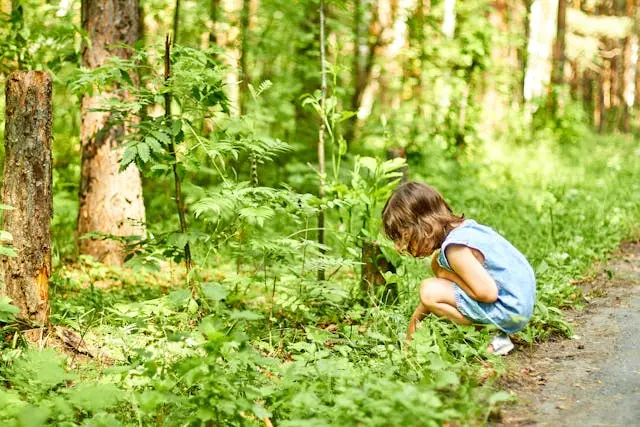
A parent who puts down their phone and sits in the garden, who crouches to look at an insect alongside their child, who expresses genuine curiosity about a cloud formation or a bird’s call — that parent is modeling a relationship with the natural world that their child will absorb and carry forward. Not as a lesson. As a lived experience of what paying attention to the world looks like.
The parent’s presence also transforms the quality of the nature experience for young children. A child alone in a garden has one kind of experience. A child in a garden with a genuinely present adult who shares their curiosity has another — richer, more language-saturated, more emotionally connected, and more likely to build the durable nature connection that research identifies as protective throughout life.
5. Use Natural Environments for Difficult Conversations
Parents of teenagers — and anyone who has read our article on what to do when your teenager stops talking to you — will recognize the principle of side-by-side conversation: teenagers often open up more easily during a shared physical activity than in a face-to-face, sit-down conversation. Walking in a natural environment takes this further. The rhythm of walking, the absence of direct eye contact, the sensory richness of the outdoor environment — all of these reduce the social pressure that face-to-face conversation places on a teenager whose defenses are up.
Some of the most important conversations I have witnessed between parents and teenagers have happened on walks. Not because the walk was planned as a conversation-starter, but because the environment itself creates conditions in which conversation becomes easier. Keep this in mind when connection with your teenager feels difficult. Suggest a walk. Have no agenda other than the walk itself. Let the conversation find its own way in.
6. Connect Nature to What Your Child Already Cares About
A child who is passionate about animals is drawn into nature through wildlife. A child who loves art is drawn in through nature journaling, leaf printing, or photography. A child who is interested in science is drawn in through observation, collection, and the genuine complexity of natural systems. A child who loves stories is drawn in through the narratives of migration, seasons, and the drama of the living world.
Nature is not a single thing. It is the context within which every human interest can find a natural expression. Finding the door that is already open for your specific child — and walking through it together — is far more effective than attempting to instill a generic love of the outdoors through obligation or prescription.
The Overlap Between Nature Connection and Environmental Responsibility
There is a profound and well-documented connection between childhood nature experience and adult environmental stewardship. The most direct route to caring for the environment as an adult is participating in wild nature activities before age 11. Children who develop genuine emotional connections to the living world grow into adults who feel motivated to protect it — not from guilt or obligation, but from love.
This is the deepest argument for nature connection as an eco-parenting strategy. Not teaching children that the environment needs protecting — but ensuring that they experience the environment as something worth protecting. Something beautiful. Something interesting. Something alive and responsive and connected to their own flourishing.
As we explored in our article on talking to children about climate change without scaring them, love must come before fear. The child who loves the natural world will grow into the adult who protects it. The child who has only been told that the natural world is in danger — without having first developed the emotional connection that makes that danger feel personal and real — will find it much harder to sustain the motivation that environmental action requires over a lifetime.
Give your child the natural world as a lived experience before you give it to them as a problem to solve. That is the gift that will last.
A Simple Weekly Nature Practice: A Starting Point for Any Family
| Frequency | What It Looks Like | What It Builds |
|---|---|---|
| Daily | 15–30 minutes outside — garden, walk, park, or simply being outdoors without screens | Attention restoration, stress reduction, mood regulation |
| Weekly | A longer outing to a park, nature reserve, or green space — ideally with something to observe or explore | Nature connection, family bonding, curiosity and awe |
| Monthly | A nature-based activity with more depth — gardening, a local wildlife area, a community clean-up, a nature journal | Environmental stewardship, sustained engagement, identity as someone who cares for the natural world |
| Seasonally | A meaningful outdoor experience that marks the season — a camping trip, a wildlife encounter, a visit to a new natural environment | Lasting memory, deep nature connection, shared family experience |
A Final Word: What You Are Actually Giving Your Child
In a world that offers children an extraordinary abundance of stimulation, activity, and organized experience — and increasingly little of what the human nervous system actually evolved to need — taking your child outside regularly is an act of genuine care.
Not because it is virtuous. Not because it will make them better at school, though the research suggests it will. Not because it will make them more environmentally conscious, though the evidence strongly supports that too.
But because a child who has felt rain on their face, who has crouched to watch an insect, who has had their attention arrested by a bird call and followed it with genuine curiosity — that child has had an experience of being alive in the world that no screen, no classroom, and no curated extracurricular activity can replicate. An experience of being small, and alive, and part of something much larger than themselves.
That experience, repeated across thousands of ordinary days, builds something that the research struggles to fully capture in measurable outcomes. It builds a person who is at home in the world. Who finds it interesting. Who feels, somewhere below the level of conscious thought, that the world is worth paying attention to — and worth protecting.
That is not a small gift. It is, in fact, one of the greatest gifts a parent can give.
Put down the phone. Open the door. Go outside together.
Summary: What To Remember
- Nature contact is one of the most evidence-based mental health interventions available for children — linked to reduced anxiety, depression, and stress, and improved attention, emotional regulation, and social skills.
- Children are spending half as much time outdoors as they did twenty years ago — and the developmental consequences are measurable and serious.
- Even 15 minutes of daily outdoor time produces cognitive reset and stress reduction — you do not need wilderness, just regularity.
- The most direct route to adult environmental stewardship is wild nature activities before age 11 — nature connection is simultaneously a mental health and an environmental intervention.
- Make outdoor time a daily non-negotiable regardless of weather — the families whose children develop lasting nature connections are the ones who go outside every day.
- Grow something — contact with soil and living systems is physically regulating and emotionally grounding.
- Create unstructured outdoor time — the most developmental benefits come from child-directed nature exploration, not adult-organized activities.
- Participate yourself with genuine presence — your relationship with the natural world shapes your child’s more than any instruction.
- Love before fear — build the emotional connection first, before introducing environmental concerns. A child who loves the world will protect it.
Younes Kehal is an educational director, certified school coach, and certified life coach with 20 years of experience working with children, families, teachers, and schools. His guidance combines practical educational experience with carefully reviewed research.