Why Your Child Needs to Play Outside Every Day — And What Happens When They Don’t
There is a generation of children growing up indoors. Not because their parents are neglectful — quite the opposite. Their parents are engaged, caring, and genuinely trying to give them the best possible start. They have filled the home with educational toys, enrolled them in structured activities, and ensured they have access to screens that are supposedly enriching. What they have given them less of — often without realizing it — is something far older, far simpler, and far more essential: unstructured time outside.
In over twenty years of working in educational settings, I have watched this shift happen gradually and then all at once. The playgrounds that used to be full after school are quieter than they were. The streets where children used to roam until dinner are largely empty. And in the classrooms, the effects are visible — in children’s attention, their emotional regulation, their social skills, and their capacity to handle the ordinary frustrations of daily life.
The research on outdoor play is among the most consistent in all of developmental science. It is not a nice-to-have. It is not a reward for finishing homework. It is a fundamental biological need — one that, when unmet, has consequences that extend far beyond physical fitness into every domain of child development.
This article is about what those consequences actually are, why they happen, and what you can practically do about it — starting today.
Table of Contents
The Numbers Behind the Shift
The decline in children’s outdoor time is not an impression — it is a measurable, documented trend across multiple countries and decades.
Children today often spend less time in unstructured outdoor play than previous generations, while screens and tightly scheduled indoor activities compete for more of their free time. Multiple studies and pediatric reviews describe a long-term decline in children’s opportunities for free play and outdoor activity. The exact amount of outdoor time varies widely by family, age, neighborhood, and season, so broad comparisons are less useful than the practical question: does your child have regular opportunities to move, explore, and play outside?
At the same time, rates of childhood anxiety, depression, attention difficulties, and obesity have risen significantly over the same period. Researchers are careful not to attribute all of this to reduced outdoor play — the causes are complex and multiple. But the correlation is consistent enough, and the research on outdoor play’s protective effects robust enough, that the connection deserves serious attention.
What Outdoor Play Actually Does to the Developing Brain and Body
To understand why outdoor play matters so much, you need to understand what it actually does — not in vague terms, but specifically, neurologically, developmentally.
1. It Restores Attention and the Capacity to Focus
One of the most counterintuitive findings in developmental research is that unstructured time outside — doing nothing in particular, exploring without direction — actually increases a child’s ability to concentrate when they return to focused tasks.
Researchers call this the Attention Restoration Theory. The idea is that directed attention — the kind required for schoolwork, for following instructions, for sitting still and concentrating — is a finite cognitive resource that depletes with use. Nature, with its gentle, non-demanding stimulation, allows this system to rest and restore. A child who has spent time outside in unstructured play returns to focused tasks with measurably better concentration than one who has spent the same time on a screen or in a structured indoor activity.
This is particularly significant for children who struggle with attention. Our article on parenting a child with ADHD notes that physical activity and time outdoors are among the most evidence-based non-medication supports for attention difficulties — and the research on this is consistent across multiple studies.
2. It Builds Physical Competence and Coordination
Running, climbing, jumping, balancing, throwing, catching — these are not just enjoyable activities. They are the experiences through which a child’s brain builds the neural maps for physical competence and spatial awareness. Every time a child navigates uneven ground, climbs a structure, or catches a ball, they are building proprioceptive awareness — the brain’s sense of the body in space — that underpins coordination, balance, and physical confidence for the rest of their life.
Research highlights that 40% of children feel more confident after using outdoor play equipment regularly. This confidence is not abstract — it is rooted in the physical experience of finding out what their body can do.
Children who spend most of their time in sedentary indoor environments miss much of this critical developmental experience. The result is not just lower fitness — it is less developed physical confidence, less refined coordination, and a body that is less practiced at the fundamental movement patterns that underpin everything from sport to the simple physical demands of daily life.
3. It Produces Vitamin D — Which Does More Than You Think
Vitamin D, produced by the skin in response to sunlight exposure, plays a role that extends well beyond bone health. Its potential benefits include boosted immune function, increased ability to prevent disease, improved mood, and reduced risk of childhood obesity.
Vitamin D deficiency in children is significantly more common than most parents realize — particularly in regions with limited sunlight, in children who spend most of their time indoors, and in children with darker skin tones who require more sun exposure to produce equivalent amounts. The consequences of deficiency are not immediately visible, which is precisely why they are so often missed. Our article on why children get sick so frequently addresses the immune system’s development in detail — and adequate Vitamin D is one of the most accessible and frequently overlooked supports for childhood immunity.
4. It Supports Mental Health in Ways That Are Increasingly Well-Documented
Research increasingly suggests that the amount of time a child spends in nature can significantly impact their psychological health throughout their life. One study found that increased childhood exposure to fresh air and greenery is associated with better mental health later in life — kids who grew up in areas with more green space had a lower risk of developing psychiatric disorders than their peers who did not.
This is not a small or marginal finding. The mental health implications of nature exposure in childhood appear to be significant and lasting. At a time when childhood anxiety and depression are at historically high levels, this research deserves to be taken seriously by every parent and educator.
5. It Develops Social Skills That Structured Activities Cannot
Unstructured outdoor play is one of the primary contexts in which children learn to negotiate, cooperate, manage conflict, create rules, and navigate the complex social dynamics of peer relationships — without an adult managing every interaction.
When children play freely outside, they encounter situations that require them to solve social problems independently: who goes first, what the rules of the game are, what happens when someone breaks a rule, how to include a new child, how to handle disagreement. These are not trivial challenges. They are the social curriculum of childhood — and they can only be learned through experience, not instruction.
Research shows that unstructured play that takes place outdoors is vital to children’s social, emotional, cognitive and physical development. Some research suggests that this reduction in opportunities for unstructured outdoor play may already be responsible for declines in creative thinking, reduced ability to get along with others, and increased mental disorders.
6. It Builds Resilience Through Manageable Risk
This is the benefit that parents most often resist — and the one that the research most consistently supports.
A comprehensive scoping review published in 2025, examining 40 empirical studies on outdoor and nature-based play, found that all 40 studies reported positive associations across multiple developmental domains, with key benefits including enhanced mental health, social competence, and anxiety prevention. One of the most significant mechanisms identified was what the researchers called “authentic child agency” — the experience of making real choices, taking real risks, and discovering real competence.
A child who climbs a tree and discovers they can reach the third branch is learning something about themselves that no adult can teach them directly. A child who falls off a bike, gets up, and tries again is building a relationship with failure and recovery that will serve them for their entire life. The small, manageable risks of outdoor play — the scraped knees, the failed jumps, the moments of genuine uncertainty — are not hazards to be eliminated. They are developmental experiences to be protected.
What Happens When Children Don’t Get Enough Outdoor Time
The research on the absence of outdoor play is as consistent as the research on its benefits. When children are chronically deprived of outdoor, unstructured play time, the effects are visible across multiple domains.
| Domain | What Research Shows When Outdoor Play Is Insufficient |
|---|---|
| Attention | Reduced ability to sustain focus; greater difficulty returning to tasks after distraction |
| Emotional regulation | Higher rates of anxiety, irritability, and emotional dysregulation; lower frustration tolerance |
| Physical health | Higher rates of obesity; Vitamin D deficiency; reduced cardiovascular fitness and motor development |
| Social skills | Reduced capacity for conflict resolution, negotiation, and independent peer interaction |
| Creativity | Measurable declines in creative thinking and imaginative play when outdoor time is severely reduced |
| Mental health | Higher rates of depression and anxiety; reduced sense of competence and self-efficacy |
How Much Outdoor Time Does My Child Actually Need?
There is no single evidence-based number of outdoor minutes that fits every child. Physical-activity guidelines are clearer than outdoor-time targets, while pediatric guidance encourages regular opportunities for outdoor play because of its added developmental and health benefits:
- Infants and toddlers (0–2): The World Health Organization recommends that infants be physically active several times a day in a variety of ways, including supervised floor play and time outdoors when weather permits. Even brief outdoor exposure at this age — sensory contact with grass, air, sunlight, and natural sounds — has developmental value.
- Preschool children (3–5): Current U.S. guidance says children this age should be physically active throughout the day; a target of about 3 hours of activity across the day is commonly used. Outdoor play can be one enjoyable way to build that movement, but there is no requirement that a fixed portion occur outdoors.
- School-age children (6–12): At least 60 minutes of moderate-to-vigorous physical activity daily. Outdoor free play can contribute to that total and also offers experiences that organized sport does not fully replace.
- Teenagers: The same 60-minute daily physical-activity guideline applies. Outdoor activity can include walking, cycling, sport, time in parks, or other forms that are realistic and enjoyable for the teenager.
These activity guidelines are health baselines, not outdoor-time prescriptions. The practical goal is to make outdoor play a regular part of family life in a way that is safe, enjoyable, and sustainable.
The Outdoor Toys That Actually Add Value
Just as with indoor toys — where we explored the difference between toys that entertain and toys that develop in our article on why children ignore expensive toys — not all outdoor play equipment is equally valuable. The same principle applies: the best outdoor tools are those that maximize what the child does, not what the equipment does.
High-Value Outdoor Play Tools
- Balls of various sizes — perhaps the most versatile developmental tool ever invented. Throwing, catching, kicking, rolling, bouncing — each engages different motor systems and can be played alone or with others at virtually any skill level.
- Bikes, scooters, and balance bikes — build balance, coordination, spatial awareness, and physical confidence in ways that are genuinely irreplaceable.
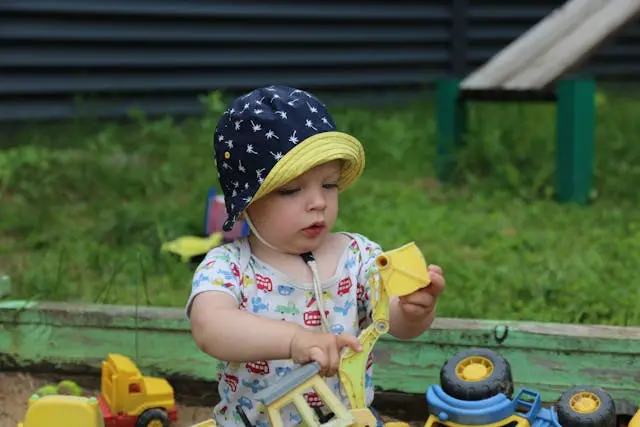
- Sandpits and mud kitchens — among the richest sensory and imaginative play environments available. The child who spends an hour in a sandpit is building sensory integration, spatial reasoning, and creative narrative simultaneously.
- Loose parts — sticks, stones, logs, rope, containers, crates. The research on “loose parts” play is remarkably consistent: children given open-ended natural materials in outdoor settings engage in more complex, sustained, and developmentally rich play than children given purpose-built equipment.
- Gardening tools — giving a child their own patch of garden and the tools to tend it builds responsibility, patience, scientific observation, and a direct relationship with the natural world that no toy can replicate.
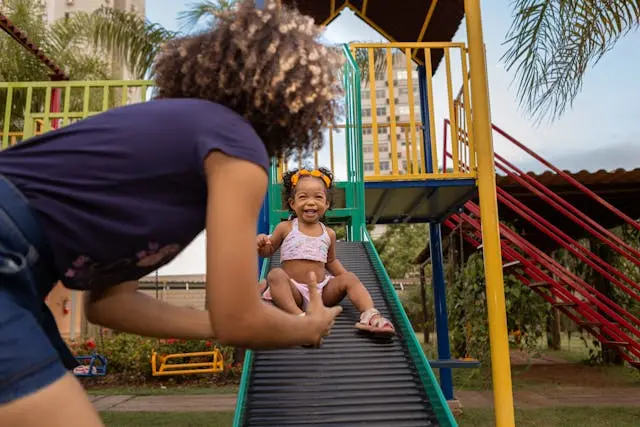
- Climbing structures — when appropriately challenging for the child’s age and ability, climbing develops risk assessment, physical confidence, upper body strength, and spatial awareness in ways that are difficult to replicate indoors.
Lower-Value Outdoor Additions
- Battery-operated ride-on vehicles — the child is transported, not active
- Screen-integrated outdoor games — they import the problems of screen-based play into the outdoor environment
- Highly structured outdoor games with single-use equipment — better than nothing, but far less developmentally rich than open-ended alternatives
Practical Strategies for Getting Your Child Outside More
Knowing that outdoor play is important and actually getting more of it into your child’s day are two different challenges. Here are the approaches that work most reliably in real family life.
Make It a Non-Negotiable Part of the Daily Routine
The most effective way to ensure outdoor time happens is to treat it exactly the way you treat meals and sleep — as a non-negotiable part of the day’s structure, not something that happens if there is time left over. Decide on a time — after school, before dinner, first thing on weekend mornings — and protect it consistently.
Children who know that outdoor time happens every day at a certain time stop arguing about it. It simply becomes part of how days work. The negotiation only persists when the schedule is inconsistent.
Go Outside With Them — At Least Sometimes
Just as with indoor play, parental presence transforms the quality of outdoor play for young children. A parent who goes outside, sits on the grass, points at a cloud, follows a beetle across the pavement, or simply reads nearby while the child plays — that presence communicates that the outdoor world is worth paying attention to. It builds the nature connection that we explored in our article on raising environmentally aware children, which begins not with conversations about climate but with simple, shared time in the natural world.
Lower the Bar for “Good Enough” Weather
Children in Scandinavian countries — where outdoor play is embedded in educational culture regardless of weather — have a saying: there is no bad weather, only bad clothing. This is worth taking seriously. A child who learns to play comfortably in rain, wind, and cold builds a relationship with the natural world that is more robust and more lasting than one who only goes outside when conditions are perfect.
Invest in good waterproof clothing. Let your child get muddy. The laundry is worth it.
Connect With Other Families
Children play outside more when other children are outside. One of the most effective ways to increase your child’s outdoor time is to establish regular outdoor playdates with other families — neighbors, school friends, families from your community. The social dimension of outdoor play is itself one of its most significant developmental benefits, and it is far more compelling than solo time outside for most children.
Resist the Urge to Over-Structure It
This is the most important practical principle: when your child is outside, resist the urge to organize their play. Do not direct the game, suggest activities, or step in when they are bored. Boredom is the gateway to creativity. A child who has nothing to do outside and no adult organizing their time will, within minutes, find something to do — and what they find will almost always be more developmentally rich than anything you would have suggested.
The adult’s role in outdoor play is to provide access, ensure basic safety, and then step back. The child’s role is to do everything else.
A Note on “Nature Deficit Disorder”
Author Richard Louv, in his landmark book Last Child in the Woods, coined the term “Nature Deficit Disorder” to describe what happens to children who grow up largely disconnected from the natural world. It is not a clinical diagnosis — it is a cultural observation. But the research that has accumulated since Louv first made this argument in 2005 has been remarkably consistent in its support of his central claim: children need nature. Not occasionally. Regularly. And the consequences of its absence are real.
What gives me genuine optimism is that the remedy is completely available to most families, and it costs almost nothing. A park. A garden. A patch of grass. A walk. The natural world has not disappeared — children’s access to it has simply been crowded out by other things. Reclaiming that access is one of the most valuable investments a parent can make in their child’s development — and one of the simplest.
Summary: What To Remember
- Outdoor play is not optional — it is a fundamental developmental need, with research-backed benefits across attention, physical health, mental health, social skills, creativity, and resilience.
- Children today are spending dramatically less time outdoors than previous generations — and the developmental consequences are visible and measurable.
- Even 60 minutes of outdoor time daily produces significant benefits; more is better, particularly for younger children.
- Unstructured outdoor play is the most developmentally valuable kind — the child should be directing, not the adult.
- The best outdoor toys are open-ended — balls, bikes, sand, loose natural materials, and gardening tools outperform purpose-built equipment for developmental richness.
- Make it routine, not optional — daily outdoor time protected in the schedule is far more likely to happen than outdoor time squeezed in when convenient.
- Go outside yourself — your presence and your relationship with the natural world shapes your child’s more than any equipment or instruction.
- Lower the bar for weather — there is no bad weather, only insufficiently prepared children.
Younes Kehal is an educational director, certified school coach, and certified life coach with 20 years of experience working with children, families, teachers, and schools. His guidance combines practical educational experience with carefully reviewed research.