How to Raise a Child Who Loves Real Food — Without Battles, Bribes, or Boredom
There is a version of the family dinner table that most parents dream of — and a version they actually live with. In the dream version, children eat what is served, try new things with curiosity, and understand in some quiet, intuitive way that food is something to be valued. In the version most parents live with, there are negotiations, standoffs, separate meals, and the creeping suspicion that their child may survive to adulthood on pasta, bread, and the specific brand of yogurt that must never, under any circumstances, be substituted for a different one.
In over twenty years of working with children and families, I have watched the relationship between children and food become one of the most anxiety-laden aspects of modern parenting. And I think a significant part of that anxiety comes from a misunderstanding of what the goal actually is.
The goal is not a child who eats everything you put in front of them without complaint. That is compliance. The goal is a child who has a genuinely positive relationship with food — who is curious about what they eat, who understands in an age-appropriate way where food comes from, who can sit at any table anywhere in the world and find something nourishing and good. That is a very different thing. And it is built not through pressure or persuasion, but through the slow, patient work of creating an environment where food is interesting, where eating together matters, and where real food is simply what the family eats.
Table of Contents
This guide is about how to build that environment — practically, sustainably, and without turning every meal into a battle.
The Foundation: What the Research Actually Shows About Food Habits
Before we talk about strategies, it is worth establishing what the research tells us about how food preferences and eating habits actually form in children — because some of what parents instinctively try is directly contradicted by the evidence.
The most consistent finding across decades of pediatric nutrition research is this: early food experiences shape long-term eating patterns in ways that persist well into adulthood. The flavors, textures, and food environments a child encounters in their first years of life lay down neural pathways that influence what feels familiar, safe, and desirable for the rest of their life. This is both a sobering and an empowering finding — sobering because it means the early years matter enormously, empowering because it means the choices you make now about what food looks like in your home have genuine and lasting impact.
The World Health Organization, in a 2026 global guideline on healthy school food environments, noted that healthy dietary practices begin early in life — and that the food environments children are exposed to in their early years have lifelong consequences. This is not about perfection. It is about the consistent, daily texture of what food means in your family.
The second consistent finding is one we explored in depth in our article on picky eating: pressure around food backfires. Children who are pressured, bribed, or forced to eat specific foods do not develop a broader or healthier relationship with food — they develop anxiety around it. The dinner table becomes a site of conflict, and food becomes something to be negotiated rather than enjoyed. Whatever strategy you adopt, the first principle is always the same: remove the pressure.
Raising a Child Who Eats Real Food: Why It Also Matters for the Planet
This is the dimension of food and children that is almost never discussed in parenting guides — and it is one that matters more than most parents realize.
The food choices families make are among the most significant environmental choices they make. Research consistently shows that diets rich in whole plant foods — vegetables, fruits, legumes, whole grains — have dramatically lower environmental footprints than diets centered on ultra-processed foods and high quantities of animal products. A child who grows up eating a varied, plant-forward diet is not just healthier — they are living more lightly on the planet.
And here is the remarkable thing: the habits that produce environmentally lighter diets are the same habits that produce healthier children. More vegetables, more legumes, more whole grains, less ultra-processed food — this is simultaneously the nutritional advice and the environmental advice. There is no trade-off. A child who loves real food is a child who is eating well for themselves and well for the world they will inherit.
As we explored in our article on raising environmentally aware children, the most powerful environmental education is not a conversation about global problems — it is the daily practice of living in ways that reflect genuine care for the world. A family that cooks real food, that grows something, that knows where their food comes from — that family is doing environmental education at the most profound level, without a single formal lesson.
8 Strategies That Build a Lifelong Positive Relationship With Real Food
1. Make Family Meals Non-Negotiable — As Often as Possible
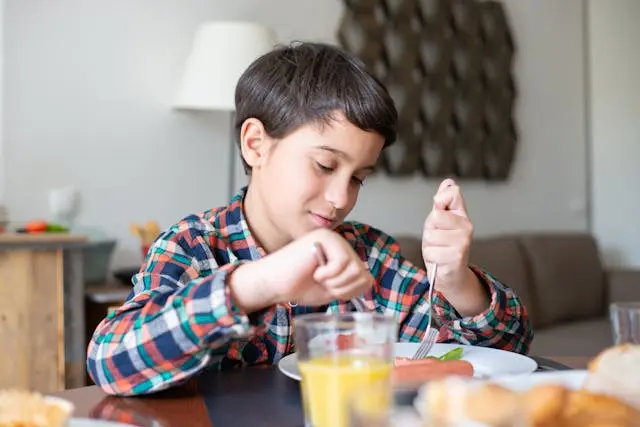
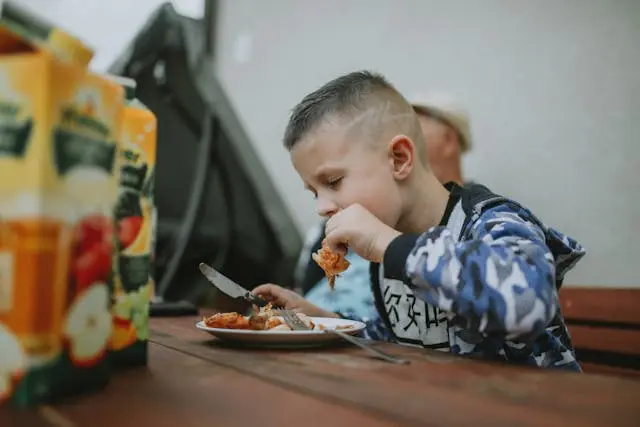
The research on family meals is among the most consistent in pediatric nutrition. Children who eat regular family meals together consume more fruits and vegetables, have higher intakes of fiber, calcium, and vitamins, and are significantly less likely to develop disordered eating patterns in adolescence. They also, as a separate but related finding, tend to have stronger family connections and better mental health outcomes.
Nemours KidsHealth summarizes it directly: kids who take part in regular family meals are more likely to eat healthy foods, less likely to develop eating disorders, and more likely to maintain a healthy weight. The family meal is not just a nutritional intervention — it is a relational one. And both dimensions matter.
This does not mean every dinner needs to be a formal occasion. It means making a genuine effort to eat together as a family, at a table, without screens, as many times per week as your schedule allows. Even three or four times a week produces measurable benefits compared to eating separately or in front of screens.
2. Cook With Your Children — Starting Earlier Than You Think
One of the most robust findings in food education research is that children who participate in food preparation are significantly more willing to try and accept the foods they have helped create. UNICEF’s parenting guidance specifically recommends involving children in food shopping and preparation as a way to build healthy eating habits — and the mechanism is straightforward: ownership changes relationship.
A child who has washed the vegetables, stirred the pot, or arranged the ingredients on a plate has a relationship with that food that is fundamentally different from a child who simply receives it on a plate. They are invested. They are curious. And the act of helping — however messily, however incompletely — builds the kind of familiarity with real ingredients that makes trying them feel natural rather than threatening.
Start earlier than you think is appropriate. A 2-year-old can wash vegetables, tear lettuce, and stir a bowl. A 3-year-old can measure ingredients with help. A 5-year-old can make a simple salad. A 7-year-old can scramble eggs. The tasks themselves matter less than the consistent presence in the kitchen — the smells, the textures, the conversations, the sense of being part of something important.
3. Grow Something — Anything
Few experiences change a child’s relationship with food as fundamentally as growing it. A child who has planted a seed, watered it daily, watched it grow, and finally harvested something edible has experienced food in a way that no supermarket visit or cooking lesson can replicate. They understand, at a visceral level, that food comes from somewhere real — from soil and water and sunlight and time — not from a package.
This does not require a garden. A single herb plant on a windowsill — basil, mint, parsley — is sufficient to start. A cherry tomato plant in a pot on a balcony. A tray of seeds on a sunny windowsill. The scale is irrelevant. What matters is the child’s direct experience of the relationship between care, growth, and food.
Research on garden-based food education consistently shows that children who grow food are more willing to try vegetables and fruits — particularly ones they have grown themselves — than children with no gardening experience. The effect is particularly strong for vegetables that children typically refuse when simply placed on a plate.
4. Shop Together and Let Them Choose
The supermarket — or better still, a farmers’ market or local produce shop — is one of the most underused educational environments available to parents. A child who accompanies their parent to buy food regularly develops an understanding of where food comes from, what different foods look and smell and feel like in their raw state, and what it means to make choices about what the family eats.
Give your child genuine agency within appropriate limits. Let them choose which vegetable to have this week from a selection of two or three. Let them pick fruit they want to try. Let them smell the herbs and choose one. When a child has chosen something, they are invested in it — and investment changes everything about how they approach the food when it appears on the plate.
At the store, as Nemours KidsHealth recommends, teach kids to check food labels — beginning the process of understanding what is actually in the food they eat. This is not an abstract lesson. It is practical literacy that serves them for their entire life.
5. Put Real Food in Front of Them — Consistently and Without Fanfare
The most effective long-term strategy for raising a child who eats real food is also the simplest: make real food what the family eats, consistently and without making it a performance.
Families where vegetables appear at most meals, where fruit is the default snack, where legumes and whole grains are regular features of the table — children in those families develop a relationship with those foods as simply normal. Not special. Not virtuous. Just what food is.
The CDC is clear on this point: parents control the supply lines. You decide which foods are bought and regularly available in the home. Children eat what is accessible. If the default snack in your home is fruit or vegetables with hummus, that becomes the norm. If it is ultra-processed packaged snacks, that becomes the norm. The power of the default environment is enormous — and it is entirely within a parent’s control.
This does not mean banning all treats or approaching food with rigid perfectionism — which, as we have discussed, creates exactly the kind of anxiety-laden relationship with food that produces the worst long-term outcomes. It means that real food is simply the standard, the background, the default — and other things are occasional variations on that standard.
6. Talk About Food With Genuine Curiosity — Not Nutrition Lectures
Children whose parents talk about food in terms of vitamins, nutrients, and health outcomes develop a relationship with food that is instrumental — food is medicine, a duty, a performance of health-consciousness. Children whose parents talk about food with genuine curiosity and pleasure develop a relationship with food that is sensory, cultural, and enjoyable.
The difference matters enormously for long-term eating patterns.
Try asking questions at meals that are genuinely curious rather than instructional: “What does this taste like to you?” “Does this remind you of anything?” “What do you think is in this?” “If you could change one thing about this dish, what would it be?” These questions treat food as interesting rather than as a lesson — and children respond to that framing by becoming more, not less, engaged with what they are eating.
Talk about where food comes from in a way that connects it to real places and real people: the farm where the tomatoes were grown, the way bread is made from wheat, the fact that honey comes from bees that have visited thousands of flowers. This is not a sustainability lecture — it is storytelling. And children love stories.
7. Model the Relationship With Food You Want Your Child to Have
As UNICEF’s guidance states directly: you can be a good role model by reaching for healthy foods, beverages and snacks yourself. This is perhaps the most powerful and most overlooked strategy in all of food parenting — because it requires something of the parent, not just the child.
Children learn what food is by watching the adults around them eat. They learn whether vegetables are something adults enjoy or something adults endure. They learn whether cooking is a pleasure or a chore. They learn whether eating is an experience to be savored or a task to be efficiently completed.
If you want your child to eat vegetables with genuine enjoyment, eat vegetables with genuine enjoyment — visibly, consistently, without making it a performance. If you want your child to be curious about food, be curious about food yourself. If you want your child to cook, cook — and involve them in the process.
You cannot outsource this to strategies and techniques. The model is you.
8. Limit Ultra-Processed Food — Without Making It Forbidden
This is the balance that many parents find most difficult — and the research on it is more nuanced than the extremes of “never allow junk food” or “everything in moderation” suggest.
Ultra-processed foods — the category that includes most packaged snacks, fast food, sweetened beverages, and industrially produced convenience meals — are engineered to override the natural appetite regulation systems that real food engages. They are designed to be hyperpalatable: more intensely flavored, more immediately rewarding, and more resistant to the “I’ve had enough” signal than any whole food. A child whose palate is primarily calibrated to ultra-processed food will genuinely find real food less interesting — not because they are difficult, but because their flavor expectations have been set to a level that whole food cannot match.
The practical implication is not to ban these foods entirely — which creates exactly the forbidden-fruit dynamic that makes them more appealing, not less — but to ensure they are genuinely occasional rather than routine. When they are occasional, they remain special. When they are routine, they become the baseline — and real food becomes the deprivation.
Age-by-Age Food Education: What to Focus On
| Age | What Matters Most | Practical Focus |
|---|---|---|
| 0–2 | Diverse flavor exposure, positive mealtime experience | Introduce a wide variety of flavors and textures early. Eat together. Keep mealtimes calm. |
| 2–5 | Involvement, low-pressure exposure, growing something | Cook together. Plant a seed. Let them choose at the market. Keep offering without pressure. |
| 5–9 | Where food comes from, basic cooking skills, food curiosity | Visit a farm or market. Cook a simple meal independently. Discuss what is in food at the store. |
| 9–13 | Food systems, sustainability, cooking competence | Cook one family meal per week. Discuss food choices and their origins. Read food labels together. |
| 13+ | Independent food decision-making, food identity | Support their emerging food identity. Discuss sustainability of food choices. Cook together as equals. |
The Connection Between Real Food and Environmental Literacy
A child who knows where food comes from — who has grown a tomato, visited a farm, watched bread being made, or simply helped prepare a meal from whole ingredients — has a relationship with the natural world that is direct, embodied, and real. They understand, at the most concrete level, that they depend on the earth for what sustains them. That understanding is the foundation of genuine environmental care.
You do not need to teach this as a lesson. You need to live it as a practice. Cook from whole ingredients. Visit a farmers’ market. Grow something in a pot. Compost your food scraps. Talk about food in ways that connect it to the natural world rather than treating it as an interchangeable commodity.
These practices are simultaneously food education and environmental education — and they are far more powerful than any formal curriculum, because they happen in the daily life of the family, repeated hundreds of times over years, shaping the neural pathways and values that will guide your child’s choices for the rest of their life.
A Word on the Long Game
Everything in this guide is oriented toward the long game. None of it will transform your child’s eating by next Tuesday. What it will do — if practiced consistently, patiently, and without perfectionism — is gradually shift the texture of your family’s relationship with food in a direction that serves your child for their entire life.
The child who cooks alongside you at seven will cook for themselves at seventeen. The child who plants seeds at four will understand something about the natural world that no classroom can fully teach. The child who sits at a family table regularly will carry that experience of belonging and nourishment forward into every table they sit at for the rest of their life.
That is the goal. Not a child who eats their vegetables tonight. A person who loves real food, knows where it comes from, and understands — in the way that only lived experience can teach — that what we eat and how we eat it matters. For ourselves, for the people we share our tables with, and for the world that feeds us.
Summary: What To Remember
- Early food experiences shape lifelong eating patterns — the daily food environment of your home is one of the most significant investments you can make in your child’s long-term health.
- Pressure backfires — remove it from the table entirely and replace it with consistent, low-key exposure to real food.
- Family meals are one of the most evidence-based nutritional interventions available — eat together as often as possible, at a table, without screens.
- Involve your child in cooking and shopping — ownership transforms relationship with food more effectively than any instruction.
- Grow something — even a single pot plant connects your child to the real origin of food in a way that nothing else can replicate.
- Model the relationship with food you want your child to have — eat vegetables with genuine enjoyment, be curious about food, cook with pleasure.
- Make real food the default — you control the supply lines. What is regularly available in your home is what your child’s palate will normalize.
- Keep ultra-processed food occasional, not routine — without banning it, which creates forbidden-fruit dynamics that make it more appealing.
- Connect food to the natural world — a child who knows where food comes from develops both better eating habits and a deeper relationship with the environment.
Younes Kehal is an educational director, certified school coach, and certified life coach with 20 years of experience working with children, families, teachers, and schools. His guidance combines practical educational experience with carefully reviewed research.