Board Games Are the Most Underrated Parenting Tool. Here’s the Science Behind Why.
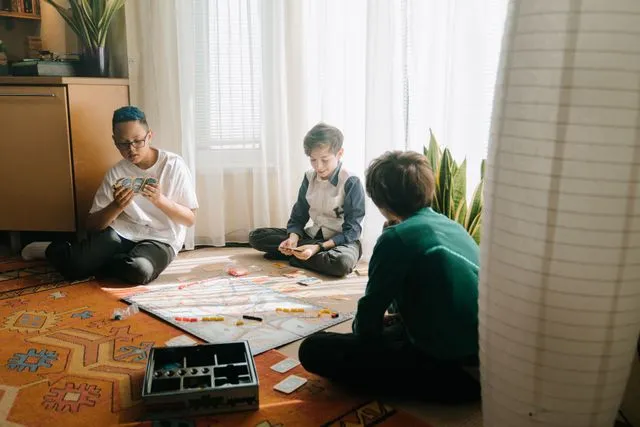
Friday evenings used to be the hardest part of the week in some of the families I have worked with.
Not because anything bad happened on Fridays. Just because Friday evening is unstructured. The week is over, everyone is tired, and the default tends to be screens — each person retreating into their own device, in the same room but not really together. Parents feel a vague guilt about it. Children do not always notice. But something is being missed.
I started suggesting board games to these families almost on a whim, years ago. A simple one first — something a five-year-old and a parent could play together without one of them being bored. What happened, consistently and across very different families, surprised me. Not just that the children enjoyed it. That the parents did too. That they ended up talking during the game — really talking — in ways they had not managed to over dinner. That a six-year-old sat through forty minutes of something demanding without anyone asking them to. That a child who struggled enormously with losing gradually, over months, got better at it.
I started paying more attention to the research. What I found was that board games are doing far more than most parents realise — and that the dismissal of them as simple entertainment misses something significant about what happens inside a child’s brain and inside a family when they sit down and play together.
Table of Contents
What Happens in the Brain During a Board Game
Board games are not passive. That sounds obvious, but it is worth saying clearly, because the contrast with other forms of entertainment is significant.
When a child watches a screen, their brain receives stimulation. When a child plays a board game, their brain performs. The distinction matters because performing — generating responses, making decisions, holding information, anticipating consequences — produces neural engagement that receiving stimulation does not.
A child playing a moderately complex board game is simultaneously managing working memory (holding the current state of the game in mind), planning (thinking ahead about possible moves), inhibitory control (resisting the impulse to take the obvious move in favour of a better one), emotional regulation (managing the frustration of a bad turn or the excitement of a good one), and social cognition (reading other players, understanding that other people have different information and different intentions).
These are not trivial capacities. Working memory, planning, inhibitory control, and emotional regulation are the core components of executive function — the set of cognitive skills that predicts academic success, social competence, and life outcomes more reliably than IQ. And they are skills that are built through practice, not through instruction. You cannot teach executive function in a classroom. You build it through repeated experience of situations that require it.
Board games are, in this sense, an executive function gym. Every game is a workout. The progress is slow and not always visible. But it accumulates.
The Research on Board Games and Child Development
The academic research on board games in child development is less extensive than on some other interventions — board games do not have powerful commercial interests funding studies about them — but what exists is consistent and sometimes striking.
A 2019 study published in the journal Early Childhood Education Journal found that children who played number-based board games showed significant improvements in numerical knowledge, including counting, number line understanding, and number comparison, compared to children in a control condition. The gains were not trivial and persisted over time. The researchers concluded that a simple board game — played for as little as four twenty-minute sessions — produced meaningful mathematical learning that other interventions struggled to match.
Research on the social dimensions of board game play is equally interesting. Studies have consistently found that cooperative and competitive play with peers and family members produces improvements in perspective-taking, emotional regulation, and conflict management. A 2020 review of the literature on games and social development concluded that structured game play — where players must follow rules, take turns, and manage both winning and losing — is among the most effective naturalistic environments for developing these capacities in children.
Perhaps most relevant for parents is the research on family board game play specifically. A study from the University of Montreal found that families who played board games together regularly showed stronger communication patterns — more reciprocal exchange, more listening, more genuine engagement — than families who spent equivalent time watching television together. The game created conditions for real interaction. The screen, predictably, mostly replaced it.
| Skill Area | What Board Game Play Develops | Evidence Strength |
|---|---|---|
| Executive Function | Working memory, planning, inhibitory control, cognitive flexibility | Strong — consistent across multiple study designs |
| Mathematical Reasoning | Number sense, counting, probability, strategic thinking | Strong — particularly for number-based games in early childhood |
| Language Development | Vocabulary, narrative, conversational turn-taking, verbal reasoning | Moderate — particularly when adults play alongside and engage verbally |
| Emotional Regulation | Frustration tolerance, managing winning and losing, delaying gratification | Strong — particularly with repeated play over time |
| Social Cognition | Perspective-taking, reading others’ intentions, cooperation and conflict management | Strong — particularly with cooperative game formats |
| Attention and Concentration | Sustained attention, resistance to distraction, focused engagement | Moderate — varies by game complexity and child age |
| Family Communication | Reciprocal exchange, listening, genuine engagement between family members | Moderate — consistently observed in family study designs |
The Losing Problem — and Why It Matters More Than Parents Think
Let me spend some time on this, because it is the issue that comes up most consistently when parents talk about board games with children.
Most children, at some point in their board game development, are terrible at losing. Catastrophically terrible. Tears, overturned boards, accusations of cheating, declarations that they will never play again. Parents who experience this once or twice often conclude that board games are not worth the drama, and quietly retire the game to the back of a cupboard.
This is, in my view, the wrong conclusion. The losing problem is not a reason to stop playing. It is the reason to keep playing. Because the ability to lose gracefully — to experience genuine disappointment and manage it without falling apart — is one of the most important emotional skills a child can develop. And it cannot be taught in a vacuum. It has to be practised, in real situations, with real stakes, over and over until the nervous system learns to tolerate the experience.
Every board game loss is a low-stakes training run for the kinds of disappointment that life will produce far more seriously later on. The child who has played hundreds of games and lost many of them, and who has gradually learned that the world does not end when they lose and that they can try again, is building a resilience that transfers. Not automatically and not completely. But measurably.
The parent’s role in this is important and often mishandled. Well-meaning parents sometimes let children win, or soften the rules to prevent losing, or rush to comfort before the child has had any time to experience the disappointment. All of these approaches, though kind in intention, deprive the child of the experience that produces growth. The child needs to lose, genuinely and repeatedly, and to discover — through that experience, not through a lecture — that losing is survivable.
What the parent can do is model. How you handle losing matters more than anything you say about it. A parent who says “oh well, good game — you played really well in the second half” and means it, who visibly experiences disappointment and visibly moves through it without making it the other person’s fault, is showing a child something that no amount of instruction replicates.
Choosing the Right Game for Your Child’s Age
The most common mistake parents make when introducing board games is choosing something too complex for the child’s current developmental stage. A game that is too hard produces frustration and disengagement. A game that is too easy produces boredom. The game that produces sustained engagement is the one sitting right at the edge of the child’s current capacity — challenging enough to require effort, achievable enough to produce the satisfaction of success.
This is the same principle that applies to all developmental learning, and it applies just as precisely to board game selection.
| Age Range | Developmental Readiness | Game Types That Work | Examples |
|---|---|---|---|
| 3 to 4 years | Beginning turn-taking; simple rules; short attention span; no strategic thinking yet | Simple matching, memory, or colour/shape games; cooperative formats work well at this age | Orchard Game, Spot It Junior, Snakes and Ladders, First Orchard |
| 4 to 6 years | Can follow multi-step rules; beginning to understand winning and losing; limited planning ahead | Simple competitive games with luck element; beginning cooperative games; memory games | Uno (simplified), Dobble, Ghost Blitz, Sleeping Queens |
| 6 to 8 years | Can plan 1–2 moves ahead; developing emotional regulation; ready for genuine competition | Games with moderate strategy; negotiation; resource management at a simple level | Ticket to Ride (First Journey), Catan Junior, Kingdomino, Labyrinth |
| 8 to 10 years | Can plan several moves ahead; stronger emotional regulation; beginning to read other players | Strategy games; trading; games requiring reading of other players’ intentions | Catan, Pandemic, Dixit, Coup, 7 Wonders Duel |
| 10 years and above | Adult-level strategic thinking possible; can handle complex rules; genuine social cognition | Complex strategy; social deduction; cooperative games with adult family members | Ticket to Ride (original), Codenames, Mysterium, Wingspan, chess |
A note on cooperative games, which are listed as appropriate for younger children but deserve emphasis across all ages. In cooperative games, all players work together against the game itself — nobody wins or loses against another player. For families with younger children who are still developing their losing-tolerance, cooperative games remove the most emotionally charged element of competitive play while retaining essentially all of the executive function, planning, and communication benefits. Pandemic is perhaps the best-known adult cooperative game. For younger children, games like First Orchard and Outfoxed work on the same principle.
What Happens in the Room That Research Cannot Measure
I want to say something that the research does not capture, because research tends to measure what it can measure — cognitive scores, skill improvements, quantifiable outcomes — and some of what matters most about board game play does not fit into those categories.
When a family sits down to play a game together, the phones are usually down. Not because anyone insisted on it. Because the game requires attention and the attention that games require is incompatible with scrolling. For the duration of the game — thirty minutes, an hour, sometimes more — everyone in that room is present with each other in a way that does not happen automatically very often.
Children see their parents as people during board games in a way they do not always elsewhere. They see a parent who is genuinely trying to win, genuinely laughing when something goes wrong, genuinely complaining about their terrible luck, genuinely delighted by a clever move. The parent becomes a person rather than a function. And that shift — from parent-as-authority-figure to parent-as-fellow-human — is one of the most valuable things that can happen in a family relationship during childhood.
I have had parents tell me that they learned things about their child during board games that they had not managed to learn in months of conversations. Not because the game was therapeutic. Because when people are doing something together, they talk differently than when they are sitting across from each other specifically to talk. The game creates a shared third thing — something both people are attending to — and conversation happens in the margins of that shared attention in a way that feels easier and less pressured.
This is, I suspect, part of why the families I know who play games regularly together tend to communicate better overall. Not because board games teach communication skills directly. Because they create regular conditions in which genuine, unhurried, playful communication simply happens.
Getting Started When Your Child Does Not Want To
Some children resist board games, at least initially. This is usually for one of a few reasons.
They have had a bad experience with losing and have decided the risk is not worth it. They find the rules overwhelming before they have played enough to internalise them. They are used to entertainment that is more immediately stimulating and find the slower pace of a board game underwhelming at first. Or they simply have not found the right game for their particular interests and personality.
The solution in almost all of these cases is the same: start easier and shorter than you think necessary, play cooperatively before competitively, and make sure the first several sessions end well — not because you let them win, but because the game is well-matched to their current level. A child who experiences board games as something they are capable of doing will be much more willing to engage with them than a child whose first experiences were confusion and losing.
It also helps, enormously, if the parent is visibly enjoying themselves. Children take their cues from their parents. A parent who plays board games with genuine enthusiasm and lightness, who laughs at bad luck and celebrates small moments, creates a very different emotional atmosphere from one who is playing dutifully to benefit their child’s cognitive development. Children know the difference. Play for fun first. The developmental benefits will follow.
For the broader question of how to choose play activities that genuinely match a child’s developmental stage and interests — not just what the age label on the box says — the article on why children abandon toys and what it tells you explores the underlying principles in detail.
A Word on Chess
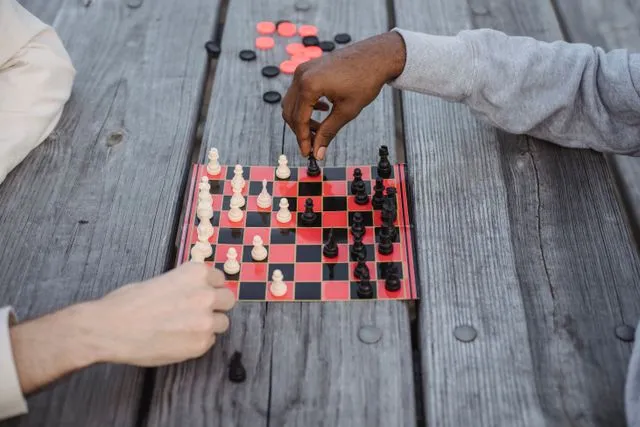
Chess deserves a separate mention because it occupies a unique position in the research on games and cognitive development, and because parents often either overestimate or underestimate it.
The research on chess and academic outcomes is genuinely interesting. Multiple studies across different countries and age groups have found associations between regular chess play and improvements in mathematical reasoning, reading comprehension, and attention. A large-scale study in Italy found that primary school children who received chess instruction showed significantly better mathematical problem-solving performance than control groups. Similar findings have emerged from studies in the UK, Spain, and several other countries.
Chess is not magic, and the causal relationships are not always clean — children who enjoy chess may be self-selecting in ways that explain some of the outcomes. But there is enough consistent evidence that chess, introduced well and at the right developmental moment, is worth the investment for families who enjoy strategy games. The FIDE (World Chess Federation) research programme on chess in education tracks the ongoing evidence base for anyone interested in the academic literature.
The right moment for chess is typically around age six or seven — old enough to manage the rules and the required concentration, young enough that the learning curve is not discouraging. Starting with simplified versions — using only pawns, then adding pieces one at a time — reduces the initial overwhelm significantly.
The Friday Evening Question
I want to come back to where I started, because I think it matters.
Most families are looking for something to do together that does not feel like effort, that everyone is at least reasonably willing to participate in, and that does not leave them feeling like they wasted the time. Board games, for many of the families I have worked with, have become that thing. Not every Friday. Not always smoothly. But regularly enough to become part of the texture of family life in a way that other activities have not.
The children in those families are, in my observation, getting something from those evenings that goes beyond the cognitive skills the research measures. They are getting the experience of being in a family that plays together. That laughs together. That argues about rules and then resolves it. That sees each other as people rather than just roles.
That is not measurable. But it is real. And in twenty years of working with families, I am increasingly convinced that these small, regular, ordinary moments of genuine togetherness are among the most important things a family can provide — more important than any particular educational activity, any particular achievement, any particular thing.
A board game on the table, a Friday evening, everyone phones down. It is a small thing. It is also not a small thing at all.
Frequently Asked Questions
At what age can children start playing board games?
Simple board games designed for young children — matching games, colour games, cooperative formats — are appropriate from around age three, when children begin developing the turn-taking and basic rule-following capacities that games require. Before three, game-like activities with a caregiver can introduce these concepts informally. The key is starting with games that are genuinely appropriate for the child’s current developmental stage, not pushing toward complexity before the child is ready.
My child cheats at board games. What should I do?
Cheating in young children is almost always a response to the discomfort of potentially losing — it is an emotional regulation failure, not a moral failure. The most effective responses combine calm, matter-of-fact rule enforcement (the rule is x, so we need to do x) with attention to whether the game is the right level of challenge. A child who consistently cheats may be playing a game that is beyond their current emotional capacity to handle competitively. Switching to cooperative formats, or a simpler competitive game, often eliminates the cheating without any direct confrontation about it.
Are video games and board games equally beneficial?
They are different in ways that matter. Both require active engagement rather than passive reception. But board games consistently provide something most video games do not: face-to-face interaction with other people who are physically present, and the management of real social dynamics — reading faces, managing conversation, navigating disagreement — that those interactions produce. Some video games, particularly cooperative or strategic ones, share cognitive benefits with board games. But the social and relational dimension of in-person board game play is difficult to replicate digitally.
How long should a board game session last with young children?
Match the game length to the child’s genuine attention span, not to what you hope their attention span is. For three-to-four-year-olds, fifteen to twenty minutes is typically the ceiling before engagement deteriorates. For five-to-seven-year-olds, thirty to forty minutes. For older children, an hour or more is reasonable. Always end on a positive note — if possible, before the child’s engagement has completely dropped — so the association with the activity remains good.
Should I let my child win to keep them interested?
Occasionally, and transparently, yes — particularly when first introducing a game and building positive association. But consistently letting children win deprives them of the experience they need to develop frustration tolerance and genuine enjoyment of the game on its own terms. Children who always win because the adults around them arrange it eventually sense this, and the victory becomes hollow. The goal is games at the right level — where the child can genuinely win sometimes without anyone arranging it.
What is the difference between cooperative and competitive board games, and which is better for children?
In cooperative games, all players work together against the game; in competitive games, players work against each other. Neither is universally better — both develop important skills. Cooperative games are particularly valuable for younger children who are still developing emotional regulation around losing, and for building communication and teamwork skills. Competitive games are important for developing frustration tolerance, learning to lose gracefully, and the genuine excitement of real competition. A mix of both across a child’s board game experience is ideal.
Younes Kehal is a Professional Educational Director and School Coach with over 20 years of experience working directly with children, families, and educational institutions. The guidance published on Parenting Assist is rooted in real field experience and evidence-based developmental science.