what can toddlers do in kitchen” ,”cooking with kids by age
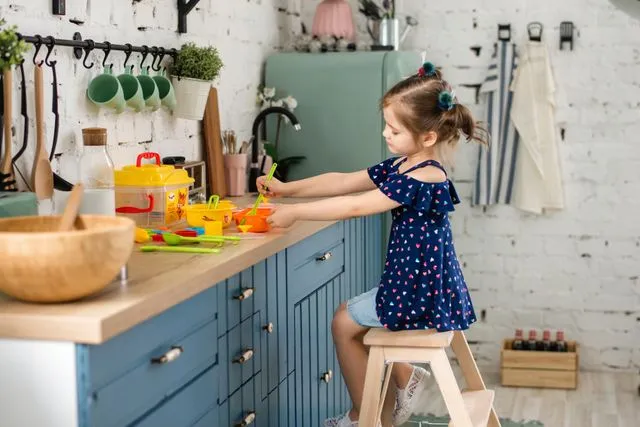
She was four years old, standing on a step stool at the kitchen counter, and she had been doing this for about eight minutes already. Measuring flour. Specifically, scooping it into the measuring cup, levelling it off with a butter knife the way she had watched me do it, and then pouring it into the bowl. Then doing it again. Then again. She was on her sixth cup of flour when I gently suggested that we only needed two.
“I’m practising,” she said, without looking up.
She was. And the thing she was practising — the careful transfer of a precise quantity from one container to another, the levelling, the checking — was, in a kitchen context, just measuring. In a classroom context, it would be mathematics. In a developmental context, it was fine motor control, sequencing, spatial awareness, and the kind of concentrated voluntary attention that researchers associate with executive function. She was doing all of this at four, voluntarily, with evident satisfaction, because it involved flour and being in the kitchen with a parent.
I have been saying for years that the kitchen is one of the most educationally rich environments available to a child. Most parents hear this as a nice sentiment. I mean it quite literally.
Table of Contents
What’s Actually Happening When a Child Cooks
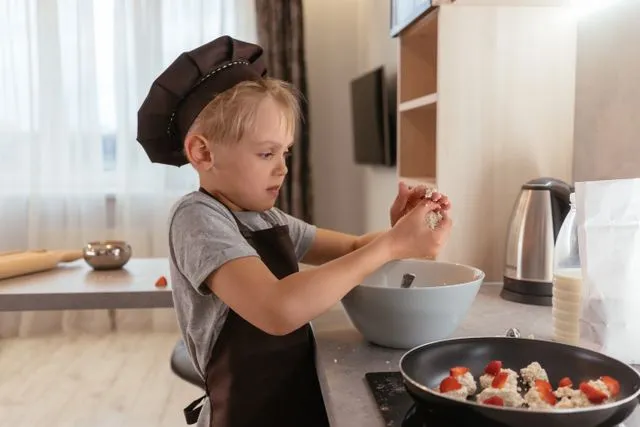
A child following a recipe is doing reading comprehension — parsing written instructions, extracting the relevant information, executing it in sequence. They are doing mathematics — measuring, counting, doubling, halving, working with fractions in a context where the fraction means something tangible and the consequence of getting it wrong is immediately apparent. They are doing science — observing what happens when heat is applied, what happens when acid meets alkali, what change of state looks like in practice. And they are doing all of this simultaneously, in a context that is intrinsically motivating, because at the end there is something to eat.
As the educator Michelle Connolly put it: when you teach a child to follow a recipe, you’re actually teaching them reading comprehension, mathematical measurement, scientific principles, and patience — all wrapped up in an activity that produces a result they can be proud of.
This is not a metaphor. A half-teaspoon is a fraction. The number on the scale is number recognition and decimal literacy. “Mix until just combined” is reading comprehension that requires the child to hold an instruction in working memory, interpret it in context, and apply it to an ongoing physical process. The baking powder that makes the cake rise is chemistry — a real chemical reaction, visible, smellable, edible.
Children learn in the kitchen in a way that is genuinely different from how they learn in formal educational settings, and the difference matters. The learning in the kitchen is embodied — it involves the hands, the senses, the whole body. It is immediately consequential — the measurement that goes wrong produces a result that is visibly, sometimes deliciously, wrong. And it is self-motivated — nobody is making the child want to cook. They want to be there. That wanting is the educational jet fuel that makes everything else work.
The Mathematics Is Everywhere and You Don’t Have to Point It Out
I want to say something about the instinct to turn cooking into a lesson. It’s an understandable instinct — you see a child measuring and you think: I should point out that this is fractions. But every time you do, you shift the child from cook to student. The flour stops being interesting. The measuring becomes a task rather than an activity. And the particular kind of motivated, embodied learning that makes the kitchen so valuable dissolves.
The mathematics in cooking doesn’t need to be pointed out to be learned. A child who measures half a cup of milk twenty times across twenty cooking sessions has developed an intuitive, physical understanding of what a half is — of what quantity means — that no worksheet can replicate. They have held it in their hands. They have seen it. They have used it. The understanding is theirs, and it belongs to them in a way that taught-and-tested mathematics often doesn’t.
The counting, the measuring, the sequencing (“What comes first? What comes after?”), the comparison (“Is this more than last time?”) — all of this is absorbed through participation, not instruction. The best thing a parent can do is cook alongside the child, narrate what they’re doing naturally, and not interrupt the flow with formal teaching moments. The kitchen teaches better when you trust it to.
The Science That Children Don’t Know They’re Learning
The kitchen is, as Kvaroy Arctic researchers describe it, a mini science laboratory. And in this lab, the experiments are edible.
What happens to butter when it heats? It melts — a change of state from solid to liquid. What happens to bread dough left in a warm place? It rises — because the yeast is alive, producing gas, and the observation of this is biology and chemistry simultaneously. What happens when baking soda meets vinegar? The fizzing is an acid-alkali reaction, and a child who witnesses it in the context of making something, rather than in a formal demonstration, files it away differently. It’s not a school fact. It’s a thing that happened while they were cooking.
Temperature, time, transformation — these are the concepts that run through every cooking process, and children who cook regularly develop an intuitive grasp of them that later formal science education lands on productively. The child who has watched dough change from a wet, sticky mass to a smooth, elastic ball has a physical memory of what mixing does. The child who has seen egg whites go from liquid to firm white peaks has seen the physical reality of protein denaturation before they have a word for it.
This matters for how science is learned later. Concepts taught in the abstract require significantly more cognitive work to retain than concepts that can be connected to a concrete physical memory. The kitchen builds those memories, quietly, one cooking session at a time.
What Cooking Does for Fine Motor Development
Stirring, pouring, kneading, rolling, spreading, cutting, squeezing — the kitchen is a fine motor workout disguised as activity. The precision required to fill a measuring spoon to exactly the right level, to transfer something liquid without spilling it, to roll pastry to an even thickness — these are demands on hand-eye coordination, grip strength, and motor control that, as we’ve discussed in our article on why every child needs creative activity, build the neural foundations for writing and other precision tasks.
For children who find formal fine motor practice — pencil exercises, worksheets — frustrating or boring, cooking offers an alternative route to the same development. The child who will not sit still for a writing exercise will often spend thirty focused minutes rolling biscuit dough. The physical experience is essentially the same, the motivation is entirely different, and the development is real.
The Language That Grows in the Kitchen
Descriptive language. Comparative language. Instructional language. The vocabulary of texture, temperature, smell, taste, colour. The technical vocabulary of cooking — simmer, fold, dice, blanch, caramelise — which is specific, precise, and often beautiful in the way technical vocabulary of any craft is beautiful.
A child who cooks regularly develops a richer sensory vocabulary than one who doesn’t, because the kitchen keeps providing occasions to use it. What does this smell like? How would you describe the texture? Is the sauce too thick or not thick enough? These are questions that require the child to reach for language, to find words for physical experiences, in a way that builds the descriptive capability that serves them in writing, in conversation, in the full range of communicative life.
Reading recipes also develops print awareness and literacy in a specific, functional way that is different from reading books. The recipe is a genre with its own conventions — the ingredient list, the method, the implicit sequencing structure. Following a recipe requires a child to read purposefully, to understand that the order of instructions is meaningful, to hold information from one sentence while executing it and then returning to the page for the next. These are reading comprehension skills that classroom instruction targets directly, but that the kitchen teaches incidentally.
What the Kitchen Teaches That No Toy Can
There is something about cooking with a child that is distinct from any other playful educational activity — and it’s the real consequences.
When a child stacks blocks and they fall down, the consequence is the fallen blocks. When a child makes a mistake in a board game, the consequence is losing a turn. These are real enough to be instructive. But when a child cooks — when they add the wrong amount of salt or forget the baking powder or don’t stir the mixture enough — the consequence is edible. The result is in their mouth. That immediacy and that concreteness change how the learning lands.
A child who has made a cake that didn’t rise, who has tasted a sauce that needed more lemon, who has experienced the satisfaction of a dish that came out exactly right — that child has a relationship with cause and effect, with attention to process, with the connection between care and outcome, that is genuinely different from the child who has only experienced consequences in game or exercise contexts.
This is also where the confidence lives. As New Horizon Academy’s research describes: cooking boosts confidence in children in a specific way — because the product is visible, shareable, and real. A four-year-old who has made biscuits has made biscuits. Not represented biscuits, not symbolic biscuits. Actual biscuits that people eat and say are good. That experience of genuine competence — of having made something real that works — is more developmentally potent than almost anything a purpose-built educational toy can offer.
Age-by-Age: What Children Can Actually Do in the Kitchen
One of the most common reasons parents don’t cook with their children is the reasonable belief that children can’t do very much until they’re quite old. This is not really true. Children can participate meaningfully in cooking much earlier than most parents expect — the tasks just need to be matched to their developmental stage.
| Age | What They Can Do | What They’re Developing |
|---|---|---|
| 18 months – 2 years | Stir with a spoon, pour from a small jug into a bowl, tear soft bread or salad leaves, wash vegetables | Grip strength, coordination, sensory exploration, cause and effect |
| 2–3 years | Measure dry ingredients with scoops, mix batters, spread with a blunt knife, press cookie cutters, peel bananas | Fine motor precision, sequencing, early mathematical concepts, vocabulary |
| 3–5 years | Measure with cups and spoons, crack eggs (with supervision and patience), knead dough, operate a hand whisk, juice citrus fruit | Fractions, measurement, scientific observation, reading number labels, sustained attention |
| 5–8 years | Read and follow simple recipes, use a child-safe knife with supervision, operate scales, grate cheese, make simple dishes independently | Reading comprehension, working memory, planning, independence, confidence |
| 8–12 years | Plan and make simple meals with guidance, adjust recipes, use the hob with supervision, understand heat safety | Problem-solving, creative thinking, life skills, understanding of nutrition and food systems |
| 12+ | Cook simple meals independently, adapt recipes, understand flavour, plan meals for the family | Independence, responsibility, creativity, life skills that will serve them for decades |
That last column matters. The child who can cook simple meals at twelve is not just a child who knows how to cook. They are a child who has experienced genuine competence in a real-world skill, who knows that effort and attention produce results, who can feed themselves. These are not small things. They are the foundation of functional adult life.
What Cooking Together Does for the Relationship
This is the dimension that developmental research consistently identifies as significant, and that parents most often overlook in the excitement of the learning benefits. Cooking together is time together — not structured, not screen-based, not with an agenda beyond the meal. It’s side-by-side activity with a shared goal, which is exactly the context in which children and parents tend to talk most honestly and most openly.
We’ve observed in several articles — including our piece on why teenagers open up more in side-by-side contexts — that meaningful conversation tends to happen not when we sit down to have it, but when we are doing something else together. The kitchen is one of the oldest and most reliable of those contexts. The parent and child are both doing something, both focused on something, and in that shared focus the incidental conversations happen that are often the most important ones.
A family that cooks together regularly builds something that goes beyond the skills. As we explored in our article on raising children who love real food, the kitchen is where relationships with food, with nourishment, and with the act of feeding people are formed. It’s also where, incidentally, some of the most interesting conversations of a childhood happen — over the mixing bowl, over the smell of something in the oven, over the question of whether this needs more salt.
A Practical Note on the Mess
Because every parent is thinking it: yes, cooking with children is messier than cooking without them. Often significantly messier. Flour on the floor, egg on the counter, a small person’s handprints in the dough and then on the handle of the cabinet and then somehow on the wall. This is real and I will not pretend otherwise.
It’s also — and I say this having cleaned up after many small people in many kitchens — completely worth it. The mess is finite. The session ends, the kitchen gets cleaned, and it’s done. The skill, the confidence, the mathematical intuition, the memory of having made something — those persist considerably longer than flour on a floor.
The families that cook most successfully with young children are the ones who have decided, before the session begins, that mess is part of the activity and not a problem to be prevented. A child who is constantly told to be careful, who is redirected before every potential spill, who feels the adult’s tension around the state of the kitchen — that child is not learning freely. The freedom to make a mess is, in the kitchen as in the art room and the garden, part of what makes the learning real.
A Few Frequently Asked Questions
What age should I start cooking with my child?
Earlier than you think. Babies and toddlers can engage with the kitchen through sensory play — wooden spoons, measuring cups, different textures and temperatures to explore safely. Meaningful participation begins around 18 months, and the complexity of tasks increases progressively from there. There is no age that is “too young” for supervised, age-appropriate kitchen involvement.
My child is a picky eater. Will cooking together help?
Often, yes — and this is one of the most well-evidenced benefits of cooking with children. As we explored in our article on the truth about picky eaters, children are significantly more likely to try foods they have had a hand in preparing. Ownership changes the relationship to food. A child who helped make the vegetable soup is a different child at the table than one to whom the soup simply appeared.
I’m not a confident cook myself. Does that matter?
Less than you fear. Cooking with your child doesn’t require culinary expertise — it requires a recipe, some ingredients, and the willingness to follow the instructions alongside them rather than ahead of them. A parent who says “I’m not sure how this works — let’s try it and see” is modelling something genuinely valuable: that not-knowing is a reasonable state from which to begin learning.
How do I manage kitchen safety with young children?
Supervision, age-appropriate tasks, and the gradual introduction of more challenging tools as competence develops. Very young children work with blunt utensils, cold ingredients, and non-stove tasks. Older children are introduced to sharp knives and heat with explicit instruction and close supervision. The kitchen does involve genuine hazards — the skill is in managing them through structure rather than exclusion.
Back to the Flour
She stopped at eight cups eventually. Not because I made her, but because she ran out of flour. She stood back and looked at the bowl — which was full of a quantity of flour that we were absolutely not going to use — with an expression of complete satisfaction.
We made biscuits with two cups of it. The other six went back in the bag. And she spent the afternoon insisting to everyone who came through the kitchen that she had made them herself.
Which she had. Almost entirely. And the fact that the measuring had been, from a strictly culinary standpoint, unnecessary is completely beside the point. What wasn’t beside the point was the hand-eye coordination, the concentration, the mathematical repetition, the motor control, the confidence. The practising.
She was practising. She knew exactly what she was doing.
Younes Kehal is an Educational Director and School Coach with over twenty years of experience working with children, families, and schools. He believes the kitchen is consistently underrated as a developmental environment, and that the mess is worth it.