The Building Block Principle: Why Simple Toys Outlast Everything Else and What Science Says About Open-Ended Play
There is a toy in almost every home with young children that cost almost nothing, arrived in a plain box, and has survived every purge of the toy cupboard for years. It might be wooden blocks. It might be a set of plain coloured cups that stack and nest. It might be a simple shape sorter with no lights, no sounds, no batteries. It sits quietly on the shelf between the things that flash and beep and demand attention, and it is the one the child returns to.
Most parents have noticed this and most parents have not quite understood it. The expensive talking robot is used twice. The age-rated electronic learning system is touched and abandoned. But the blocks — the plain, simple, do-nothing blocks — get pulled out every few days by children of different ages for different purposes and always produce genuine absorption.
There is a reason for this. It is not nostalgia and it is not parental preference. It is something about the structure of the toy itself — about what it requires of the child and what it gives back — that produces a pattern of engagement that no amount of electronic sophistication replicates. Understanding that reason changes the way parents buy toys and, more importantly, changes the way they think about what makes play genuinely valuable rather than merely entertaining.
This article is about that reason.
Table of Contents
The Spectrum of Toys: Closed and Open
Every toy sits somewhere on a spectrum between closed and open.
A closed toy has one correct use. It produces one outcome. It has a prescribed interaction that, when completed, is done. Most electronic learning toys are at this end — the child presses the button, the toy responds, the interaction is complete. The toy has done the work. The child has received the output.
An open-ended toy has no single correct use. It can be configured in an unlimited number of ways. It produces different outcomes depending on what the child brings to it. Most natural materials and simple construction toys are at this end — blocks, sand, water, clay, plain fabric. The child does the work. The toy provides the material.
Between these extremes are the vast majority of commercially produced children’s toys — board games with rules, dolls with prescribed roles, vehicles that move in specific ways, puzzles with one correct solution. These are not better or worse than closed or open toys. They develop specific things. But they develop different things.
The developmental research has been consistent for decades in finding that open-ended play — play with materials that can be used in unlimited ways, in which the child defines the activity rather than the toy defining it — produces the broadest developmental benefits. Not because it is morally superior. Because what happens in open-ended play — the generation of the activity, the sustained problem-solving, the self-regulation of engagement — requires and therefore develops a different and broader set of capacities than closed play does.
What Open-Ended Play Actually Requires
This is the key insight that most parents are missing, and it is worth spelling out clearly.
When a child plays with a closed toy, the cognitive work of generating the activity has been done for them. The toy presents an interaction. The child responds. The response is correct or incorrect. The toy confirms and moves on. The child’s job is to engage with what has been provided.
When a child plays with open-ended materials, there is no provided interaction to respond to. The materials simply exist, with their physical properties. Everything else — what to make, how to combine them, what the result means, what to do with it, what problem to solve next — has to come from the child. The activity is generated from the inside rather than received from the outside.
Generating an activity from the inside requires things that responding to an activity provided from outside does not. It requires imagination — the capacity to conceive of a possibility that does not yet exist in the physical world. It requires planning — deciding what the activity will be and how to pursue it. It requires sustained self-regulation — staying engaged with something that produces no external rewards and no external prompts. And it requires the tolerance of uncertainty and failure that every act of making something new involves.
These are, precisely, the capacities that the research on executive function and creativity identifies as most predictive of long-term outcomes. Not the specific content knowledge that a particular toy might teach. The meta-capacities that underlie the ability to direct one’s own activity, to generate rather than merely receive, to persist through difficulty, and to think outside the presented options.
Open-ended toys build these capacities because they require them, every time the child picks them up. Closed toys build different things — specific knowledge, specific skills, the pleasure of correct response — but they do not require or build the self-generative capacity, because they are doing the generative work themselves.
The Science of Simple
The research base supporting the value of open-ended play is more substantial than most parents realise, and more consistent in its direction than the toy marketing landscape would suggest.
Research by Adele Diamond on executive function development in early childhood consistently identifies play — and specifically unstructured, child-directed play — as one of the primary contexts in which executive function is developed. The mechanism is straightforward: executive function is built through repeated practice of its component operations — working memory, inhibitory control, cognitive flexibility — and unstructured play with open-ended materials provides this practice in a context that is intrinsically motivating and therefore reliably sustained.
Research by Sandra Leanne Bosacki and colleagues on symbolic play — the kind of play in which objects represent other things, a block becomes a car, a stick becomes a sword — found that the capacity for symbolic play is associated with theory of mind development, language development, and later creative thinking. Symbolic play is most naturally and richly generated with simple, non-representational objects that can stand for anything. A detailed realistic toy car can only be a car. A block can be a car, a building, a boat, a phone, a baby, or anything else the child’s imagination provides.
Research on creativity in children consistently finds that divergent thinking — the ability to generate multiple different uses for a single object — is associated with creative achievement and is measurably higher in children with more experience of open-ended play. The classic “alternative uses” test (how many things can you use a brick for?) produces better performance in children who have spent more time with open-ended materials — not because they have been taught creativity, but because the open-ended play has built the cognitive flexibility that creativity requires.
And perhaps most practically relevant: research on toy engagement duration — how long children actually play with different types of toys — consistently finds that open-ended toys produce longer sustained engagement than closed toys, even in children as young as eighteen months. The reason is intuitive once you understand the mechanism: a closed toy exhausts its interaction space relatively quickly, because there are only so many ways to press the button. An open-ended set of blocks never exhausts its interaction space, because the combinatorial possibilities are genuinely unlimited.
| Feature | Closed Toys | Open-Ended Toys |
|---|---|---|
| Activity generation | Provided by the toy | Generated by the child |
| Correct outcomes | Prescribed — one right response | Unlimited — whatever the child creates |
| Executive function demands | Lower — structure is provided externally | Higher — child must plan, regulate, and sustain independently |
| Sustained engagement duration | Shorter — interaction space is finite | Longer — combinatorial possibilities are unlimited |
| Imaginative development | Limited — uses are prescribed | High — object can represent anything |
| Age range of use | Narrow — rapidly outgrown | Wide — same materials used differently across ages |
| Specific knowledge taught | Often higher — specific content or skill | Less prescribed — broader capacities developed |
Why Children Abandon Closed Toys
The phenomenon of the abandoned toy is one of the most universal experiences of parenting — and one that parents mostly interpret as evidence of the child’s fickle attention or of a poor purchase decision. Both interpretations are sometimes accurate. But the deeper explanation is structural.
A closed toy presents an interaction space. The first time the child encounters it, the interaction space is unknown and therefore interesting. Exploration happens. The interaction space is mapped. Once it is mapped — once the child has discovered what the toy does and how it responds — the motivation to continue exploring drops sharply. The toy has been understood. There is nothing new in it.
The speed at which this happens depends on the complexity and depth of the interaction space. A simple button toy is understood within minutes. A more complex electronic toy may take days. But all closed toys have a finite interaction space, and once that space has been exhausted, the toy loses its pull. The child did not lose interest in play. They lost interest in a particular toy whose possibilities had been fully explored.
Open-ended materials do not have this finite quality. The blocks that a two-year-old uses to build a simple tower are the same blocks that a seven-year-old uses to construct an elaborate city with roads and bridges and rules about what goes where. The same physical object has been used differently across five years of development, not because the blocks changed but because the child changed. The interaction space of the blocks is not fixed — it grows with the child’s capacities, always offering possibilities slightly beyond what has already been achieved.
This is the building block principle: the simplest toys have the longest developmental arc, precisely because they have no prescribed use that limits their development alongside the child. The toy that does nothing is the toy that can become anything.
The Best Open-Ended Toys: What Research and Practice Support
Not all open-ended materials are equally useful, and the category is broad enough to require some practical guidance about what is worth prioritising.
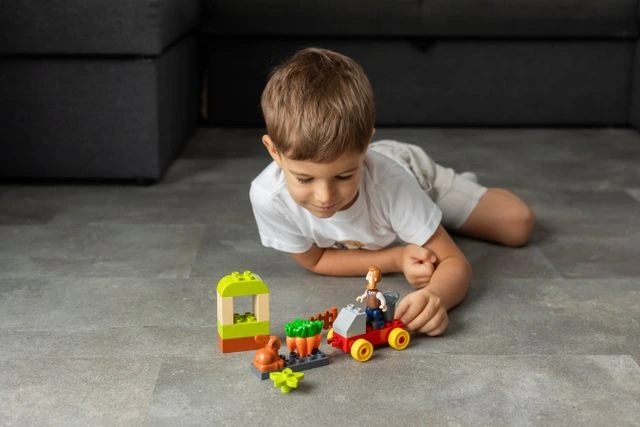
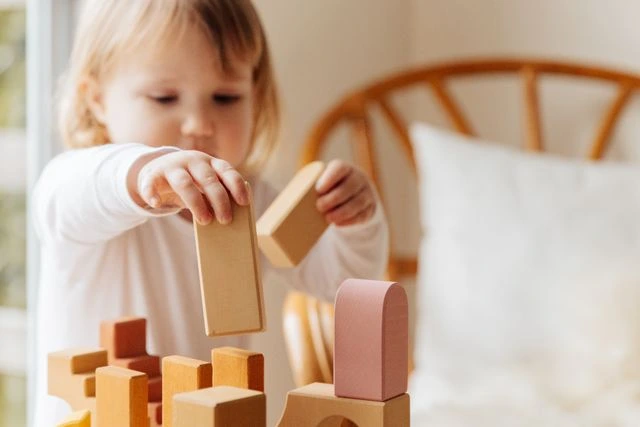
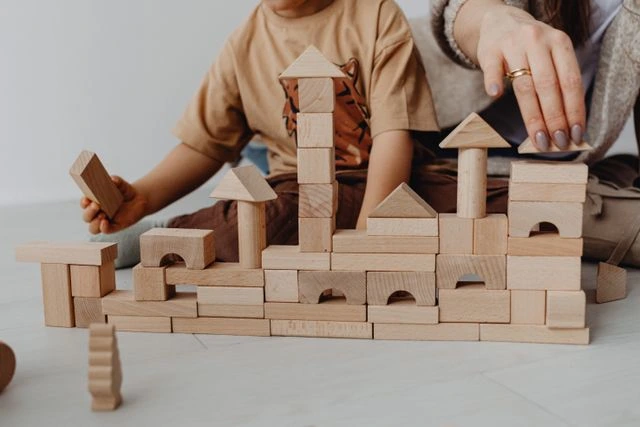
Unit blocks — the classic hardwood blocks in standard proportions that fit together in specific ratios — have the longest research base of any educational toy material. Studies from the 1930s onward have documented their contributions to spatial reasoning, mathematical thinking, symbolic play, and social development when used collaboratively. Children who have significant experience with unit blocks show advantages in mathematics, spatial reasoning, and executive function that persist into school years. They are worth buying well and maintaining — good quality blocks last for decades.
Loose parts — the broad category of miscellaneous objects, natural and manufactured, that can be combined and reconfigured in unlimited ways — have accumulated significant research interest since architect Simon Nicholson first proposed the “theory of loose parts” in 1972. Nicholson’s insight was that the degree to which an environment offers loose parts — materials that can be moved, combined, redesigned, and used for multiple purposes — is directly related to the degree to which it stimulates creativity and inventive thinking. The research that has followed has supported this consistently: children with access to rich loose parts environments show higher levels of creative play, more complex problem-solving, and more sustained engagement than those in environments where everything has a prescribed use.
The most useful loose parts for different ages vary, but include natural materials (sticks, stones, shells, pinecones), simple containers (tubes, boxes, jars), fabric and rope, and manufactured objects without prescribed use (spools, corks, bottle caps). None of these cost anything significant. All of them produce richer play than most purpose-built educational toys.
Clay and dough — real clay where possible, good quality modelling dough otherwise — provide the three-dimensional, tactile, open-ended engagement that builds the specific fine motor and spatial capacities that two-dimensional flat surfaces cannot. A child working with clay is making real decisions about three-dimensional form — decisions that require and develop spatial reasoning in ways that drawing or flat building do not.
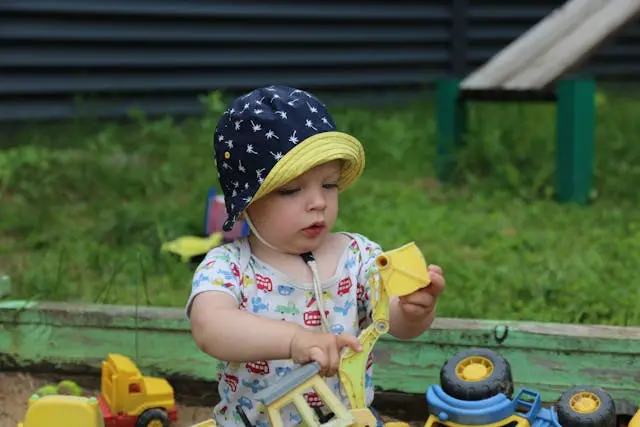
Sand and water — when access is possible — are among the most open-ended materials available to young children, and among the most researched in terms of their developmental contributions. Water play in particular has consistent evidence for contributions to early scientific thinking, mathematical concepts (volume, measurement, buoyancy), and sensory regulation. A sand and water table is one of the most developmentally versatile investments available for a young child.
What to Do With the Toy Collection You Already Have
This is where most discussions of open-ended play become impractical, because most families already have a significant collection of closed and semi-closed toys, and the argument for open-ended play does not require getting rid of everything that has ever been purchased.
A more useful frame is proportion and priority. The question is not whether to have any closed toys, but what proportion of the play environment is open-ended versus closed, and what gets prioritised when new toys are considered.
The toy rotation principle — keeping a smaller number of toys available at any time rather than the full collection simultaneously — serves open-ended materials particularly well. A basket of blocks that is always available is more likely to be used regularly than one that has to be located and retrieved from a cupboard. An art materials table that is set up and accessible produces more art than one where everything has to be assembled before play can begin. Reducing friction — the effort required to start playing with something — consistently increases engagement with that thing.
The toy shelf approach, derived from Montessori principles, suggests keeping a small, rotating selection of materials visible and accessible on low shelves, rather than stored in toy boxes where they become buried and invisible. The theory is simple and the practice consistently supported: children play with what they can see and reach. Materials that are invisible are materials that are not used.
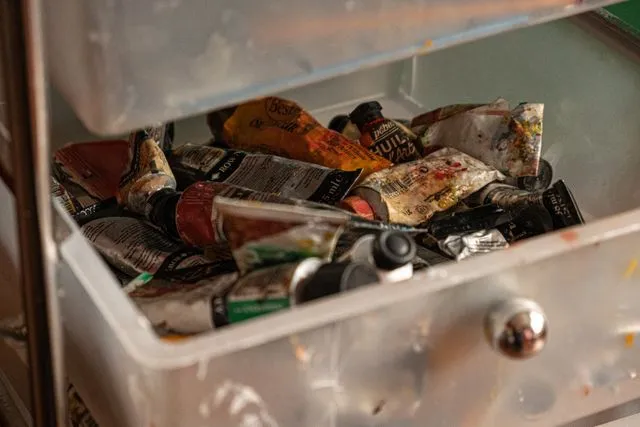
For the specific developmental value of art materials as one of the most powerful open-ended play resources — and the practical guidance on what materials are worth having and how to make them consistently accessible — the article on why the art supplies in the back of the drawer matter more than you think covers this in depth. And for the specific case of construction toys — including why LEGO, unit blocks, and other construction systems do what they do in the developing brain — the article on what LEGO is actually teaching your child provides the complementary analysis for that specific material type.
The Toy Shopping Question
Most families buy toys for birthdays and holidays, responding to marketing, peer comparison, and the child’s stated preferences. The child who wants the specific electronic toy that everyone else has is expressing a legitimate social desire, not a developmental need. And overriding it entirely, in the name of open-ended play principles, is neither realistic nor advisable.
What is worth doing is developing a set of questions that bring a different lens to toy selection — not to eliminate closed or electronic toys, but to ensure that the collection overall is weighted toward the materials that produce the deepest developmental engagement.
How many ways can this be used? A toy that can be used in three ways will be played with more, and more developmentally richly, than one that can be used in one. The number of possible uses is a better predictor of sustained engagement than any marketing claim about developmental value.
Who does the work — the toy or the child? A toy that does more is a toy that requires less of the child. A toy that requires more — more imagination, more problem-solving, more decision-making — builds more. The toy that impresses at first and is abandoned within a week has typically done most of the work itself. The toy that seems simple but gets used for years has typically required the child to provide most of the work.
How long will this be interesting? The toy appropriate for a three-year-old but not a five-year-old has a two-year window. The toy that a three-year-old and a seven-year-old use differently but both genuinely — that toy is significantly better value, in developmental and financial terms.
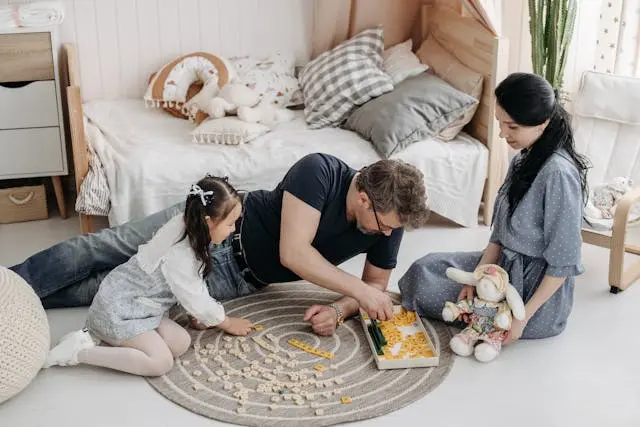
Does it work with other things? Open-ended materials are most powerful in combination. Blocks that combine with loose parts, art materials, and imaginative play produce richer play than any of these in isolation. A toy that works with everything else the child has extends the play possibilities of the whole environment rather than simply adding another discrete activity.
| Age | Most Valuable Open-Ended Materials | Why |
|---|---|---|
| 6 to 18 months | Nesting cups, simple wooden rings, fabric scarves, everyday household objects | Sensory exploration; object permanence; cause and effect through physical manipulation |
| 18 months to 3 years | DUPLO or large unit blocks; simple loose parts; water and sand; modelling dough; crayons and paper | Beginning symbolic play; construction; sensory development; early mark-making |
| 3 to 5 years | Unit blocks; art materials; clay; loose parts collection; simple fabric and rope; sand and water | Symbolic play peak; spatial reasoning development; creative combination; collaborative play |
| 5 to 8 years | Standard LEGO; unit blocks; art and making materials; loose parts; craft materials | Complex construction; narrative play; rule invention; creative problem-solving |
| 8 years and above | LEGO Technic; complex art materials; craft kits that leave outcomes open; natural building materials | Engineering thinking; sustained projects; creative agency; increasing technical complexity |
The Digital Question
No discussion of open-ended play in the contemporary context can avoid the question of digital open-ended experiences — the creative sandbox games, the digital building platforms, the apps that allow children to make and arrange things on screen.
Some of these have genuine open-ended qualities. Minecraft is the most obvious example — a game in which the child builds whatever they can imagine, in an essentially unlimited world, following no prescribed narrative or outcome. The research on Minecraft’s developmental value is mixed but more positive than most screen content, and its open-ended building dimension genuinely shares some qualities with physical construction play.
What digital open-ended play does not provide is the physical, tactile, three-dimensional engagement that physical open-ended play provides. The child who builds a city in Minecraft is doing something genuinely imaginative and spatially complex. The child who builds the same city with blocks is also building finger strength, hand-eye coordination, the felt experience of physical weight and balance, the understanding of three-dimensional space that comes from touching and manipulating it rather than representing it on a flat screen.
Physical open-ended play and digital open-ended play are not identical, and for young children in particular, the physical matters in ways that the digital does not fully replicate. For older children, a combination — physical making alongside creative digital experiences — covers the developmental territory more completely than either alone.
What Simple Toys Teach That Money Cannot Buy
I want to end with something that goes beyond the developmental science, because the building block principle is ultimately about something more than cognitive outcomes.
A child who has spent significant time with simple, open-ended materials has had a particular kind of experience that shapes something about how they relate to the world. They have learned, through repeated embodied experience, that interesting things can be made from simple components. That problems can be generated and solved without anyone else setting the problem. That an hour of genuine absorption can come from things that cost almost nothing and ask nothing of the world except some space and some time.
These are not trivial learnings. They are, in some respects, the most important learnings available in childhood. The adult who has them — who knows how to generate their own engagement, who can be absorbed in something for its own sake, who does not need external stimulation to feel interested in the world — has something that no amount of elaborate entertainment produces and that simple play builds, quietly, over years.
The blocks on the shelf are not failing to be exciting. They are doing exactly what they are doing: waiting for the child to bring something to them, and giving everything back.
Frequently Asked Questions
What makes a toy “open-ended”?
An open-ended toy can be used in multiple ways, with no single prescribed correct use or outcome. The child defines how it is used and what it becomes. Examples include unit blocks, loose parts, clay, sand, water, plain fabric, and simple art materials. The key characteristic is that the child generates the activity rather than responding to the activity the toy prescribes.
Are electronic toys bad for children?
Not bad, but they develop different things than open-ended toys — and the difference matters. Electronic toys tend to be at the closed end of the spectrum, with prescribed interactions and finite interaction spaces. They can teach specific content and develop specific skills. What they do not typically develop are the self-generative, imaginative, and executive function capacities that open-ended play builds. A balanced collection that includes both is better than an exclusively electronic one.
My child says they are bored with the simple toys. What should I do?
Boredom with simple toys is usually a sign that the child has not yet developed the habit of open-ended play — that they are waiting for the toy to tell them what to do and the toy is not doing it. Rather than immediately providing alternatives, try sitting nearby and playing with the materials yourself, without directing the child. Your engagement often triggers theirs. Introducing the materials in combination with other things — blocks with small figurines, art materials with loose parts — can also open new possibilities. The capacity to generate open-ended play is built through practice, and children who have not had much practice may need more initial scaffolding before it becomes self-sustaining.
How many toys should a child have?
Less than most children in most households currently have. Research on toy density — the amount of toys available in a play environment — consistently finds that more toys does not produce more or better play. A classic study by researchers at the University of Toledo found that toddlers played more creatively and with more sustained engagement when they had four toys available than when they had sixteen. The toys available to them at any one time matters more than the total collection size. Toy rotation — cycling toys in and out of use — maintains novelty without accumulating a quantity that fragments attention and reduces the depth of engagement with any individual material.
What is the most developmentally valuable toy I could buy for a young child?
A good set of unit wooden blocks — hardwood, in standard proportions, enough of them to build something substantial. They have the longest research base of any educational toy material, the widest age range of genuine use, and the broadest developmental contributions. They are not exciting and they do not make noise and they have no batteries. And they are consistently found, in research studies and in the direct observation of development professionals, to produce the deepest and most sustained engagement of any toy material available. The plain, simple, do-nothing blocks. Every time.
Should I spend more money on better toys or the same money on simple materials?
The same money on more simple materials, almost always. A larger set of unit blocks, more varied loose parts, better quality art materials — these produce more developmental value than the equivalent expenditure on complex, purpose-built toys. The developmental value of a toy correlates much more strongly with its openness and simplicity than with its price. The most expensive toys in the educational toy market are frequently the ones with the most prescribed uses and therefore the least developmental depth. The least expensive — the blocks, the loose parts, the modelling clay — are frequently the most developmentally significant.
Younes Kehal is an educational director, certified school coach, and certified life coach with 20 years of experience working with children, families, teachers, and schools. His guidance combines practical educational experience with carefully reviewed research.