
Your Child Is Bored. Good. Here’s Why Boredom Might Be the Most Underrated Tool in Your Parenting Kit.
“I’m bored.”
Two words that produce, in most parents, an immediate and almost reflexive response. The reaching for a screen, or a suggestion, or an activity. The slight anxiety about whether the child should be doing something. The background guilt about not having provided enough stimulation, enough structure, enough of whatever it is that prevents children from feeling this particular feeling.
I want to challenge that response. Not the guilt — that is understandable and almost universal — but the assumption underneath it. The assumption that boredom is a problem. That it is something to be fixed. That a child who is bored is a child who is not getting what they need.
The evidence on boredom and child development points in a different direction. Boredom, it turns out, is not the absence of something valuable. It is the presence of something valuable. And the rush to eliminate it — the immediacy with which contemporary childhood fills every available moment with stimulation, activity, and entertainment — is costing children something that they cannot easily get back once it is gone.
This article is about what boredom actually does, why it matters, and what happens when children are never allowed to experience it.
Table of Contents
What Is Actually Happening When a Child Is Bored
Boredom is not, neurologically speaking, an absence of brain activity. It is a specific kind of brain activity — one that researchers have only recently begun to understand properly, and whose importance they have significantly underestimated.
When a person is bored — when there is no immediate external demand on their attention — the brain shifts into what neuroscientists call the default mode network. This is a set of brain regions that become active during undirected thought: daydreaming, mind-wandering, self-reflection, and spontaneous mental association. For a long time, this network was considered a kind of neural background noise — what the brain does when it is not doing anything important.
Research over the past two decades has comprehensively overturned that view. The default mode network is now understood to be critical for some of the most sophisticated cognitive processes the brain performs: creative thinking, problem-solving by analogy, the integration of disparate ideas, self-understanding, and the simulation of future scenarios. Far from being idle, the bored brain is doing some of its most important work.
For children specifically, this matters enormously. The unstructured mental time that boredom creates is when imagination develops. It is when children develop the internal capacity to generate their own entertainment, their own narrative, their own direction for the next hour. A child who is never bored — whose every moment is structured or stimulated — is a child who never gets the practice of being the source of their own engagement. And that practice matters.
The Research on Boredom and Creativity
The connection between boredom and creativity is one of the more counterintuitive findings in developmental psychology, but it is consistent enough to take seriously.
A series of studies by researchers at the University of Central Lancashire found that participants who were made to perform a boring task before a creativity test produced significantly more creative responses than those who went directly to the creativity task. The boredom, the researchers concluded, had triggered the kind of diffuse, associative thinking that creative problem-solving requires — thinking that focused, stimulated attention tends to suppress.
Similar findings have emerged in research specifically on children. Children who have significant amounts of unstructured time — who are not in scheduled activities, who have stretches of time with nothing in particular to do — show higher levels of creative play and self-generated activity than those with heavily scheduled days. The boredom that parents worry about is, in the research, a precursor to exactly the kind of creative engagement that parents want to cultivate.
There is an irony here that is worth sitting with. The parents who fill their children’s schedules most completely — out of concern about stimulation, development, not wasting the childhood years — are often the parents whose children have the least capacity for self-generated activity. Because that capacity is built in the stretches of unstructured time that the schedule eliminates.
A child who is bored and left to be bored — not immediately rescued from the feeling, not handed a screen, not enrolled in another activity — is a child who is, through the discomfort of that experience, developing something that structured activities cannot produce: the ability to be the author of their own engagement.
What Children Do When They Are Allowed to Be Bored
I have spent twenty years watching children in educational settings, and I want to describe what actually happens when a child who says “I’m bored” is not immediately rescued from that state.
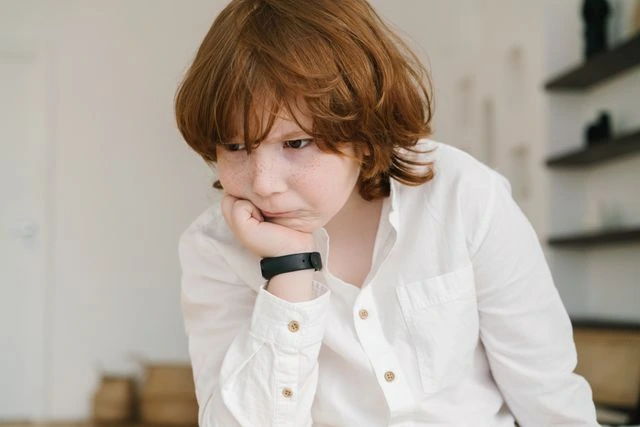
The first ten to fifteen minutes are the hardest. The child protests. They come back repeatedly to express that they are bored, in case the adult did not hear it the first time. They try the most obvious, lowest-effort options — the screen they are usually allowed, the parent’s attention, the path of least resistance. If none of these is available, they hover. They move around. They pick things up and put them down.
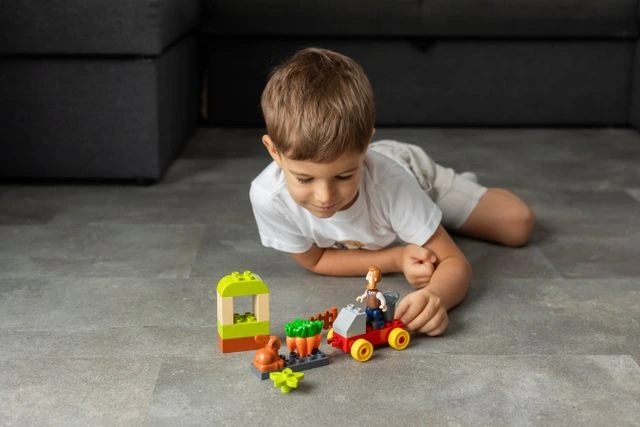
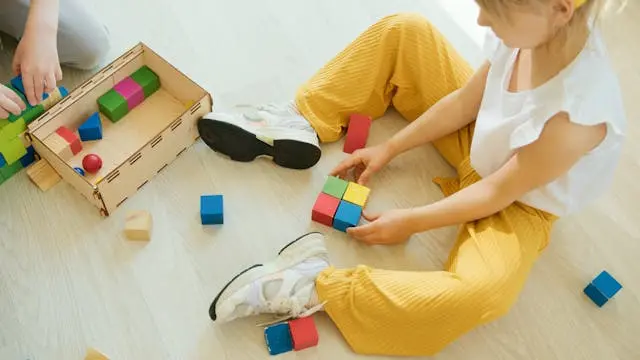
And then — not always, but often, and consistently enough to be worth noting — something shifts. The child settles into something. Not the something that the parent would have suggested. Something that emerged from the child’s own meandering attention. A game they invented. A project that has no product. A story they are telling themselves. An extended and elaborate construction that serves no purpose except the one the child has given it.
This is the play that no educational toy produces. It comes from the inside rather than from an external prompt. And it tends to be, in my observation, more absorbing and more sustained than almost any structured activity, because the child is invested in it in a way that externally provided entertainment rarely achieves.
Not every child gets there every time. Some children, particularly those who have been heavily scheduled for years, have lost the tolerance for the discomfort of boredom. They have not developed the internal resources to fill unstructured time because they have never had to. For these children, the tolerance has to be built gradually — short periods of unstructured time that expand as the child develops the capacity to manage them.
| Phase | What the Child Does | What Is Happening Neurologically | Developmental Value |
|---|---|---|---|
| Initial discomfort (0–15 minutes) | Protests; seeks external rescue; tries familiar options | Transition from active attention to default mode network activation | Frustration tolerance; beginning of self-regulation without external support |
| Restless exploration (15–30 minutes) | Moves around; picks things up; tries multiple options without committing | Default mode network active; diffuse associative thinking beginning | Curiosity without direction; building internal attentional resources |
| Self-generated engagement (30+ minutes) | Settles into self-initiated activity; often deeply absorbed | Internally generated attention; creative and associative thinking active | Intrinsic motivation; creativity; imagination; capacity for deep engagement |
The Problem With Always Having a Solution
Contemporary childhood is extraordinarily well-stocked with solutions to boredom. Screens, of course — which provide immediate, high-stimulation entertainment that eliminates the discomfort of boredom within seconds. But also extracurricular activities, structured playdates, educational programmes, and the general tendency toward scheduling that characterises middle-class childhood in many countries.
None of these things are wrong in themselves. Screens, activities, and structured learning all have genuine value. The problem is the totality — the degree to which boredom has been so thoroughly eliminated from childhood that children have never had to develop any relationship with it at all.
A child who has never been bored has never had to discover that they can tolerate boredom. Has never learned that the discomfort of boredom passes, and that what often follows it is genuinely engaging. Has never developed the internal attentional resources that unstructured time builds. Has never had the experience of being the origin of their own entertainment, which is one of the most important experiences of childhood.
What this produces, in adolescence and adulthood, is a person with low tolerance for unstructured time and an almost compulsive need for external stimulation. The teenager who cannot be alone without a screen. The adult who cannot sit in a waiting room without checking their phone. The person who has never learned to be comfortable in their own company — because they were never required to practice it.
This is not a small thing. The capacity to be alone, to tolerate unstructured time, to generate engagement from internal rather than external sources, is associated with higher creativity, better emotional regulation, greater resilience, and more genuine autonomy. It is built in childhood, in the spaces that boredom creates. When those spaces are systematically eliminated, the capacity is not built.
The Overscheduling Question
I want to spend some time on this because I think it is the practical implication that parents most need to hear, and also the one that produces the most resistance.
Most parents of school-age children, if they are honest, have more activities in the weekly schedule than they are entirely comfortable with. The gymnastics class, the music lesson, the tutoring session, the sports training. Each individual activity was chosen for good reasons. Each has genuine value. Together, they produce a schedule that leaves very little room for the unstructured time that this article is arguing for.
The pressure to schedule comes from multiple directions simultaneously. The anxiety about whether the child is keeping up academically and socially. The competitive awareness of what other children in the cohort are doing. The genuine belief that activities are good for children — which they are, in appropriate amounts. And the practical reality that a child who is in a scheduled activity is a child who is safe and supervised, which solves a problem that unstructured outdoor time used to solve but no longer reliably does in many urban and suburban environments.
I am not going to suggest that all the activities be cancelled. That is not realistic, and many of them are genuinely valuable. What I want to suggest is a more deliberate audit of the schedule — not with the goal of eliminating activities, but with the specific goal of protecting unstructured time as a category of experience that the child needs, rather than treating it as what is left over after everything else has been scheduled.
If a child has at least two afternoons per week with no structure — no activity, no supervised playtime, no educational programme — just time to be in the house or the garden or the neighbourhood with nothing particular required of them, that is a meaningful provision of the boredom-space that this article is describing. Two afternoons. That is not a radical prescription. But for many families, achieving it requires a conscious decision to protect those afternoons against the constant pressure to fill them.
| Age Group | Recommended Unstructured Time Per Day | What It Should Look Like | What to Avoid |
|---|---|---|---|
| Under 5 years | The majority of the day outside of meals, sleep, and care routines | Child-led play; minimal adult direction; access to simple materials | Over-scheduling; screen replacement for boredom; constant adult-initiated activity |
| 5 to 8 years | Minimum 1–2 hours daily outside structured activities and homework | Outdoor play; imaginative play; self-chosen activities without adult agenda | Back-to-back scheduled activities; screens as default boredom solution |
| 8 to 12 years | Minimum 1 hour daily; 2+ unstructured afternoons per week | Child-chosen activities; social play without adult organisation; solitary exploration | Fully scheduled days; academic enrichment in every available slot |
| 12 years and above | Daily downtime; weekend periods without scheduled demands | Self-directed time; includes low-stimulation activities like reading, music, being outside | Screens as the only unstructured option; no protected downtime from performance demands |
Screens Are Not the Same as Boredom
This is the point where I have to be most direct, because it is the one that is most frequently misunderstood.
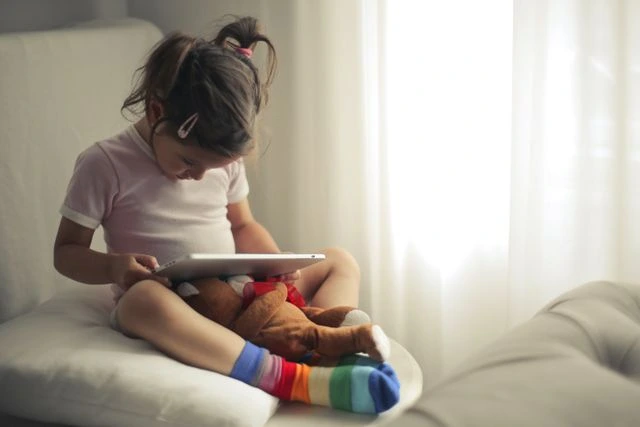
Giving a child a screen when they are bored does not solve the boredom. It bypasses it. And bypassing boredom is not the same as providing what boredom offers.
Screen entertainment — even good screen entertainment — is, from the brain’s perspective, incoming stimulation. It is external. It demands the child’s attention and provides its own direction, its own narrative, its own reward. The child is a consumer of the experience rather than the generator of it. The default mode network, which is what boredom activates, is suppressed rather than engaged.
This does not make screens harmful in themselves. Screens are not harmful in reasonable quantities and with appropriate content. But using screens specifically to eliminate boredom — as the reflexive answer to “I’m bored,” every time, immediately — trains a child to outsource their engagement to an external source rather than generating it internally. And that outsourcing becomes increasingly compulsive over time, because the internal capacity to generate engagement is never developed.
The child who is given a screen every time they are bored learns that boredom is solved by screens. The child who is allowed to be bored, and who survives the discomfort of it and finds their own way through it, learns something more durable: that boredom is temporary and that they have the internal resources to resolve it themselves.
That is a different relationship with the feeling — and a different relationship with their own capacity — that pays dividends across a lifetime.
What Parents Can Do
The practical answer to “my child says they’re bored” is simpler than it might seem, once you have accepted the underlying argument.
The response that serves them best is something like: “I hear you. What do you think you could do?” Not providing the answer. Not reaching for the screen. Not organising an activity. Reflecting the problem back to the child with confidence — the confidence that they have the capacity to resolve it, which they do, even if they have not been required to demonstrate it recently.
You may need to hold the line for some time. The child will come back. They will say they cannot think of anything. You can respond with mild curiosity: “Hmm. What about your [blocks / art things / the garden]?” Not instruction. A light suggestion, offered and then withdrawn, that leaves the decision back with the child.
What you are not doing is solving the problem for them. And that restraint — that willingness to let them sit in the discomfort long enough to find their own way out — is one of the most developmentally important things you can offer.
It also helps to ensure that the environment contains materials that reward exploration without requiring instruction. The art supplies on the table rather than in the cupboard. The box of miscellaneous objects that has no prescribed use. The outdoor space that has enough in it to invite investigation. These things do not tell the child what to do. They create conditions in which the child can discover what to do — which is the whole point.
For a fuller picture of how open-ended materials support the kind of self-generated play that boredom makes possible — and why they consistently outperform purpose-built educational toys in terms of genuine engagement — the article on why children abandon toys and what it tells you covers the underlying principles in depth. And for the specific developmental power of art materials as one of the most fertile environments for boredom-to-creativity transitions, the article on why drawing and making things matters more than parents think is worth reading alongside this one.
The Long-Term Argument
I want to end with something that might seem slightly abstract but that I think is the most important point in this article.
The capacity to tolerate boredom is not just a childhood skill. It is a lifelong one. And it is a capacity that is increasingly rare and increasingly valuable — precisely because the world has become so extraordinarily effective at eliminating boredom that the people who have learned to exist without constant stimulation have access to an inner life that those who have not are missing.
Creative people — writers, artists, scientists, inventors, anyone whose work requires the generation of genuinely new ideas — almost universally describe a relationship with unstructured time and mind-wandering that produced their work. The shower thought. The long walk. The period of apparent inactivity that preceded a breakthrough. These are not incidental. They are the default mode network doing what it does — and the capacity to access that network, to tolerate the boredom that precedes it, is built in childhood in the spaces between activities.
A child who has been raised in an environment that tolerates and even encourages boredom is a child who is developing an inner life. Who is learning to be their own company. Who is building the internal attentional resources that will eventually allow them to sit with a problem long enough to find a genuinely novel solution. Who is, in the stretches of apparent emptiness, actually filling up.
That is not nothing. That is, arguably, one of the most important things a childhood can provide.
So the next time your child says they are bored, and the reflex to fix it rises immediately — pause. Take a breath. And consider that what they are actually saying is that the conditions are in place for something valuable to happen. They just do not know it yet. And your job is not to prevent it. It is to trust it enough to let it.
Frequently Asked Questions
Is it okay to let my child be bored?
Not only okay — genuinely beneficial. Boredom activates the brain’s default mode network, which supports creative thinking, imagination, self-reflection, and the capacity to generate internal engagement. A child who is sometimes bored and left to resolve that boredom themselves is developing cognitive and emotional resources that heavily scheduled, constantly stimulated children often do not. The discomfort of boredom is temporary. What it builds is not.
How long should I let my child be bored before stepping in?
As long as it takes for them to find their own way through it — which typically happens within twenty to forty minutes, once the child has discovered that rescue is not coming and that they are capable of finding something themselves. This feels longer than it is. The resistance in the first ten to fifteen minutes is usually the worst of it. Stepping in before the child has had a genuine chance to resolve the boredom themselves short-circuits exactly the process that makes the experience valuable.
My child says there is nothing to do. How do I respond?
With calm confidence rather than problem-solving. “I hear you. What do you think you could try?” is a better response than immediately suggesting activities. If the child genuinely needs a prompt, a light and non-directive one — “What about your art things?” — is fine. The key is that the suggestion is offered and then the choice is returned to the child. You are not organising their time. You are giving them the confidence that they can organise it themselves.
Is screen time a reasonable solution to boredom?
As a consistent, default solution, no — because it bypasses boredom rather than letting the child move through it and out the other side. Screens provide external stimulation that suppresses the default mode network activity that boredom enables. A child who is always given a screen when bored never develops the internal capacity to resolve boredom themselves. Screens have their place in childhood. That place is not as the reflexive answer to “I’m bored.”
My child has been heavily scheduled for years and cannot tolerate unstructured time. What do I do?
Build the tolerance gradually. Start with shorter periods of unstructured time — twenty to thirty minutes — rather than expecting a child who has never had to manage boredom to suddenly manage hours of it. Keep the environment interesting but not prescriptive: materials available, outdoor access if possible, no immediate alternative offered. Gradually extend the periods as the child’s tolerance develops. The capacity is buildable at any age, but it takes longer for children who have had less practice.
How is healthy boredom different from concerning boredom?
Healthy boredom is episodic, resolves into self-generated activity, and is associated with normal mood and energy. Concerning boredom is persistent, does not resolve even with time and freedom, is accompanied by flat affect, loss of interest in everything including previously enjoyed activities, and is part of a pattern of withdrawal and disengagement. The second pattern is not boredom in the developmental sense — it is more likely a mood or mental health signal that deserves attention. If your child seems persistently unable to engage with anything, including things they previously enjoyed, that warrants a conversation with a paediatrician or mental health professional rather than an approach of waiting for boredom to resolve itself.
Younes Kehal is an educational director, certified school coach, and certified life coach with 20 years of experience working with children, families, teachers, and schools. His guidance combines practical educational experience with carefully reviewed research.