The Instrument in the Corner — Why Learning Music Does Something to Your Child’s Brain That Nothing Else Does
It has been in the corner for three months. The small guitar, or the keyboard, or the violin in its case — whatever it was that your child absolutely had to have, begged for with genuine passion, and now regards with the mild guilt of something once loved and quietly abandoned. You have stopped mentioning it, mostly because every time you do, the conversation ends in negotiation about practice and nobody enjoys it.
I want to make an argument for bringing it back out of the corner. Not because your child is going to be a musician — they may not be, and that is entirely fine. But because what happens in a child’s brain when they are learning to play an instrument is so specific, so well-documented, and so difficult to replicate through any other activity, that it deserves a conversation that goes beyond “it would be good for you.”
Music instruction appears to accelerate brain development in young children, particularly in the areas responsible for processing sound, language development, speech perception, and reading skills, according to a five-year USC study. And a review of multiple studies published in the National Institutes of Health found that benefits of musical training extend beyond the skills it directly aims to train and last well into adulthood — into verbal memory, reading ability, executive function, and even IQ in young adulthood.
These are not modest findings. They are among the most consistent results in developmental neuroscience — and they are almost entirely unknown to the parents who are making decisions about whether that instrument comes back out of the corner.
Table of Contents
What Happens in the Brain When a Child Learns Music
To understand why music is neurologically unique, you need to understand what the brain is actually doing when a child plays an instrument. It is, quite simply, doing more than it does during almost any other activity available to children.
Playing an instrument requires the brain to simultaneously process visual information — reading notation, watching their hands — auditory information — the sound they are making, whether it matches what they intended — and motor information — the precise coordination of hands, fingers, breath, or embouchure to produce the intended sound. The prefrontal cortex is engaged in planning and decision-making. The auditory cortex is processing sound. The cerebellum is managing movement and coordination. The hippocampus is forming and retrieving memories. And the corpus callosum — the structure connecting the brain’s two hemispheres — is orchestrating all of it simultaneously.
Research has found that the corpus callosum of musicians is thicker and more fully developed than in non-musicians — reflecting the extraordinary cross-hemisphere communication that musical performance demands. And a USC neuroscience study found that within two years of musical training, the auditory systems of children in the music program were maturing faster than in children who were not learning music — a difference visible in brain structure, not just in behavior or performance.
This is not metaphorical. Musical training is physically changing the developing brain — building it faster, connecting it more richly, and producing structural differences that persist well beyond childhood.
The Six Things Music Builds That Have Nothing to Do With Music
1. Reading and Language — More Than Any Other Academic Support
The connection between musical training and language development is one of the most replicated findings in developmental neuroscience — and one of the most practically important for parents.
Children who study music tend to have larger vocabularies and more advanced reading skills than their peers who do not participate in music lessons. Children who engage in musical training show enhanced linguistic skills, including improved vocabulary and reading comprehension. This happens because music and language share overlapping neural networks in the brain — the same auditory processing pathways that allow a child to distinguish between musical pitches are the pathways used to distinguish between speech sounds, which underpins phonological awareness — the foundational skill for reading.
A child who is learning to read sheet music is simultaneously strengthening the neural architecture for reading words. A child who is trained to hear the difference between a C and a C-sharp is training the same system that will help them distinguish between similar phonemes — the foundation of decoding. This is not a coincidence. It is a direct neurological relationship.
For children who struggle with reading — including those with dyslexia, as we discussed in our article on supporting children with learning disabilities — musical training is an increasingly recognized complement to specialist literacy support. The auditory processing training that music provides strengthens precisely the phonological pathways that dyslexia affects.
2. Mathematics — Through a Different Door
The relationship between music and mathematics is equally well-documented and equally counterintuitive in its depth. Music is, at its structural core, mathematics made audible: rhythm is division and fractions, scales are ratios, harmony is relationships between frequencies. A child learning to count beats, read time signatures, and understand rhythmic notation is encountering mathematical concepts in a context that is engaging, embodied, and immediately meaningful.
Children who receive music education tend to perform better in academic subjects like mathematics and language arts. And a multilevel meta-analysis published in the National Institutes of Health found that musical training enhances working memory capacity — the cognitive resource most closely associated with mathematical reasoning and problem-solving.
The mechanism here is working memory: the ability to hold information in mind while simultaneously processing and manipulating it. Sight-reading music requires holding the upcoming notes in memory while playing the current ones. Keeping a steady rhythm while adjusting for dynamics requires processing multiple streams of information simultaneously. These are precisely the cognitive demands that build the working memory capacity that mathematics requires.
3. Executive Function — Built Through Practice Itself
Learning to play an instrument is, at its core, a sustained exercise in executive function. Planning a practice session. Breaking a piece into manageable sections. Identifying where the errors are and targeting those specific passages. Maintaining focus for the duration of a practice session. Evaluating one’s own performance honestly and adjusting accordingly.
Every one of these demands the same cognitive skills — planning, monitoring, inhibition, cognitive flexibility — that research identifies as the strongest predictors of academic success and life outcomes. As we discussed in our article on how play builds executive function, the activities that most effectively develop these skills are those that require children to engage them voluntarily, in pursuit of a goal they care about. Learning a piece of music they genuinely want to play is one of the most powerful available contexts for this.
And unlike most executive function training programs, music comes with an intrinsic reward — the sound of the music itself, the piece that eventually sounds right, the performance that lands. That intrinsic reward sustains the engagement that makes the executive function development possible over years rather than weeks.
4. Emotional Intelligence and Self-Expression
Music is one of the oldest and most universal human tools for emotional expression — and learning to play it gives children access to that tool in a direct, personal, and uniquely powerful way. Music provides an outlet for self-expression, helping children process and articulate their emotions. Music training strengthens emotional and behavioral regulation.
For children who struggle to find words for what they feel — including those with social communication differences, as we noted in our article on understanding sensory processing disorder, music offers an alternative expressive pathway that language cannot always provide. The child who can play what they feel has access to emotional expression that the child who can only talk about feelings does not.
Beyond expression, musical performance requires emotional engagement — the musician must connect with the emotional content of the piece to communicate it. This ongoing practice of emotional recognition, interpretation, and expression builds the emotional intelligence that underpins empathy, social connection, and the ability to understand and communicate one’s own inner life.
5. Discipline, Persistence, and the Growth Mindset
Learning to play an instrument is one of the few activities in a child’s life that comes with the guarantee of sounding bad before it sounds good — and requiring sustained effort, regular practice, and tolerance for imperfection before competence arrives. Playing a musical instrument strengthens eye-hand coordination and fine motor skills, and kids who study an instrument learn a lot about discipline, dedication, and the rewards of hard work.
This is not incidental. It is central to the developmental value of musical training. In a world that increasingly offers children instant gratification and rapid feedback — the video game that provides rewards in seconds, the social media that delivers approval immediately — music is one of the few remaining activities that requires a genuinely long runway between beginning and competence. The child who stays with an instrument through the early weeks of producing sounds they find embarrassing, who keeps practicing until the piece begins to sound like what they intended, who performs something they have worked on for months — that child has experienced something increasingly rare: the earned satisfaction of a long-term investment in genuine skill.
That experience builds a relationship with effort and mastery that transfers into every other domain of the child’s life. The research is explicit: learning to play an instrument as a child may even predict academic performance and IQ in young adulthood.
6. Social Connection and Belonging
Music is inherently social. The child who plays in an ensemble, who participates in a school band or orchestra or choir, who jams informally with a friend or a family member — that child is experiencing music as a shared human activity that connects people across differences in ways that few other activities do.
The social context of musical education is an important yet neglected factor affecting the long-term benefits of musical training. Playing music with others requires the listening, the responsiveness, the timing, and the mutual attunement that underpin the most important social skills. A child who has played in a group — who has had to match their tempo to others, who has had to listen as well as play, who has experienced the particular satisfaction of making something together that neither could make alone — has had an experience of human connection that is both deeply enjoyable and deeply developmental.
When to Start — and Why Earlier Is Better
The research on timing is consistent and important. The first three years of life are critical for optimal brain development, for music, and for learning through music. And it is found that no one has been able to acquire absolute pitch after age ten — one of the clearest examples of a critical period in musical development, but also a marker of the broader principle that musical training has greater structural impact on the brain the earlier it begins.
This does not mean that musical training begun at twelve or fifteen produces no benefits — it does. But the degree of structural and functional adaptation in the brain correlates with both the intensity and the timing of musical initiation due to sensitive periods during development. The brain that begins musical training at five is being shaped at a time of maximum neurological plasticity. The structural changes — the thicker corpus callosum, the more developed auditory cortex, the more richly connected language networks — are more dramatic and more durable when training begins early.
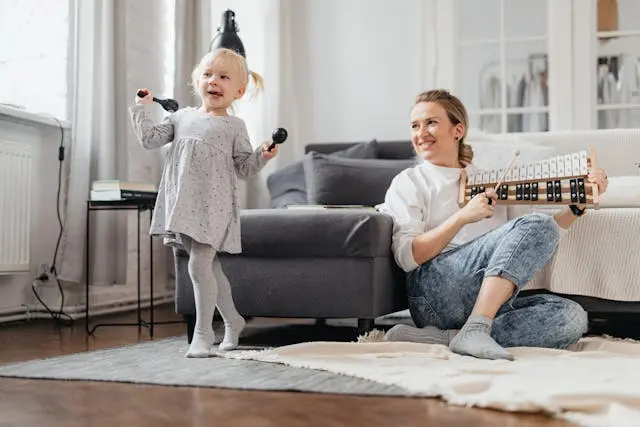
For young children, musical engagement does not need to be formal instrument lessons. Singing together, moving to music, exploring percussion with household objects, listening to a wide variety of musical styles with genuine attention — all of these engage the musical brain in ways that lay the foundation for formal training when the child is developmentally ready. Most specialists suggest that formal instrument lessons are most productive from around age six or seven, when children have the attention span, the fine motor control, and the reading readiness that formal musical training requires.
Choosing the Right Instrument — and the Right Approach
Not all instruments are equally appropriate at all ages, and the choice of instrument has a significant impact on whether a child persists with musical training or abandons it within a few months. Here are the considerations that research and practical experience consistently identify as most important.
| Instrument | Best Age to Start | Key Considerations |
|---|---|---|
| Piano / Keyboard | 5–7 years | The ideal foundation instrument — keys are visual, the relationship between notes is immediately visible, and piano skills transfer to all other instruments. Most music theory is taught through piano. |
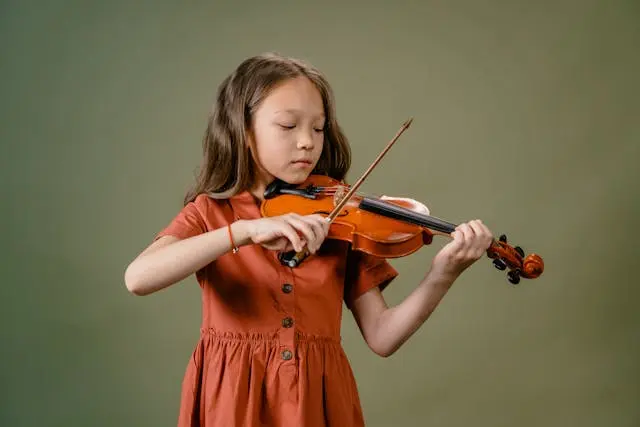
| Violin / Viola | 4–6 years (child-sized instruments available) | Exceptional for early development — requires intense bilateral coordination. The Suzuki method, designed specifically for young beginners, is highly effective. Produces initially challenging sounds that improve rapidly with good teaching. |
| Guitar | 7–9 years | Highly motivating for children who love popular music. The initial finger soreness on steel strings can deter beginners — classical or nylon-string guitar is gentler. Produces satisfying sounds relatively quickly. |
| Drums / Percussion | 6–8 years | Exceptional for rhythm development and bilateral coordination. Immediately satisfying for children with physical energy. Practice pads allow quiet home practice before a full kit is needed. |
| Wind instruments | 8–10 years (lung development) | Recorder is an excellent and underrated introduction at 6–7. Flute, clarinet, saxophone from around 8–10. Develops breath control and contributes significantly to lung capacity. |
| Voice / Singing | Any age — always | The original instrument — available to every child at no cost. Singing together from the earliest age builds musical ear, language development, and emotional connection. Never too early, never too late. |
The most important principle in choosing an instrument is not developmental appropriateness — it is the child’s genuine interest. A child who is passionate about the drums will practice the drums. A child who has been assigned the violin because it is good for them and does not care about the violin will not practice the violin for long. Involve the child in the choice, where you can. Let them encounter different instruments — through YouTube, through concerts, through friends’ instruments — before committing. The instrument they choose because they want to play it will be in their hands rather than the corner.
The Practice Problem — and How to Solve It
Every parent of a child learning an instrument knows the practice problem: the child who was enthusiastic about the instrument is considerably less enthusiastic about the daily practice that makes progress possible. And the parent who pushes practice creates conflict; the parent who does not push practice sees no progress; and either way someone ends up frustrated.
The research offers some clarity here. Motivation, reward, and social context of musical education are important yet neglected factors affecting the long-term benefits of musical training. And a 2019 study found that children who practiced music for just 20 minutes a day demonstrated better memory recall in both verbal and visual tasks. Twenty minutes. Not an hour, not a punishing daily session — twenty consistent minutes.
What makes practice sustainable:
- Make it short and consistent rather than long and sporadic. Twenty minutes every day produces far more progress and far less conflict than a two-hour session once a week. Build practice into the daily routine at a consistent time — before dinner, after school, before screens — so it becomes automatic rather than negotiated each day.
- Let the child choose what to practice within the session. A child who has some control over which piece they work on, which passage they target, what they want to try — is significantly more engaged than one who is simply told what to do for twenty minutes.
- Sit with them sometimes, without directing. Parental presence — without advice, without correction, simply with genuine interest — communicates that what they are doing matters. It also gives you something to genuinely compliment: not “good job” but “I could hear the difference in that passage from yesterday.”
- Celebrate audible progress, not just effort. The moment when a piece that sounded wrong begins to sound right is intrinsically motivating — make sure you notice and name it. “That sounds so different from last week — you can really hear the work you put in.”
- Keep the goal connected to music they love. A child who is working toward playing a song they genuinely love has a motivational engine that formal exercises and scales alone cannot provide. Ask the teacher to incorporate music the child is genuinely excited about alongside the necessary technical work.
Music Without Lessons — What Even Non-Instrument Families Can Do
Not every family is in a position to afford instrument lessons or to provide the time and support that learning an instrument requires. The developmental benefits of musical engagement, however, are not exclusively available to children in formal lessons.
Daily music experiences can make many valuable connections to children’s language capabilities, memory, physical activity, creative thinking, emotional stability, and emerging academic success. Singing together. Dancing to music. Listening actively — not as background noise, but with attention, talking about what you are hearing. Playing percussion with household items. Exposing children to a wide range of musical styles from the earliest age. Attending live music — even informal community performances.
These are not substitutes for the neurological development that sustained instrument training produces. But they are genuinely valuable, they are accessible to every family, and they build the musical ear and the musical relationship that makes formal training more effective when it does become possible.
Singing, in particular, is available to every family at no cost and produces remarkable developmental benefits. Children who grow up in households where singing is a regular part of daily life — lullabies, songs in the car, singing along to music during cooking — are developing phonological awareness, musical pitch, and the emotional relationship with music that underpins everything else.
The Bigger Picture: What Music Is Really Teaching
I want to close with something that the research does not capture — because the most important things rarely are.
A child who learns to play music is learning that some things worth having require a long time to acquire. That the sound you make today will be different from the sound you make in six months, if you keep at it. That there is a particular kind of satisfaction — deeper and more durable than anything instant gratification offers — in producing something beautiful through sustained effort. That music, the thing itself, is one of the most profound expressions of what it means to be human — a way of communicating that exists alongside language and sometimes reaches further than language can.
These are not small lessons. And they arrive not through instruction but through the lived experience of sitting with an instrument, working at something difficult, and discovering — slowly, imperfectly, with more starts and stops than anyone planned for — that you can make something that did not exist before you made it.
That is worth bringing the instrument back out of the corner for.
Summary: What To Remember
- Music instruction physically changes the developing brain — accelerating development in areas responsible for language, sound processing, and reading skills, with structural differences visible in brain scans.
- The benefits extend far beyond music itself: stronger reading and vocabulary, enhanced mathematical reasoning, improved executive function, emotional intelligence, discipline, and social connection.
- Earlier is better — the brain’s neurological plasticity means that musical training begun in early childhood produces greater and more lasting structural changes than training begun later.
- Twenty consistent minutes of daily practice produces measurably better outcomes than sporadic longer sessions — and significantly less family conflict.
- The child’s genuine interest in the instrument is the most important factor in whether training persists long enough to produce lasting benefits. Involve them in the choice.
- Motivation, social context, and enjoyment are the neglected factors most associated with long-term benefit from musical training.
- Families without formal lessons can still access significant musical benefits through daily singing, active listening, and musical engagement at home.
- The corpus callosum of musicians is measurably thicker — reflecting the extraordinary cross-hemisphere brain communication that musical performance requires and builds.
- The deeper lesson of music is the relationship with sustained effort, with earned mastery, and with the creation of something beautiful through patience and practice — a lesson that transfers into every domain of a child’s life.
Younes Kehal is an educational director, certified school coach, and certified life coach with 20 years of experience working with children, families, teachers, and schools. His guidance combines practical educational experience with carefully reviewed research.