
Your Child Asked You If the Planet Is Dying: How to Answer Honestly Without Terrifying Them
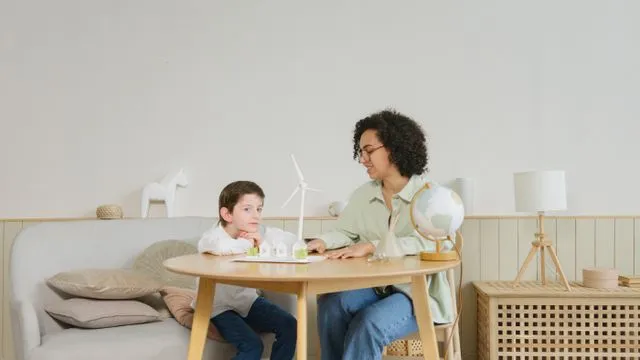
It comes out of nowhere. In the car, usually. Or at dinner. Or just before bed, when the child has clearly been turning something over for a while and has finally decided to ask.
“Is the planet going to die?”
Or: “Is climate change going to kill all the animals?”
Or, in the more direct version that younger children sometimes produce: “Are we going to be okay?”
And the parent is suddenly somewhere they did not expect to be — trying to formulate, in real time, an honest response to one of the most complicated questions of the twenty-first century, calibrated to a child of seven or ten or twelve, in a way that is neither a lie nor a catastrophe.
Most parents handle this badly. Not through lack of care — through lack of preparation and through the competing pressures of the moment. The most common responses are at the extremes. Either the reassurance that closes the conversation: “Don’t worry, it’ll be fine.” Or the unloading that produces the opposite of reassurance. Both miss the child. Both miss the opportunity.
This article is about what to say instead.
Table of Contents
What the Child Is Actually Asking
When a child asks whether the planet is dying, they are rarely making a purely informational inquiry. The question has a subtext that is almost always emotional. What they are really asking is: “I have encountered information that frightens me, and I need to know whether the fear is appropriate and whether I am safe and whether the adults around me are aware of this.”
Before answering any content, the most useful thing a parent can do is briefly acknowledge the emotional reality behind the question. “That sounds like something you’ve been thinking about. What made you start wondering about it?” This gives the parent more information about what the child actually knows and is concerned about, and it signals that their feelings are as worth attending to as the question itself.
What the child has usually encountered, by the time they ask this question, is something — a news report, a school conversation, a documentary, a social media post — that was not calibrated for their age and was not accompanied by the emotional scaffolding that makes frightening information manageable. They have received the information without the context. The parent’s job is to provide both the context and the emotional scaffolding that was missing.
The Honesty Problem
Parents are caught between two legitimate commitments that pull in opposite directions.
The first is honesty. Children deserve truthful responses to genuine questions. A parent who tells a child “it’ll all be fine” when they themselves believe that significant damage is being done to the planet is misleading — and children often know it. Protection through dishonesty tends to backfire: children who discover they were told comfortable untruths lose trust in the parent as a reliable source of information.
The second is the child’s wellbeing. Research on climate anxiety in children finds that those exposed to detailed, graphic, hopeless accounts of climate damage show significantly higher rates of anxiety and depression than those who received accurate but context-rich information. The content matters. But the framing matters more.
The resolution is not to choose between honesty and protection. It is to be honest in the right way — accurate about what is happening, honest about the uncertainty, and deliberate about framing the information within a context that includes human agency, collective action, and the genuine possibility of better outcomes.
What the Research on Climate Communication Says
The most consistently supported finding in climate communication research is that hopeless framing is counterproductive. Information about climate change delivered without any account of what can be done, who is doing it, and what has already been achieved, produces paralysis rather than engagement. This is true for adults. It is even more true for children.
Research by Caroline Hickman and colleagues, published in The Lancet in 2021, found that the emotional factors most associated with better wellbeing in climate-aware young people were a sense of agency (“I can do something”), social connection (“I am not facing this alone”), and positive future orientation (“a better future is possible”). These are not corrections of facts. They are emotional conditions that determine how the same factual information is processed.
The implication is clear: the emotional architecture of the conversation matters as much as its factual content. A child who leaves feeling informed but helpless has not been served. A child who leaves feeling informed, not alone, and with some sense that they have a meaningful relationship to what is happening has been served.
What Is Actually True — The Honest Version
The honest answer to “is the planet dying?” is something like this:
The planet itself is not dying. What is genuinely happening is that human activity — primarily the burning of fossil fuels — has increased the concentration of greenhouse gases in the atmosphere, which is warming the planet. This warming is real, measurable, and producing changes that are genuinely harmful to many ecosystems, many species, and many communities of people.
These changes are serious. Some of them — the loss of certain species, the acidification of parts of the ocean, the displacement of people due to sea level rise and extreme weather — are already happening and will not be reversed in any human lifetime.
And: the trajectory is not fixed. The amount of warming that happens depends on decisions that human societies make about energy, land use, and consumption over the coming decades. The difference between a two-degree warming and a four-degree warming is significant and real, and what happens in the coming decades matters enormously for which trajectory we end up on.
This is not optimism. It is an accurate description of the situation. The honest answer includes both the genuine seriousness of what is happening and the genuine significance of what human beings are doing in response.
What Children Can Handle at Different Ages
Young children — under approximately seven years — have limited capacity for abstract systemic thinking. A conversation about climate change with a five-year-old should focus on what they can observe directly — weather patterns, animals struggling, ice melting — and should be accompanied by concrete, immediate actions that connect their own life to the response. The abstract global picture is not appropriate developmental content at this age.
School-age children — roughly seven to eleven — can understand systemic causation and engage with collective action at a simple level. They can understand that energy comes from burning things, that burning things produces gases that warm the atmosphere, and that people are working on ways to get energy without burning things. They can engage with age-appropriate information about climate action.
Adolescents can engage with full complexity — the scale of the problem, the inadequacy of current responses, the specific political and economic forces slowing progress, and the genuine uncertainty about outcomes. The support they need alongside accurate information is not protection from complexity but engagement with agency.
| Age Group | What Children Can Understand | What to Focus On | What to Avoid |
|---|---|---|---|
| Under 7 years | Concrete, visible, immediate effects; simple cause and effect | Observable changes; simple actions the child can take; nature connection | Abstract statistics; catastrophic projections; hopeless framing |
| 7 to 11 years | Systemic causation; collective action; what people are doing | How climate change works simply; human response and innovation; family action | Graphic worst-case scenarios; hopeless framing; detail beyond their capacity |
| 11 to 14 years | Complex systems; political dimensions; range of outcomes | Full picture with honest acknowledgment of difficulty; agency and action | Hopeless framing; dismissive minimisation; information without agency |
| 14 years and above | Full complexity; scientific uncertainty; political failure | Honest engagement with complexity; individual and collective agency; emotional support alongside information | Dismissing their distress; pretending the situation is fine |
What Children Can Actually Do
One of the most important things a parent can do in this conversation is connect the child to a sense of meaningful agency — not placing adult responsibility on children’s shoulders, but giving them a genuine role in the response rather than leaving them as passive spectators.
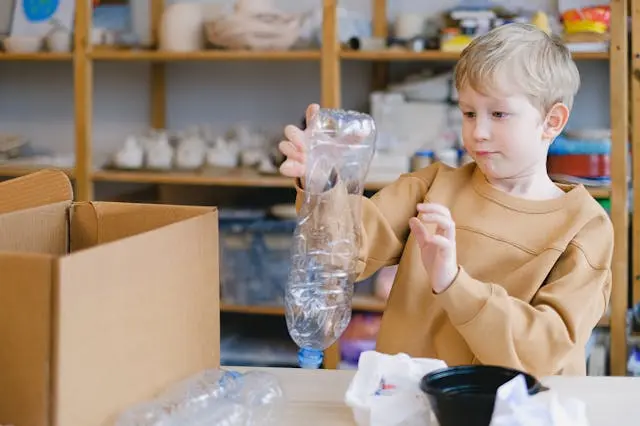
For young children, the actions worth highlighting are concrete, immediate, and positively framed: turning off lights, eating more plants, choosing to walk, reducing waste, growing things, learning about nature. These give the child an embodied sense of participation — of their choices being part of a meaningful pattern — that protects against the helplessness that produces climate anxiety.
For older children and adolescents, the conversation can expand to include collective action — the fact that young people have historically been powerful agents in social change, and that the specific political choices made in coming decades will significantly shape outcomes. This is not a call to burden children with adult responsibilities. It is an accurate account of why their voice and participation matter.
| Action | Best Age to Introduce | Environmental Impact | Psychological Benefit |
|---|---|---|---|
| Turning off lights; not wasting water | 3 to 4 years | Modest but real | Strong sense of agency; habit formation |
| Growing food; composting | 4 to 6 years | Moderate | Connection to living systems; visible impact |
| Reducing meat consumption; buying secondhand | 7 to 10 years | High | Values alignment; meaningful choice |
| Community involvement; advocacy; voting when eligible | 12 years and above | Potentially very high | Collective efficacy; social connection |
Your Own Climate Feelings — and Why They Matter
Parents who are themselves anxious about climate change sometimes find this conversation the hardest. They are not sure they can provide the emotional scaffolding the child needs because they themselves find the hopelessness/hope balance difficult.
A parent who is genuinely distressed and trying to hide that distress in order to appear calm is communicating something the child can feel even when it is not being said. The parent who says “it’ll be fine” in a tone that does not match the words is not reassuring the child. They are confusing them.
A parent who can genuinely model a relationship with climate anxiety — who can say “I find this scary sometimes too, and I have found ways to act rather than just worry” — is providing something more valuable than false calm. They are modelling that difficult feelings are manageable and that meaningful action is possible in the presence of those feelings. This is exactly what the child needs to see.
If your own climate anxiety is significant — if it is affecting your daily functioning or your ability to have productive conversations — resources like the Climate Mental Health Network provide specific support for people experiencing significant eco-anxiety, including guidance for parents navigating these conversations from a place of their own distress.
The Conversation After the Conversation
The conversation about whether the planet is dying is not a single conversation. It is the beginning of an ongoing one that will evolve as the child’s understanding, the world’s situation, and the family’s engagement all develop.
The most valuable outcome of the first conversation is not that the child now has correct information about climate change. It is that the child has learned that this is a topic that can be discussed with the adults in their life — that the question was received, that the feelings behind it were acknowledged, that honest and thoughtful engagement was possible. That opens the door to every subsequent conversation.
The parent who said “I don’t know — let’s think about that together” has done something more valuable than the one who delivered a perfect climate briefing. They have established themselves as a thinking partner in the child’s ongoing encounter with the world’s most complicated ongoing problem. That partnership is what the child actually needed from the conversation. Everything else follows from it.
For the daily habits and choices that give children an embodied sense of participation in the environmental response — which is one of the most effective protections against the helplessness that drives anxiety — the article on building eco-friendly family habits covers the practical landscape. And for the specific energy and consumption conversations that give children concrete understanding of their family’s own environmental impact, the article on using the energy bill as a teaching tool provides complementary practical approaches.
Frequently Asked Questions
My child is very young — should I tell them anything about climate change at all?
At under five, climate change as a concept is not developmentally accessible and is not worth introducing directly. What is appropriate is building a positive relationship with the natural world — time outside, attention to living things, the beginning of environmental habits — that will provide the foundation for later conversations. If the child asks a question prompted by something they overheard, answer it simply and concretely, and do not introduce more than the question asks for.
My teenager says climate change is hopeless and they do not want to have children. How do I respond?
With genuine engagement rather than dismissal or forced optimism. This is a real feeling that many young people are experiencing and it deserves to be taken seriously. Ask what they have been reading or thinking about. Listen to what they say about why hope feels unavailable. Then offer the perspective that the full picture is genuinely more complex than the hopeless framing — not that everything will be fine, but that the outcome is not determined and human choices in the coming decades matter significantly. If the hopelessness is accompanied by depression or significant mental health difficulty, that warrants professional attention.
My child has seen something online that has really scared them. What do I do?
Start with the feeling rather than the information. “That sounds like it really worried you. Tell me what you saw.” Then, once you understand what specifically scared them, you can provide context — which might include correcting inaccuracies, providing the missing hopeful frame, or simply acknowledging that the thing they saw represents real concerns that people are actively working on.
What do I say to the child who blames our generation for the problem?
Honestly, and without defensiveness. The critique has some validity — the choices made by governments and industries over the past fifty years have been consequential. At the same time, most individuals have had limited control over the systemic forces that have driven emissions. “You’re right that things needed to change sooner. Here is what I have done and what I am doing now” is a more honest and more productive response than either defensiveness or complete acceptance of blame.
Is climate anxiety in children a serious mental health issue?
For most children, climate concern is a normal response to real information about a real situation and does not constitute a clinical mental health problem. For a smaller number of children and adolescents, climate anxiety has reached a level genuinely interfering with daily functioning — persistent intrusive thoughts, inability to engage with future planning, significant depression. This level of distress warrants professional attention, in the same way that any other significant anxiety warrants it. The climate-specific dimension does not make it less real or less treatable.
Should I involve my child in climate activism?
If the child is interested and the involvement is age-appropriate, yes. Research on the benefits of environmental action for children’s wellbeing is consistent: participation in meaningful environmental activity is associated with better wellbeing and less climate anxiety. The key is that the involvement is genuine rather than performative, and that it is the child’s own rather than something the parent is requiring.
Younes Kehal is a Professional Educational Director and School Coach with over 20 years of experience working directly with children, families, and educational institutions. The guidance published on Parenting Assist is rooted in real field experience and evidence-based developmental science.