
Fast Fashion and Your Child: How to Talk About Clothes, Consumption, and Why What We Wear Matters
Imagine a teenager coming home pleased with a bag of inexpensive clothes. A parent wants to discuss how those clothes were made and how long they might last, without turning the conversation into criticism of the teenager’s taste or budget.
This is an illustrative situation, not a personal family anecdote. It raises a useful question: how can you talk about buying clothes while taking both affordability and the teenager’s preferences seriously?
Start with curiosity about the purchase. Then explore practical choices such as checking quality, caring for clothes, repairing an item, or trying secondhand options when they fit the family’s needs.
This article is an attempt to give you that. Not a script, but a framework — for understanding the issue well enough to discuss it honestly, for finding the entry points that make the conversation productive rather than defensive, and for building a relationship with clothing and consumption in your household that is grounded in something more than habit.
Table of Contents
What Fast Fashion Actually Is
Fast fashion is a business model, not just a category of cheap clothing. The model is built on the rapid production of high volumes of trend-driven garments at the lowest possible cost, sold at prices that assume the garments will be worn a small number of times and then discarded. It emerged as a distinct industry model in the 1990s and has accelerated dramatically in the 2000s and 2010s with the rise of online retail and social media-driven trend cycles.
The traditional fashion industry operated on two seasons a year — spring/summer and autumn/winter. Fast fashion brands introduced the concept of “micro-seasons” — some now produce as many as fifty-two collections per year, one per week, ensuring that what was purchased last month already feels dated. This is a deliberate design: the business model depends on consumers buying continuously rather than investing in durable items that they wear for years.
The environmental costs of this model are substantial. The fashion industry is responsible for approximately 10% of global carbon dioxide emissions annually — more than aviation and maritime shipping combined. It is the second-largest consumer of fresh water in the world. It produces 20% of global wastewater from dyeing and treatment processes. And it generates an estimated 92 million tonnes of textile waste per year, much of which ends up in landfill in the Global South, in countries that have received these exports without the infrastructure to manage them.
These are not contested facts. They are figures cited by the United Nations Environment Programme, the World Bank, and a consistent body of industry research. The fashion industry itself acknowledges them, though its response to them has so far been largely inadequate relative to the scale of the problem.
Why Children and Teenagers Are the Target Audience
The fast fashion industry is not incidentally appealing to young people. Young people are its primary market, and the industry’s business model is specifically designed around the social and developmental vulnerabilities of adolescence.
Adolescents are developmentally in the process of constructing their identity, and clothing is one of the most accessible and socially legible tools for that construction. What you wear communicates group membership, aesthetic preference, values, status — all things that matter enormously during a developmental period when belonging and differentiation are central psychological preoccupations. The fast fashion industry provides an apparently unlimited palette for this identity work at prices that are affordable even on pocket money.
Social media has turbocharged this dynamic. The combination of visible social comparison (what my peers are wearing), trend acceleration (what is “in” changes constantly), and the influencer economy (aspirational figures wearing new things constantly, at least partly because they are paid to) creates conditions in which the desire to participate in fashion feels both urgent and unending. The teenager who bought something last month has already seen it appear on a hundred feeds and feels its moment has passed.
Understanding this dynamic — not to dismiss it, but to name it — is the first step toward being able to talk about it productively with a teenager. The desire to use clothing as a tool of identity construction is not shallow or wrong. The industry’s exploitation of that desire, and the environmental cost of the business model built around it, is what deserves scrutiny.
What Children and Teenagers Do Not Know About Clothing
The knowledge gaps around clothing production are even more profound than those around food production, and that is saying something. Most children have no idea where their clothes come from, how they are made, who makes them, or what the conditions of that production are.
They do not know that the vast majority of fast fashion garments are produced in factories in Bangladesh, Cambodia, Vietnam, and similar countries, by workers — predominantly women — who are paid wages that typically amount to a small fraction of a living wage, working in conditions that range from difficult to genuinely dangerous. The 2013 Rana Plaza factory collapse in Bangladesh, which killed 1,134 garment workers, was the most visible tragedy produced by these conditions, but it was not an isolated incident.
They do not know that polyester — which constitutes the majority of fast fashion fabric — is a plastic, derived from fossil fuels, that does not biodegrade. Every wash of a polyester garment releases microplastics into the water system. Every polyester garment that ends up in landfill will remain there for hundreds of years. The cheap dress that felt like a bargain has a material cost that outlasts the pleasure of owning it by decades.
They do not know that the “natural” alternatives — cotton, in particular — have their own significant environmental footprint. Cotton is one of the most water-intensive crops in agricultural production, and conventional cotton farming uses significant quantities of pesticides and herbicides. Organic cotton is significantly better on these measures, but represents a small fraction of total cotton production.
This is not information designed to produce guilt. It is information that makes a choice a choice rather than a default — that transforms a purchase from a thoughtless transaction into a decision made with awareness of its context.
| Item | Approximate Water Used in Production | CO₂ Emissions | End-of-Life Issue |
|---|---|---|---|
| Cotton t-shirt | ~2,700 litres | ~2.1 kg CO₂ | Biodegradable but often landfilled before decomposition |
| Pair of jeans | ~7,000–10,000 litres | ~33 kg CO₂ (full lifecycle) | Typically landfilled; denim takes decades to break down |
| Polyester dress | Lower water use in production | ~5 kg CO₂ (fossil fuel derived) | Does not biodegrade; sheds microplastics in every wash |
| Wool jumper | Moderate | Higher than cotton due to methane from sheep | Biodegradable; durable if well-maintained |
| Secondhand garment (any) | Zero additional production water | Zero additional production emissions | Extends existing item’s useful life; defers landfill |
How to Have the Conversation Without Losing Your Teenager
The conversation about fast fashion is one that goes wrong very easily. Most of the ways it goes wrong follow a predictable pattern: the parent leads with environmental information, the teenager experiences this as a lecture or a judgment of their choices, and the conversation closes before it has produced anything useful.
The conversations that work follow a different pattern. They start with curiosity rather than information. They acknowledge the genuine appeal of what the industry offers before critiquing it. They distinguish between the individual and the system — making clear that the problem is not the teenager’s desire for affordable, on-trend clothing, but the industry’s exploitation of that desire and the production model built around it. And they offer agency — not the agency of self-denial, but the agency of informed choice.
The specific entry point matters. For some teenagers, the labour dimension is the most compelling — the human story of who made the garment, under what conditions, for what pay. For others, the environmental dimension is more engaging. For others still, the durability argument — the observation that a well-made garment bought secondhand for the same price as a new fast fashion item will last ten times as long and ultimately cost far less — is the most practically persuasive.
Finding which entry point resonates with your specific teenager requires listening before talking. Asking what they think about where their clothes come from, rather than telling them, often produces more genuine engagement than the reverse.
The labour conversation
For the teenager who is interested in justice and fairness — which many adolescents are, in the way that moral development at this age tends to be — the story of who made their clothes and under what conditions is often the most powerful entry point. The average garment worker in Bangladesh earns approximately $95 per month — less than 3% of the retail price of the garment in a Western market. The documentary “The True Cost” — freely available on many streaming platforms — makes this human reality visible in a way that abstract statistics do not.
This conversation does not require the teenager to feel guilty. It requires them to know. What they do with the knowledge is their decision. The parent’s job is to make the information available in a way that is honest and non-accusatory.
The quality conversation
This is the least charged entry point and often the most practically persuasive. Fast fashion garments are made to a price point that produces genuinely inferior quality — thin fabric, poor construction, colours that fade, seams that give. The teenager who has experienced this — who has bought something that fell apart after three washes, or faded after two — already has first-hand evidence of the trade-off between price and quality.
The observation that a well-made garment — whether new from a responsible brand or secondhand from a charity shop or vintage market — lasts significantly longer and ultimately costs less per wear than a series of fast fashion replacements, is a financial argument rather than a moral one. For some teenagers, this reframe is more accessible than the environmental or labour frames.
The identity conversation
This is the most sophisticated entry point and the one most likely to produce lasting change, because it addresses the deepest driver. The fast fashion industry sells not just clothes but the promise of identity — the suggestion that wearing the right things, following the right trends, consuming the right content, produces a self that is adequate and belonging and on point.
Helping a teenager see through this — not in a dismissive way, but in a genuinely curious way — involves asking questions rather than making declarations. “What do you love about your style when you’re wearing it?” “What makes you feel most like yourself?” “Is there a way to dress that feels like you rather than like the trend?” These questions take the conversation away from what the industry wants to sell and toward the teenager’s own relationship with self-expression through clothing.
A teenager who has developed a strong, personal sense of their own style — who chooses clothes because they genuinely like them, because they express something real about themselves, rather than because they are what everyone is wearing this week — is a teenager who is significantly less susceptible to the fast fashion model’s constant churn. Style is more protective than guilt.
What Families Can Actually Do
The structural solution to fast fashion is regulatory and industrial — mandatory supply chain transparency, living wages for garment workers, extended producer responsibility for textile waste. These are important and worth advocating for. They are also not within the direct control of individual families.
What individual families can do falls into two categories: reducing the quantity of new clothing purchased, and making more thoughtful choices about what is purchased when new purchases are necessary.
Buy less and better
The most impactful individual action on clothing’s environmental footprint is reducing the total quantity of new garments purchased. Not eliminating new clothing purchases — that is neither realistic nor necessary. But shifting from a high-volume, low-price, high-churn model to a lower-volume, higher-quality, longer-lasting model. The garment that costs three times as much but lasts ten times as long and is worn regularly rather than once is genuinely a more environmentally and financially sensible choice, once the calculation is made explicit.
Involving children and teenagers in this calculation — helping them understand their actual cost-per-wear for different purchases — builds financial literacy alongside environmental awareness. “This jacket costs £80 and will last five years if we look after it, so it costs about £16 per year. This one costs £20 but will need replacing in six months, so it costs £40 per year” is a concrete, financially grounded argument that most teenagers can engage with.
Embrace secondhand
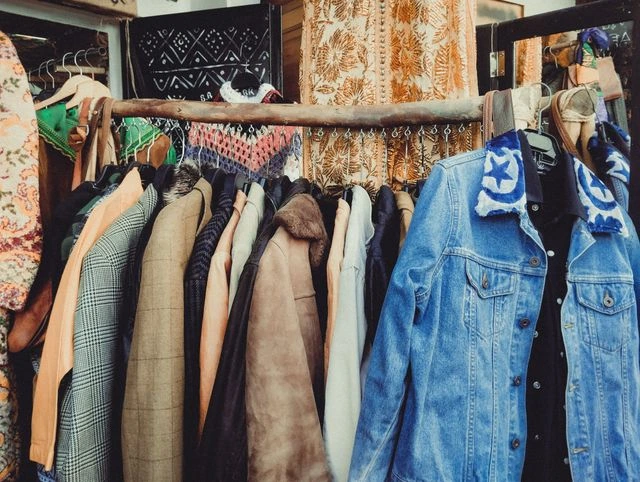
Secondhand clothing is the single most effective individual action available in the clothing space, because it produces zero additional production environmental cost while extending the useful life of an existing garment. The cultural shift toward secondhand — driven partly by economic necessity, partly by environmental awareness, and partly by the aesthetic appeal of vintage and unique items — has been significant among younger generations, and the growing infrastructure of apps, markets, and charity shops makes secondhand increasingly accessible.
For families who have established a secondhand habit in other areas, extending it to clothing is natural. For families who have not, starting with one category — children’s clothes, which are outgrown so quickly that new purchases are particularly wasteful, or books, or accessories — makes the habit more approachable before it becomes a broader household norm. The article on how buying secondhand changed our family covers the practicalities and the mindset shift in depth.
Care for what you have
The environmental footprint of a garment is significantly affected by how long it is kept and how it is maintained. Washing at lower temperatures, washing less frequently, line drying rather than tumble drying, repairing minor damage before it becomes irreversible — these practices extend the life of garments significantly and reduce the environmental cost of the washing itself. Teaching children to care for their clothes as a basic life skill — how to wash, how to repair a seam or a button, how to store things properly — is both practically useful and contributes to a different relationship with clothing as something worth maintaining rather than replacing.
| Action | Environmental Impact | Difficulty to Implement | Best Starting Point |
|---|---|---|---|
| Buy secondhand instead of new | Very high — eliminates production impact | Medium — requires habit and infrastructure change | Children’s clothing (outgrown quickly; secondhand near-new) |
| Reduce total quantity purchased | High — fewer garments produced | Medium to high — requires behaviour change | Capsule wardrobe approach; cost-per-wear calculation |
| Choose better-made, longer-lasting items when buying new | Moderate to high — fewer replacements needed | Medium — higher upfront cost | One category at a time (e.g. jeans, footwear) |
| Wash at lower temperatures | Moderate — reduces energy and microplastic release | Low — simple habit change | Immediately implementable |
| Repair rather than replace | Moderate — extends garment life | Low to medium — requires basic skills | Simple repairs: buttons, seams, hems |
| Donate or sell rather than discard | Moderate — keeps items in use | Low — minimal effort once habit established | Immediately implementable |
The Broader Value Behind the Conversation
I want to end with something that goes beyond the specific issue of fast fashion, because I think the clothing conversation is really a proxy for a broader conversation about consumption and value that is one of the most important things a family can have.
Contemporary consumer culture — in which the default response to almost any desire or discomfort is a purchase, in which the volume of what we own has expanded dramatically while the satisfaction produced by ownership has not, in which the environmental and human cost of production is systematically obscured from the people doing the consuming — is something that children who grow up without ever questioning it are poorly prepared for. The teenager who buys eighteen euros of synthetic clothing and feels briefly happy and then, within weeks, feels the urge to buy more, is inside a system that has been deliberately designed to produce exactly this pattern.
The parent who is willing to name that system — who can say “this is how it works and here is what it is doing” — is giving their teenager something genuinely valuable. Not the guilt. Not the restriction. The understanding. The ability to see the mechanism rather than simply being inside it. That understanding does not necessarily produce different choices immediately. But it produces something more important over time: a person who chooses deliberately rather than defaults automatically, who knows what their choices cost and what they mean, and who has a basis for a different relationship with consumption than the one the market is working hard to install.
That is the conversation worth having. It begins with the pile of synthetic clothes on the bed. It ends somewhere quite different.
Frequently Asked Questions
How do I bring up fast fashion without sounding preachy?
Start with curiosity rather than information. Ask what they know about where their clothes come from before telling them. Find the entry point that connects to something they already care about — justice, money, their own style identity — rather than leading with the environmental data. And acknowledge what is genuinely appealing about what the industry offers before critiquing it. The conversation that starts with “I understand why this feels like a good deal” is received very differently from one that starts with “do you know what this costs the planet.”
My teenager only wants to wear specific brands or styles. How do I navigate this?
Acknowledge the social reality first. Clothing and belonging are genuinely connected for teenagers, and dismissing the social dimension is dismissing something real. Then explore it: what specifically about the brand or style appeals? Is it the aesthetic, the social signal, the quality? Often the underlying desire can be met in ways that do not require new fast fashion purchases — vintage, secondhand, or better-made alternatives that hit the same aesthetic note. Finding these alternatives together, as a collaborative project rather than a parental veto, is more likely to succeed than prohibition.
Is it hypocritical to talk to my teenager about fast fashion if I still buy it myself?
Honest engagement with a topic you are still navigating is not hypocrisy. It is accurate self-representation. “I’m trying to think differently about this too — here is what I’m working on changing” is a more productive opening than either silence (pretending there is no issue) or a position of authority you cannot actually sustain. Teenagers respond much better to honest imperfection than to performed virtue they can see through.
What are some good alternatives to fast fashion for teenagers on a limited budget?
Charity shops and secondhand apps (Vinted, Depop, ThredUp) are the most accessible. Many teenagers find the hunt for interesting secondhand pieces more creatively satisfying than buying from the same fast fashion sites as everyone else. Clothing swaps — with friends or through organised community events — are free and produce variety without production cost. For specific items that are better bought new, looking for sale periods at more ethical brands, or investing in one well-made item rather than several cheap ones, shifts the model without requiring a prohibitive budget.
Does what I buy really make a difference given the scale of the industry?
Individual purchasing decisions matter in two ways: directly, by reducing demand that would otherwise drive production, and indirectly, by being part of a broader cultural shift that influences industry behaviour and regulatory environment. The fashion industry is responding to consumer pressure — the growth of secondhand, the demand for transparency, the increasing scrutiny of greenwashing — more than it would without it. Individual action is not sufficient to solve the problem on its own. It is a necessary part of the collective response. And it is the only part within your direct control.
My child says “it doesn’t matter what I do, companies are the real problem.” How do I respond?
They are partially right, and saying so makes the conversation more productive. Systemic change — regulation, supply chain transparency, extended producer responsibility — matters more than individual consumer choices at scale. Both things can be true: companies bear primary responsibility and individuals have some meaningful agency within the system. The either/or framing — either individual action matters or systemic change does — is a false choice. Both are necessary. Engaging with both — making thoughtful individual choices while also caring about the policy and regulatory environment — is the coherent position.
Younes Kehal is an educational director, certified school coach, and certified life coach with 20 years of experience working with children, families, teachers, and schools. His guidance combines practical educational experience with carefully reviewed research.