Eco-Friendly Parenting: Raising Conscious Kids in a Plastic-Filled World
In my 20 years of experience as an educational director and school coach, I have sat in countless classrooms and observed how children interact with their physical environment. Years ago, a child’s playground was primarily composed of natural elements—dirt, wooden sticks, and open green spaces. Today, if you walk into a modern nursery or a family living room, you are met with a literal sea of synthetic, brightly colored petroleum products. From plastic teething rings to disposable synthetic wipes, modern childhood has become entirely wrapped in plastic.
As parents, we are facing a dual crisis. We want to protect our children’s immediate physical development, but we are also increasingly aware of the ecological footprint we are leaving behind. How do we raise environmentally conscious, healthy children without turning our daily lives into an exhausting, guilt-ridden struggle? How do we practice sustainable living when convenience culture constantly pushes us toward disposable plastic options?
This is where the philosophy of Eco Parenting shifts the narrative. Eco parenting is not about achieving absolute zero-waste perfection; that is a myth that only induces parental burnout. Instead, it is about making intentional, incremental, and micro-level shifts in our household consumption. It is about understanding that protecting our children’s internal biology is directly connected to how we protect the external ecosystem.
In this comprehensive, evidence-based guide, we will dive deep into the hidden chemical realities of modern baby products, explore actionable strategies to detoxify your home environment, and outline practical educational coaching tools to instill a lifelong, deep-seated respect for nature in your children.
Table of Contents
The Hidden Bio-Invoice: Microplastics, Endocrine Disruptors, and Child Health
When parents consult me about creating a healthy home baseline, they often focus entirely on organic nutrition or limiting digital stimulation. While reducing screen time is vital for neurological stability, we must look closely at the chemical infrastructure of the objects our children touch, chew, and breathe every single day. The physical toys and textiles surrounding our kids have a profound impact on child health.
Children are not just miniature adults; their physiology is uniquely vulnerable to environmental toxins. A toddler’s metabolic rate is much faster, their skin is thinner and more permeable, and their hand-to-mouth behavior means they ingest everything in their immediate vicinity. When those objects are made of cheap, unmonitored plastics, the chemical exposure can be significant.
The Threat of Endocrine Disrupting Chemicals (EDCs)
Most commercial soft plastics, synthetic toys, and vinyl products contain a class of chemical additives known as Phthalates and Bisphenols (such as BPA and BPS). These compounds are used to make plastics flexible and durable. However, chemically speaking, these molecules are not bound tightly to the plastic matrix; they slowly leach out into the air, house dust, and saliva when chewed.
Once inside a child’s body, these compounds act as endocrine disruptors. They literally mimic natural hormones like estrogen and thyroid hormones, blocking or scrambling the critical chemical signals that dictate physical growth, metabolic health, and brain development. Clinical environmental health data has linked chronic exposure to EDCs during early childhood to early puberty, metabolic deceleration, and immune system sensitivity.
“The toxicological reality is simple: modern children are ingesting microplastics at an unprecedented rate. True eco-parenting begins by systematically eliminating these chemical pathways from our children’s immediate sensory environments.”— Environmental Health & Pediatric Safety Research
The Eco-Parenting Blueprint: 4 High-Impact Sustainable Shifts
Transitioning your household toward sustainability doesn’t require an overnight revolution. In educational coaching, we always advocate for the “Habit Stacking” method—mastering one sustainable shift before moving to the next. Here are the four most impactful structural changes you can implement in your home today.
1. Reclaiming the Nursery: From Synthetics to Natural Textiles
An infant or toddler spends up to 14 hours a day in their sleeping environment. Traditional mattresses and bedding are frequently made of synthetic polyurethane foam and treated with chemical flame retardants, which slowly off-gas volatile organic compounds (VOCs) into the night air.
Prioritize natural, organic fibers for everything that directly touches your child’s skin. Switch to certified organic cotton, bamboo, or wool sheets and sleep sacks. These natural fibers are not only free from pesticide residues and heavy metals, but they are also highly breathable, aiding your child’s natural thermoregulation and significantly improving sleep quality.
2. The Disposable Diaper Dilemma: Finding a Sustainable Middle Ground
The statistics surrounding disposable diapers are staggering. A single infant will utilize roughly 5,000 to 7,000 disposable diapers before being successfully potty trained. These traditional diapers are constructed primarily of synthetic plastics, bleached with chlorine, and take approximately 500 years to decompose in a landfill.
If full-time cloth diapering feels too overwhelming for your lifestyle, utilize the hybrid approach. Use plant-based, biodegradable, chlorine-free disposable diapers during the day, or reserve cloth diapering specifically for when you are at home over the weekend. Every single plastic diaper diverted from a landfill is a tangible victory for the environment.
3. Detoxifying the Cleaning Ritual: The Power of Plant-Based Chemistry
Ironically, in our quest to sanitize our homes for child safety, we often coat our floors and countertops in aggressive chemical chemical residues. Traditional disinfectants containing ammonia, synthetic fragrances, and chlorine can irritate a toddler’s highly sensitive respiratory tract, increasing the risk of early childhood asthma.
Transition to simple, plant-based cleaning agents. Pure white vinegar, baking soda, and castile soap can effectively sanitize nearly any household surface without leaving a toxic chemical film behind where your children crawl and play.
The Educational Paradigm: Consumerist Parenting vs. Eco-Conscious Coaching
Eco parenting is more than just buying sustainable products; it is an educational philosophy. It changes how we teach children to view consumption, resources, and their place in the natural world. Let us look at how this philosophy differs from standard consumerist patterns:
| Dimension | Consumerist Parenting Pattern | Eco-Conscious Coaching Pattern |
|---|---|---|
| Toy Acquisition | Frequent purchase of cheap, plastic, single-use toys to soothe temporary boredom. | Fewer, high-quality, open-ended wooden or natural toys that last generations. |
| Relationship with Nature | Nature is viewed as a backdrop or an occasional weekend entertainment venue. | Nature is an essential daily living space and a vital teacher for sensory integration. |
| Handling Resource Scarcity | Waste is invisible; items are thrown away and replaced immediately without thought. | Repairs, composting, and recycling are modeled openly as a family ritual. |
| Emotional Core | Gratification is tied to acquiring new material objects. | Gratification is tied to experiences, creativity, and connection. |
Nature Deficit Disorder: Cultivating Environmental Guardians
In my two decades as a school coach, I have watched with deep concern as children’s outdoor playtime has collapsed. Richard Louv co-authored a transformative term known as “Nature-Deficit Disorder” to describe the psychological and physical costs of alienation from the natural world.
When children are isolated indoors, staring at screens, they do not just suffer physically; they fail to develop an emotional connection to the earth. You cannot expect a child to protect or care about a planet they have never deeply touched, smelled, or explored.
How to Cultivate a Deep Nature Connection
To reverse this deficit, we must integrate nature into our daily educational coaching practices at home. Here are three highly practical ways to foster this connection, even if you live in a dense urban environment:
- The “Micro-Greenhouse” Kitchen Project: You do not need a massive backyard to teach food systems. Plant simple seeds—like basil, mint, or microgreens—in small ceramic pots on your kitchen windowsill with your child. Let them feel the damp soil, water the seeds daily, and witness the magic of photosynthesis firsthand. When a child grows their own food, their psychological understanding of natural resources shifts fundamentally.
- Implement “No-Weather-Bans” Outings: Modern parenting culture tells us that if it rains or drops in temperature, children must stay locked indoors. Break this pattern. Buy high-quality, non-toxic rain boots and raincoats, and take your child outside to splash in mud puddles, track rain patterns, and watch earthworms emerge. This prevents your child from developing a phobia of natural elements and teaches them resilience. If these outdoor transitions trigger behavioral resistance or toddler tantrums, utilize the gentle co-regulation strategies we established previously to ease the transition.
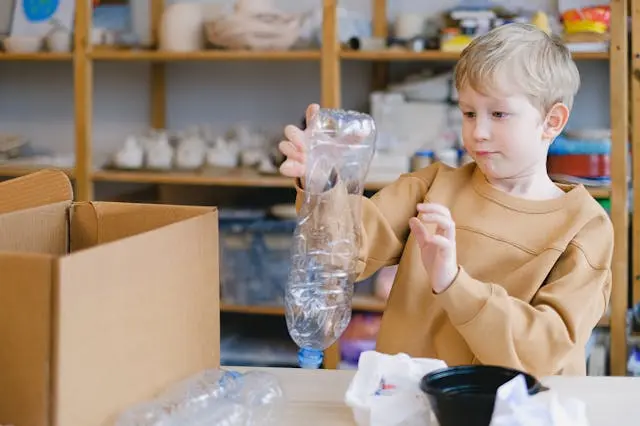
- The “Trash-to-Treasure” Upcycling Ritual: Before throwing cardboard boxes, plastic caps, or old jars into the waste bin, create an engineering station in your living room. Teach your child how to look at waste as a raw material for creativity. Transforming a cardboard box into a spaceship or an old glass jar into a colored pencil holder builds creative problem-solving skills that traditional commercial toys can never replicate.
Navigating Social Pressures: Holding Sustainable Boundaries Peacefully
One of the hardest aspects of eco parenting isn’t your own household consumption; it is managing the external world. Grandparents who shower your children with cheap plastic trinkets, birthday parties packed with single-use plastic waste, and the intense peer pressure your kids face to own the latest heavily marketed plastic toy trends.
How do we manage these situations without isolating our families or sounding preachy? We utilize gentle communication scripts that center our choices around health, not moral superiority.
The “Experience Gift” Request Script
When holiday or birthday seasons arrive, communicate proactively with extended family members before they buy gifts. You can send a warm, collaborative message like this:
“We are so incredibly grateful for your love and generosity toward the kids! This year, we are focusing deeply on creating memories and keeping our living space minimal and calm. If you would love to get something for the kids, they would be absolutely thrilled with an experience gift—like a trip to the zoo with you, a museum pass, or an art class. These are the things they remember forever!”
If plastic toys still enter your home through well-meaning friends, do not create a dramatic scene or make your child feel guilty. Accept the gift with grace, let your child play with it, and eventually, when interest naturally fades, donate it to a local community center or nursery where its operational lifespan can be extended.
The Legacy of Eco-Conscious Parenting
Eco-friendly parenting is not an all-or-nothing commitment. It is a daily practice of mindfulness. Every time you opt for a glass container over a plastic one, every time you choose an hour in the park over an hour of consumerist shopping, you are voting for a healthier future for your child’s biological body and our planet.
You are raising a generation that will look at the earth not as a resource to be stripped and exploited, but as a living ecosystem to be cherished, respected, and protected. That is the ultimate legacy of an eco-conscious parent.
Younes Kehal is an educational director, certified school coach, and certified life coach with over 20 years of experience working directly with children, families, and educational institutions. The guidance published on Parenting Assist is rooted in real field experience and evidence-based developmental science, dedicated to helping parents build deeper, calmer connections with their children.