How to talk to your child about climate change without scaring them
Your child comes home from school with a question you did not expect today: “Is the planet going to die?” Or perhaps they saw something on television, overheard a conversation, or came across something online. Now they are looking at you — and you are trying to figure out how to answer honestly without keeping them awake at night for the next two weeks.
This is one of the most genuinely difficult conversations modern parents face. Climate change is real, it is serious, and it deserves honest acknowledgment. At the same time, the research is equally clear that fear-based messaging — particularly for children — can produce exactly the opposite of what we hope for: emotional numbing, helplessness, paralysis, and withdrawal rather than engagement and action.
The good news is that there is a way through this. A way to be honest, to raise genuinely environmentally aware and caring children, without planting seeds of anxiety that grow into despair. This guide will show you how — drawing on behavioral science, developmental psychology, and two decades of experience working with children and families.
Table of Contents
Why Fear Does Not Work — And What the Research Shows
It feels intuitive: if children understand how serious the climate crisis is, they will be motivated to care about it and do something about it. The research consistently challenges this assumption.
Studies on environmental communication and behavioral change show that fear-based messaging, especially for children, tends to produce emotional numbing, helplessness, or avoidance — all of which ultimately decrease motivation to engage rather than increase it. When a problem feels too big to influence, the psychological response is not action. It is shutdown.
We are already seeing this in children and young people. Researchers have documented a phenomenon called eco-anxiety — chronic fear and distress about environmental threats — that is affecting children globally in measurably increasing numbers. For some children, eco-anxiety manifests as worry that interferes with sleep and daily functioning. For others, it produces a kind of resigned helplessness: nothing I do matters anyway.
Neither paralysis nor helplessness produces the environmentally engaged adults the world needs. What produces them is something quite different — and it starts in childhood, in the way we frame the conversation.
The Foundational Principle: Love Before Fear
The most important insight from both developmental psychology and environmental education is this: children who love the natural world protect it. Children who fear for the natural world often shut down.
The sequence matters enormously. Before you ask a child to worry about the planet, you need to give them reasons to love it. Before you introduce the concept of climate threat, you need to build a deep, embodied, emotional connection to the living world — the kind of connection that comes from lying in grass and watching clouds, from finding a frog at the edge of a pond, from growing a tomato plant from seed and watching it fruit.
This is not delay or avoidance. It is the necessary foundation. A child who loves the natural world will develop the motivation to protect it organically, from the inside out. That motivation is far more durable and generative than fear — which is external, exhausting, and ultimately paralyzing.
Give your child reasons to love the world before you ask them to worry about it. That is the single most important piece of guidance in this entire article.
When and How to Start the Conversation
Let Their Questions Guide the Timing
You do not need to sit your young child down for a formal conversation about climate change. In fact, initiating that conversation unprompted with a young child is rarely necessary and often counterproductive — it introduces anxiety before the child has the emotional or cognitive tools to process it.
Instead, follow the child’s lead. When they ask a question — about weather, about animals, about something they saw — that is your invitation. Answer it honestly and at the level they asked. A 5-year-old asking why it is so hot this summer needs a different response than a 12-year-old who has been learning about greenhouse gases at school.

Match the Depth to the Age
Children’s capacity to engage with complex, systemic problems develops gradually alongside their cognitive development. Pushing information or emotional weight onto a child before they have the developmental tools to process it does not produce awareness — it produces anxiety without agency.
Here is a rough guide to what is developmentally appropriate at each stage:
| Age | What They Can Handle | How to Frame It |
|---|---|---|
| Under 6 | Simple nature connection, basic care habits | “We take care of the things we love.” Focus on love, wonder, and simple daily habits |
| 6–9 | Basic cause and effect, concrete actions | “Our choices affect the world. Here are things our family does to help.” Emphasize agency |
| 9–12 | Systemic thinking, global awareness, values formation | Honest, balanced information. Solutions alongside problems. Channel concern into action |
| 13+ | Complex systems, ethical dimensions, identity and values | Full honesty, genuine dialogue. Treat them as emerging adults. Validate complexity and emotion |
What to Actually Say: Language That Works at Every Age
For Young Children (Under 6)
At this age, the goal is not information — it is relationship. You are building the emotional foundation that will make everything else possible. Keep the conversation rooted in love, wonder, and simple, empowering actions.
When a young child asks about weather or nature: “The world is full of amazing living things — animals, plants, rivers, clouds. Our family takes care of these things because we love them. When we turn off the tap while brushing our teeth, we are taking care of the water. When we pick up litter, we are taking care of the park.”
The message at this age is simple and consistent: we love the world, and we take care of the things we love. That is enough. It is, in fact, the most important message they will ever receive on this subject.
For School-Age Children (6–12)
As children develop the cognitive capacity for cause-and-effect thinking, you can begin to introduce more honest and specific information — always paired with agency and solutions.
A useful framework for this age is the Problem — Reason — Action structure:
- Problem: “The Earth is getting warmer because of some gases that build up in the air when we burn fuels like petrol and coal.”
- Reason for hope: “Lots of people all over the world are working hard to fix this — scientists, engineers, governments, and ordinary families like ours.”
- Action: “And there are things our family can do that actually make a difference.”
The action component is not a token addition. It is neurologically and psychologically essential. Research on human responses to threat consistently shows that people — including children — can tolerate significant amounts of difficult information when they have a sense of agency. When they feel powerless, the same information becomes overwhelming. Always pair the problem with what can be done.
For Teenagers
Teenagers are capable of engaging with climate change in its full complexity — and many already are, through school, social media, and peer conversations. What they need from parents is not simplified messaging but genuine dialogue.
This means being honest about what you know and what you do not know. It means acknowledging the real scale of the challenge without dismissing it. It means validating the emotions they bring — anger, grief, anxiety, and determination are all entirely appropriate responses to what they are encountering. And it means treating them as people whose perspective matters, not as recipients of your reassurance.
“How are you feeling about all of this? What have you been reading or thinking about?” These questions do more for a teenager than any prepared speech.
Recognizing and Responding to Eco-Anxiety
If your child is showing signs of climate-related anxiety — recurring worry, questions that seem driven by fear rather than curiosity, difficulty sleeping, or expressions of hopelessness about the future — it is important to take this seriously without amplifying it.
What Eco-Anxiety Looks Like
- Repeatedly asking fearful questions about environmental collapse or extinction
- Expressing hopelessness about the future: “What is the point of anything?”
- Avoiding news, school discussions, or conversations about the environment because they cause distress
- Sleep disruption or intrusive thoughts related to environmental fears
- Guilt about normal activities like using a car or eating meat
What Helps
Validate without amplifying. “I understand why this feels scary. It is a serious thing. And I want you to know that there are millions of people working hard on this, and our family is one of them.” You are acknowledging reality, containing the fear, and restoring agency — all in a few sentences.
Redirect from global overwhelm to local action. The scale of climate change is genuinely paralyzing if it remains at the global level. Bringing it back to concrete, local, achievable actions restores the sense of agency that counters helplessness. A child who plants a tree, participates in a neighborhood clean-up, or helps start a composting system at school has tangible evidence that their actions have real effects.
Limit unfiltered exposure. Young children do not need access to news coverage of climate disasters. Teenagers benefit from your help in filtering and contextualizing what they encounter. You cannot and should not shield them from reality — but you can be present to help them process it rather than leaving them alone with it.
Seek professional support if needed. If eco-anxiety is interfering with your child’s sleep, school attendance, or daily functioning, a child psychologist who understands climate-related distress can provide genuine help. This is not an overreaction — it is appropriate care for a real and growing phenomenon.
Building Environmental Values Through Daily Life
The most enduring environmental values are not taught through conversations about climate change. They are built through daily habits, shared experiences, and the consistent modeling of values in action. Here are the approaches that behavioral science and practical experience identify as most effective.
1. Spend Time in Nature — Consistently and Without Agenda
Research from Rare, an organization that uses behavioral science to address environmental challenges, identifies unstructured outdoor time as one of the single most effective foundations for environmental values. Early positive experiences in the natural world create lasting emotional connections that motivate care and protection far more reliably than information alone.
This does not require wilderness access. A garden, a park, a patch of grass, a puddle after rain — these are sufficient. What matters is presence, attention, and the freedom to explore without being directed. Let your child find things, touch things, ask questions, get dirty. The dirty footprints are worth every bit of what they build.
2. Model Environmental Behavior Consistently and Visibly
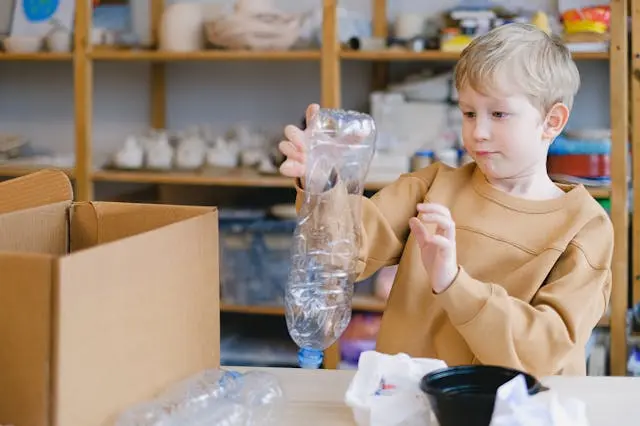
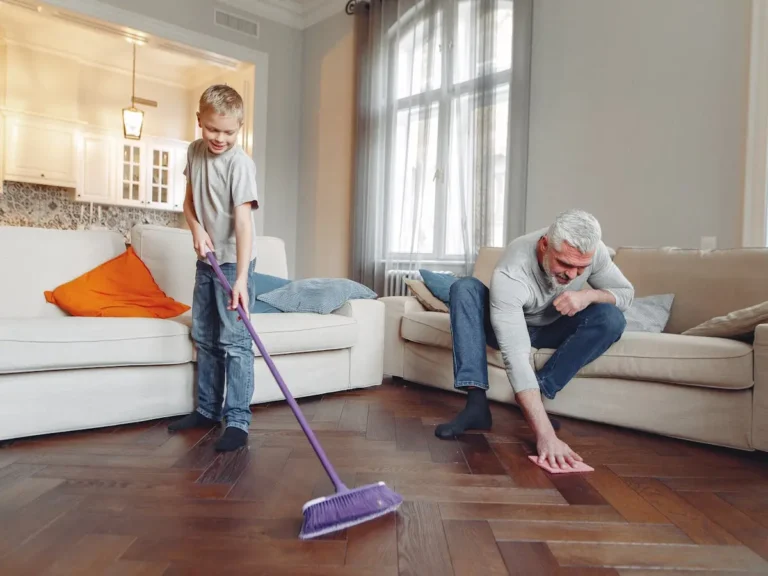
Children absorb the habits of the adults around them far more readily than they absorb instructions. When they consistently observe you recycling, composting, choosing products thoughtfully, turning off lights, reducing waste, and making sustainable choices — they internalize these behaviors as normal. Not as sacrifice, not as political statement, but simply as how our family lives.
Name the reasons simply and without drama: “We bring our own bags because we want to create less plastic waste.” “We’re walking today instead of driving because it’s better for the air.” These quiet, consistent narrations over years build values more deeply than any single conversation.
3. Give Children Real Responsibility for Something Living
A child who cares for a plant, a pet, a vegetable garden, or a small patch of outdoor space develops a direct, personal relationship with living systems. They experience what it means for something to thrive or struggle based on the care they give it. This is one of the most powerful environmental educators available — not abstract, not frightening, entirely within their control.
Start small. A single herb on a windowsill. A seed planted in a cup. A bird feeder they fill and watch. The scale is irrelevant — the relationship is everything.
4. Frame Environmental Choices as Expressions of Love, Not Sacrifice
The language we use around environmental choices matters more than most parents realize. When eco-friendly choices are framed as deprivation — “we can’t have that because it’s bad for the environment” — children absorb the message that caring for the planet means going without. This creates resistance rather than values.
When those same choices are framed as expressions of care — “we choose this because we love the ocean” or “we do this because our family believes in taking care of things” — children absorb an identity rather than a rule. They become people who care for the world, not people who are restricted by environmental concerns. The distinction is profound and lasting.
5. Celebrate Small Actions Without Perfectionism
Eco-perfectionism — the pressure to do everything right, to have no environmental footprint, to live a fully sustainable life — is one of the fastest paths to both parental burnout and childhood eco-anxiety. It is also, frankly, impossible. And modeling impossibility does not build values — it builds guilt.
What works is progress over perfection. Celebrating the things your family does do. Being honest about the things you find difficult or have not managed to change yet. Approaching sustainability as a direction rather than a destination. This models not only environmental engagement but also the healthy psychological relationship with imperfection that children need in every area of life.
Age-by-Age Environmental Activities That Build Values Through Experience
| Age | Activities That Build Connection and Values |
|---|---|
| 2–4 | Puddle jumping, watching birds, watering a plant, collecting leaves and stones, playing in sand and soil |
| 4–7 | Growing vegetables from seed, feeding birds, nature walks with a magnifying glass, sorting recycling, helping in the garden |
| 7–10 | Starting a compost bin, neighborhood litter picks, learning about local wildlife, visiting nature reserves, cooking with seasonal vegetables |
| 10–13 | Researching a local environmental issue, reducing household waste as a family project, choosing secondhand clothing, learning about food systems |
| 13+ | Youth environmental groups, school sustainability projects, researching solutions, discussing policy and ethics, making independent sustainable choices |
A Note on Honesty: What to Do When Your Child Asks Hard Questions
Children — especially older ones — will sometimes ask questions that are genuinely hard to answer without either catastrophizing or dismissing.
“Will there still be polar bears when I grow up?”
“Is it going to get too hot to live here?”
“Why aren’t governments doing more?”
The honest answer to some of these questions involves uncertainty, and saying so is entirely appropriate. “I don’t know exactly what the future will look like. What I do know is that millions of people are working very hard on this, that real progress is happening, and that the choices our generation and yours make in the next few decades will matter a great deal.”
This is honest. It acknowledges uncertainty without catastrophizing. It restores agency. And it models the kind of clear-eyed, action-oriented relationship with difficult problems that produces not anxiety but resilience.
You do not need to have all the answers. You need to be willing to sit with the questions alongside your child, without flinching and without pretending. That kind of honest, steady companionship is itself an act of eco-parenting at its best.
Summary: What To Remember
- Fear-based messaging produces paralysis, not engagement. Research shows it leads to emotional numbing and avoidance in children.
- Build love before introducing worry. A child’s deep connection to nature is the most powerful foundation for environmental values.
- Match the depth of the conversation to the child’s developmental stage — simple and action-focused for young children, more honest and complex for teenagers.
- Always pair problems with agency. Children — like adults — can handle difficult information when they have a sense that their actions matter.
- Model environmental behavior consistently and visibly — children absorb habits far more readily than instructions.
- Frame choices as expressions of love, not sacrifice — this builds identity rather than rules.
- Celebrate progress, not perfection. Eco-perfectionism creates guilt and burnout, not values.
- Take eco-anxiety seriously. If it interferes with daily life, seek professional support.
- You do not need all the answers. Honest, steady companionship through hard questions is one of the most powerful things a parent can offer.
Younes Kehal is an educational director, certified school coach, and certified life coach with 20 years of experience working with children, families, teachers, and schools. His guidance combines practical educational experience with carefully reviewed research.