The Invisible Toy: Why Storytelling Is the Most Developmentally Powerful Play Your Child Will Ever Do
There is a particular kind of play that costs nothing. Requires no batteries, no setup, no cleanup. Cannot be purchased, does not arrive in packaging, has no age range printed on it, and is available to any child with a functioning imagination and someone willing to listen.
It is also, according to a growing body of developmental research, one of the most cognitively and emotionally significant activities available to children — more developmentally rich than most educational toys, more broadly impactful than many structured learning activities, and more deeply connected to adult competence in language, empathy, and reasoning than most people recognise.
Storytelling. The making up of stories. The spinning out of narrative, alone or together, from nothing but whatever is in the child’s mind. The game of “let’s pretend” that evolves into the elaborate shared fiction of a weeks-long imaginative world. The bedtime stories that the child starts making up themselves rather than requesting. The voices given to figurines, the scenario played out with sticks in the garden, the conversation between two children that is entirely fictional and entirely serious and apparently going to last another forty-five minutes.
This article is about why this invisible toy matters so much, and what parents can do to protect and nurture it in a childhood that is increasingly structured, scheduled, and screen-saturated.
Table of Contents
What a Story Requires
To understand why storytelling is developmentally significant, it helps to understand what creating a story actually requires of the child who is doing it.
A story requires a character — which means imagining a perspective, a set of motivations, a way of experiencing the world that is different from the storyteller’s own. This is theory of mind in action: the ability to hold another person’s mental state in mind and use it to generate consistent, coherent behaviour. The child who gives their toy bear a personality — who decides what the bear wants, how the bear feels, what the bear is afraid of — is practising the cognitive operation that underlies empathy, social understanding, and the capacity to navigate complex relationships.
A story requires a problem. Something has to want to happen and be prevented from happening, or something has to go wrong that needs to be resolved. The narrative drive of a story is fundamentally a problem-solving structure: state → complication → resolution. A child who constructs stories is repeatedly practising the identification of problems, the generation of possible responses to those problems, and the evaluation of outcomes. This is not trivial. It is the basic cognitive structure of planning and causal reasoning.
A story requires time — a before, a during, and an after. It requires the child to hold a sequence in mind and to maintain the logic of that sequence as the story develops. This is working memory and sequential reasoning in action. The child who keeps track of what has already happened in the story, what is happening now, and what is likely to happen next is doing something cognitively demanding that looks, from the outside, like play.
And a story requires language. Not just vocabulary — though storytelling builds vocabulary significantly — but the kind of complex, subordinate-clause-heavy, temporally structured language that distinguishes sophisticated verbal expression from simple description. “Because the dragon was afraid of the princess, he hid behind the mountain, but she had already seen him, and now she had to decide whether to pretend she hadn’t” is a sentence that requires understanding of causality, temporal sequence, mental states, and conditional possibility. Children who tell stories regularly produce language like this naturally, through practice, before they are taught any of its formal components.
The Research on Narrative and Development
The developmental psychology of narrative — the study of how children’s ability to create and understand stories relates to their broader cognitive and social development — is one of the more consistent and less celebrated bodies of research in the field. Its findings have significant implications for how we think about children’s play, and specifically about the relative developmental value of structured educational activities versus unstructured imaginative play.
Research by Jerome Bruner — one of the founding figures of cognitive developmental psychology — proposed that narrative is not merely a form of communication but a fundamental mode of human thought. Bruner distinguished between “logico-scientific” thinking — the mode of formal reasoning, hypothesis testing, and causal analysis — and “narrative” thinking — the mode of understanding human experience through stories, intentions, and meanings. Both modes are important. Narrative thinking, Bruner argued, is the earlier-developing and more fundamental of the two, and it provides the scaffold on which formal logical reasoning is built.
Research by Janellen Huttenlocher and Susan Levine on early language development found that children’s exposure to complex narrative language — hearing and producing stories rather than just simple descriptions — was one of the strongest predictors of later vocabulary and reading comprehension, above and beyond simple word exposure. Children who hear more stories, and who tell more stories, develop more sophisticated language capacities than those who have equivalent or greater word exposure in non-narrative contexts.
Research on pretend play and theory of mind has repeatedly found that children who engage in more pretend play — and particularly more collaborative, socially shared pretend play — show earlier and more sophisticated theory of mind development than those who engage in less. The relationship appears to be bidirectional: theory of mind supports richer pretend play, and richer pretend play further develops theory of mind. The shared imaginative game, in which two children must maintain and coordinate separate perspectives within a shared fictional world, is one of the most cognitively demanding social activities available to young children.
Research on emotional development and narrative has found that the ability to tell a coherent story about an emotional experience — to construct a narrative that includes what happened, what the protagonist felt, why they felt it, and what happened as a result — is associated with better emotional regulation, better coping with stressful experiences, and better social relationships. Children who have developed strong narrative capacity are better able to make sense of difficult experiences, which makes them more resilient than those for whom difficult experiences remain inarticulate and therefore harder to process.
| Developmental Domain | What Narrative Play Builds | Evidence Strength |
|---|---|---|
| Theory of mind | Understanding other perspectives; inferring mental states; social cognition | Very strong — consistent across multiple study designs |
| Language development | Complex syntax; temporal language; causal language; vocabulary in context | Very strong — among the most consistent findings in early language research |
| Emotional regulation | Processing difficult experiences through narrative; understanding emotional causality | Strong — narrative coherence associated with better emotional outcomes |
| Executive function | Working memory for plot; planning for story outcomes; inhibitory control of character consistency | Strong — particularly in collaborative narrative contexts |
| Literacy and reading comprehension | Understanding story structure; inferential comprehension; engagement with written narrative | Very strong — oral narrative skill is one of the best predictors of reading comprehension |
| Problem-solving | Identifying problems; generating possible responses; evaluating outcomes | Strong — narrative structure is fundamentally a problem-solving structure |
| Empathy | Practising perspective-taking through character; understanding motivation and feeling | Strong — empathy and narrative capacity are closely related in the research |
The Difference Between Reading Stories and Making Them
Reading stories to children is one of the best things a parent can do for their development. The research on reading aloud — its contribution to vocabulary, narrative comprehension, literacy readiness, and the love of books — is unambiguous and extensive.
But making stories is different from receiving them, and the difference matters.
When a child listens to a story, they are processing narrative that has already been constructed — following a sequence that has been determined, understanding a plot that exists. The cognitive operations involved are real and significant. But they are primarily receptive.
When a child makes a story — when they are the author, the narrator, the character creator, the problem generator and problem solver — the cognitive operations are generative. They are producing the sequence, determining the plot, creating the characters, deciding what happens next. The active construction of narrative requires more from the child than the reception of narrative, and it builds capacities that reception alone does not.
This distinction matters because much of the emphasis in early childhood literacy is on reading — on exposing children to books and stories, which is entirely right and important. But considerably less emphasis is placed on children’s own storytelling and story-making, which is equally important and somewhat differently important. The child who reads a lot but never makes up stories of their own is developing some of the capacities that narrative builds, but not all of them. The making is irreplaceable.
What This Looks Like at Different Ages
Narrative play — the play that involves making up stories — looks very different at different developmental stages, and understanding what is developmentally appropriate at each stage helps parents create the right conditions rather than expecting a four-year-old to produce a complex plot or waiting until a child is older to begin supporting this kind of play.
Toddlers (18 months to 3 years)
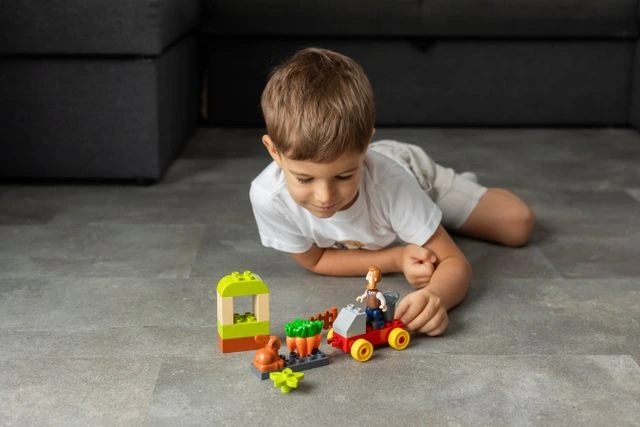
The earliest precursors of storytelling appear in the second year of life, in the form of pretend play — the child who makes a spoon “fly” across the table, who feeds a doll, who announces that they are a cat and proceeds to meow for the next twenty minutes. These are not yet stories in a recognisable sense, but they are the beginning of the narrative imagination — the capacity to assign a role and a meaning to an object or a self that is different from its literal reality.
Supporting narrative play at this stage means playing along. Following the child’s fiction rather than correcting it. Saying “oh, are you a cat? What kind of cat are you?” rather than “you’re not a cat, you’re Maya.” The child’s imaginative proposal is an invitation. Accepting it is the most important thing a parent can do.
Preschoolers (3 to 5 years)
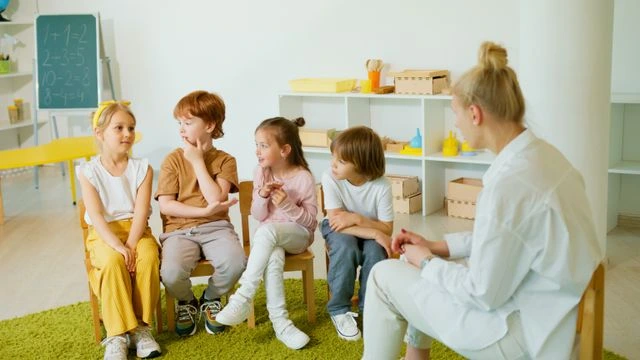
At this age, story-making becomes more elaborate and more socially shared. Children at this age engage in extended pretend scenarios — playing house, playing doctors, playing superheroes — that have narrative structure, character roles, and evolving plot. The scenarios can last hours and be resumed days later. They involve negotiation, role assignment, conflict about what happens next, and the remarkable social achievement of maintaining a shared imaginative world between two or more people who both have their own ideas about what should happen.
Supporting narrative play at this age means providing the props and the space and the time, and being willing to be assigned a role yourself when invited. The parent who accepts their assigned role in the game — who follows the four-year-old’s plot without taking it over — is providing the most valuable possible form of participation. Not directing. Following.
School-age children (5 to 10 years)
At this age, narrative play becomes more explicitly verbal. Children at this age make up stories that are told rather than enacted — they narrate elaborate plots to willing listeners, write the beginning of stories they will not finish, invent characters who become companions in an ongoing private universe, produce oral sequels to books they have read. The play is increasingly internal and increasingly complex.
Supporting narrative play at this age means being a willing listener and reader. Asking questions that extend the story rather than redirect it. Not correcting the inconsistencies or the improbabilities — the internal logic of a ten-year-old’s invented world is its own, and disrupting it is disrupting the creative process. Taking the storytelling seriously, as the significant imaginative work it is, rather than treating it as a charming but marginal activity.
Adolescents
The narrative imagination does not stop at the end of childhood. Adolescents write fanfiction, develop elaborate fantasy worlds with friends, engage in collaborative storytelling games, and — in ways they may not recognise as storytelling — construct the ongoing narrative of their own identity. Who am I? Where did I come from? Where am I going? These are narrative questions, and the capacity to answer them well is built, in part, on the narrative competence that was developed in childhood play.
Supporting narrative play in adolescence means taking seriously the creative work that adolescents do — the writing, the worldbuilding, the roleplay — and not treating it as something to grow out of. The narrative imagination is not a childish phase. It is a fundamental cognitive capacity that remains important throughout adult life.
Storytelling Together: The Most Underused Parenting Tool
I want to spend some time on a specific practice that is both extraordinarily valuable and remarkably underused: making up stories together, as a regular family activity.
Not reading stories — making them up. Taking turns. One person starts with a character or a situation, the next person adds something, and the story develops in directions that neither person anticipated. This can happen in the car, at the dinner table, before bed, on a walk. It requires no materials. It can be as brief or as extended as the moment allows.
What this practice does, in developmental terms, is remarkable. It builds narrative skill through the most engaging possible form of practice — a collaborative game with someone the child cares about. It develops the capacity to build on another person’s contribution, to maintain consistency with what has already been established, and to generate creative additions that advance the story rather than derailing it. It builds theory of mind through the collaborative process of maintaining a shared imaginative world. And it produces the kind of playful, creative family interaction that most families desperately want and find surprisingly hard to create through more conventional means.
For very young children, the parent simply follows and extends. “Once there was a cat — tell me more about the cat.” For school-age children, the turn-taking can become more genuinely collaborative. For older children and adolescents, the stories can become genuinely surprising — a story made up with a teenager who is a good storyteller is often something you did not expect, and the unexpected quality is part of what makes it delightful.
The constraints of the car journey — confined space, a destination, no screens — make it one of the best environments for collaborative storytelling that families have. The next time the journey is longer than expected and everyone is bored and fractious, the story that begins with “once there was a—” and turns into something entirely its own over the next thirty minutes is worth more than any podcast.

Screen Stories vs. Self-Made Stories
I want to address this directly, because it is the most practically relevant tension for most contemporary families.
Screen stories — films, television programmes, streaming series — are stories. They develop narrative comprehension, vocabulary, and emotional understanding in ways that are real and not negligible. Many children’s screen stories are beautifully made, thematically rich, and narratively sophisticated. Watching them is not developmentally empty.
But watching a story and making a story are not the same thing, for the same reasons that reading a story and making a story are not the same thing. Screen stories are received. They are produced by someone else. The child is a consumer of the narrative rather than its creator. The generative, constructive cognitive operations — the character invention, the plot production, the problem generation and solving — are done by the screenwriter and the director, not by the child.
The additional concern with screen stories specifically, as opposed to book stories, is that they are typically more immersive and more passively engaging than books — the combination of moving image, sound design, and dialogue removes more of the imaginative work from the viewer than print narrative does. The child who reads a book must construct the visual world of the story in their own mind. The child who watches a screen has that construction done for them.
None of this means children should not watch screens. It means that screen time does not substitute for the story-making play that builds the capacities described in this article, and that protecting time for that play — even as screen access expands — is worth doing deliberately rather than hoping it will happen in whatever space the screen leaves behind.
| Activity | Mode | Primary Cognitive Operation | What It Builds That the Other Does Not |
|---|---|---|---|
| Making up stories (alone or with others) | Generative | Character creation, plot construction, problem generation and solving | Creative agency; narrative authorship; active perspective-taking; generative language |
| Reading books | Receptive — partially generative (visual construction) | Narrative comprehension; visual imagination; inference; vocabulary acquisition | Exposure to written language structures; sustained attention to print; visual world construction |
| Watching screens | Primarily receptive | Narrative comprehension; vocabulary from dialogue | Rich audio-visual narrative experience; cultural literacy; emotional engagement with story |
| Collaborative pretend play | Generative and social | Shared narrative construction; role maintenance; negotiation of story direction | Social theory of mind; collaborative creativity; conflict within fiction; shared imaginative world |
What Happens to Storytelling Without Support
I want to end with something that concerns me in my work with children, because I think it is underacknowledged.
The capacity for rich imaginative storytelling — for extended, complex, self-generated narrative — requires practice. Like any cognitive capacity, it is built through use. And in a childhood that is heavily structured, heavily screened, and heavily programmed, many children are simply not getting enough practice with the kind of unstructured imaginative play in which storytelling develops.
The result is visible. Children who have not had significant experience of self-generated imaginative play often show a narrower range of narrative strategies than children who have. They rely more heavily on the stories they have received — from screens, from books — as raw material for their own storytelling, which produces a derivative quality rather than the genuine originality that emerges when a child has been generating their own narratives for years. They may find open-ended storytelling tasks more difficult, because the capacity for narrative generation that should be automatic by this age has not been fully built.
This is not a criticism of the children. It is an observation about the environment they have grown up in. And it points toward something practical: protecting time for unstructured play, and specifically for the kind of imaginative, narrative play described in this article, is not a nice-to-have. It is a developmental priority that the contemporary childhood environment consistently threatens and that parents who understand its importance have to consciously defend.
For the broader argument about why unstructured play — including the imaginative play in which storytelling lives — needs to be actively protected in the contemporary childhood environment, the article on why boredom is the most underrated parenting tool makes the complementary case for the value of the unstructured time in which imaginative storytelling most naturally emerges. And for the specific contribution of books and reading aloud to the narrative development described here — the receptive counterpart to the generative play this article is about — the article on why the first three years are not primarily about teaching covers the evidence for reading aloud as one of the most important things parents of young children can do.
Frequently Asked Questions
At what age do children start telling stories?
The earliest precursors appear in the second year of life, in the form of pretend play — assigning roles and meanings to objects and actions. By age three, most children are engaging in extended pretend scenarios with narrative structure. By age five, most children can produce a recognisable story with a beginning, middle, and end when asked. The sophistication, coherence, and complexity of children’s stories continues to develop throughout childhood and adolescence, and is significantly influenced by the storytelling experience they have had.
My child only wants to retell stories they have seen on screen rather than making up their own. Is this a problem?
Retelling and reimagining existing stories is a legitimate and developmentally normal form of narrative play — it is how children have always engaged with the stories they encounter, and it produces some of the same cognitive benefits as original story creation. The concern arises when it entirely replaces original invention — when the child has no imaginative world of their own and only recombines existing material. Gently introducing open-ended story prompts (“what if the character went somewhere different?”, “what would happen if the story continued?”) can support the development of original invention without rejecting what the child is already doing.
How do I encourage a child who says they are “not good at stories”?
By removing the performance pressure entirely. Story-making play does not need to produce a good story. It needs to produce a story. The child who says they are not good at stories has usually received some message — explicit or implicit — that stories can be better or worse, which creates the very pressure that blocks creative engagement. Starting with constraints that remove the pressure of originality (“let’s make a story about a dog who finds something unusual — what does the dog find?”) gives the child a starting point without requiring them to generate the entire story from nothing. Following their contribution with genuine interest and building on it — rather than evaluating it — changes the relationship with the activity.
Is roleplay with figurines and toys as valuable as verbal storytelling?
Yes. The developmental benefits of narrative play apply across its forms: verbal storytelling, collaborative pretend play, roleplay with figurines or dolls, dramatic play in dress-up scenarios, and any other form in which a child is constructing and inhabiting a narrative rather than receiving one. The specific cognitive operations involved are the same regardless of the medium. Some children are more naturally drawn to embodied narrative play (acting it out) and some to verbal narrative (telling it), and both forms are developmentally valid and valuable.
Do video games with stories count?
Partially. Video games that involve narrative — particularly those with branching stories, character development, and player agency in plot direction — do engage some of the narrative capacities described in this article, particularly causal reasoning and decision-making within a story context. They are not equivalent to self-generated storytelling, because the narrative world and characters are primarily provided rather than constructed by the child. But they are not narrative-empty either, and for children who are drawn to them, they can be a legitimate part of a broader story-rich environment rather than a replacement for it.
How much time should children spend on imaginative and narrative play?
No specific amount is definitively established, but the research on the developmental value of unstructured play — and on the consequences of its absence — suggests that daily time for imaginative, self-directed play is important across the childhood years. Protecting two or more hours of genuinely unstructured time daily for young children (under eight), and at least one hour for older children, is a reasonable guideline. Within that time, narrative and imaginative play will emerge naturally when the child has the space and the absence of competing stimulation to generate it.
Younes Kehal is an educational director, certified school coach, and certified life coach with 20 years of experience working with children, families, teachers, and schools. His guidance combines practical educational experience with carefully reviewed research.