The Cognitive Architecture of Play: How Educational Toys Shape Early Brain Development
Throughout my 20 years of experience as an educational director and school coach, I have spent thousands of hours analyzing the microscopic differences between children who thrive academically and those who struggle with fundamental cognitive concepts. When parents come to my office asking for early childhood interventions, they often expect me to recommend advanced worksheets, rigid academic flashcards, or structured early reading programs. Instead, my professional advice frequently catches them off guard: “Show me your child’s toy box.”
In the modern parenting landscape, the word “educational” has been heavily commodified. Toy manufacturers slap this label on almost anything that blinks, makes synthetic noises, or recites the alphabet at the press of a plastic button. We are led to believe that the more complex, expensive, and electronically advanced a toy is, the smarter it will make our children. However, from the perspective of neurodevelopmental science, the exact opposite is almost always true.
Play is not merely a way for children to pass the time until they are old enough to start formal schooling; play is the literal work of early childhood. Toys are the structural tools through which a developing brain builds its cognitive architecture. When a child interacts with the right physical object, they are creating thousands of new neural pathways every single minute.
This comprehensive guide will bypass the marketing myths of the modern toy industry. Grounded in educational psychology, we will explore the neurobiology of play, break down the structural difference between passive and active toys, and provide an actionable blueprint to curate an intentional, brain-optimized toy ecosystem in your home.
Table of Contents
Synaptic Sculpting: The Neurobiology of Early Childhood Play
To truly understand why educational toys are vital to child health, we must look at the physical brain of a young child. At birth, a baby’s brain contains roughly 86 billion neurons, but very few connections (synapses) between them. By the age of three, through the process of interacting with their physical environment, that same brain will have formed over one quadrillion synaptic connections—double the amount found in an adult brain.
This massive explosion of neural wiring is shaped entirely by sensory and physical experiences. When a toddler interacts with physical objects in three-dimensional space, their brain is conducting complex calculations regarding gravity, mass, friction, spatial relationships, and cause-and-effect.
The Concept of Enriched Environments
Decades of neurological research have proven that mammals raised in “enriched environments”—spaces filled with novel, varied, and manipulable physical objects—develop a significantly thicker cerebral cortex and higher synaptic density than those raised in barren or rigid environments.
“Toys are the raw structural materials of thought. When a child manipulates an open-ended physical object, they are not just playing; they are actively engineering the physical circuitry of their prefrontal cortex.”— Insights from Modern Educational Neuropsychology
When a child’s environment is dominated by toys that do all the thinking for them—toys that talk, move, and illuminate automatically—the child’s brain remains a passive observer. The neurons do not fire aggressively because the child isn’t required to problem-solve, imagine, or exert physical willpower. To build a robust mind, we must transition our homes from spaces of passive entertainment to arenas of active cognitive exploration.
The Grand Paradox: Battery-Operated Passive Toys vs. Open-Ended Active Toys
One of the core pillars I emphasize during school coaching consultations is the structural rule of toy selection: “The more a toy does, the less the child has to do; the less a toy does, the more the child must do.”
Let us analyze the profound behavioral and cognitive divide between these two categories of toys using a clinical framework:
| Toy Characteristic | Electronic / Battery-Operated Toys | Open-Ended / Natural Toys |
|---|---|---|
| Cognitive Role of Child | Passive consumer; presses a button to trigger a pre-programmed response. | Active creator; must determine what the object becomes and how it moves. |
| Attention Span Impact | Fractures focus; mimics the hyper-stimulation pathways of heavy screen time. | Builds deep, sustained focus; trains the brain to endure healthy frustration. |
| Imaginative Potential | Low; a plastic electronic phone can only ever be a phone in the child’s play script. | Infinite; a simple wooden block can become a car, a phone, a tree, or a castle tower. |
| Sensory Quality | Synthetic, uniform plastic surfaces that offer no variation in weight, texture, or temperature. | Rich tactile feedback; varied wood grains, natural metals, or fabrics that stimulate development. |
When you fill a nursery with electronic toys that emit loud, synthesized voices to teach the alphabet, you are accidentally creating a sensory environment that leaves children overstimulated. This overstimulation frequently leads to the exact same executive functioning fatigue that triggers explosive toddler tantrums later in the day.
The Core Four: Essential Toy Categories Every Child Needs
To optimize your home’s educational environment, you do not need hundreds of toys. In fact, toy minimalism is highly beneficial for a child’s focus. A curated selection of high-quality items across these four cognitive pillars will provide all the neurological stimulation your child requires:
1. Spatial and Structural Manipulatives (The Engineers)
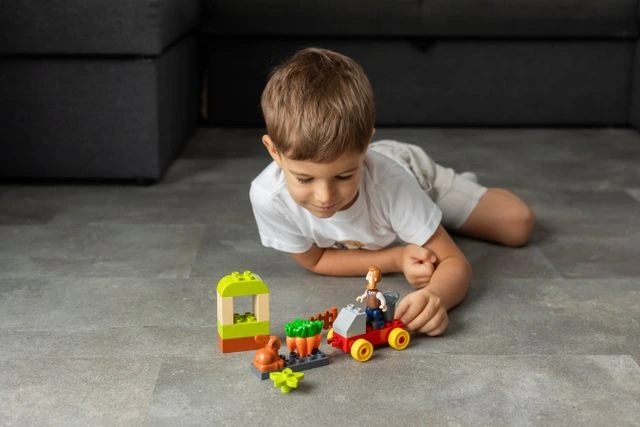
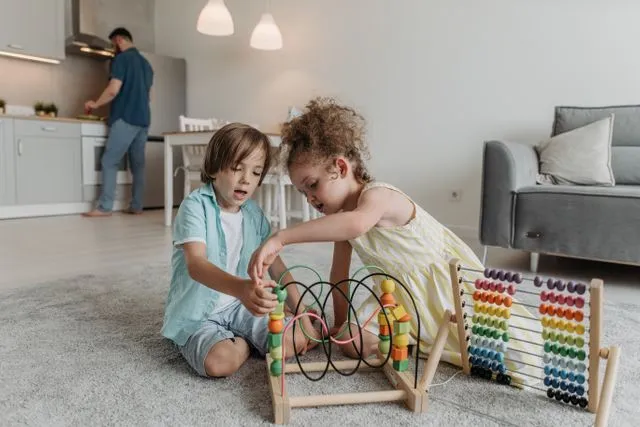
This category includes classic unit blocks, interlocking wooden bricks, magnetic tiles, and nesting cups. When a child builds with blocks, they are engaging in complex spatial visualization—a skill that developmental psychology has directly linked to high mathematical achievement and future problem-solving capacity in STEM fields.
As they balance a heavy wooden block atop two smaller ones, their motor cortex and visual systems are working together to calculate equilibrium, spatial symmetry, and gravity through direct tactile feedback.
2. Fine-Motor and Coordination Tools (The Craftsmen)
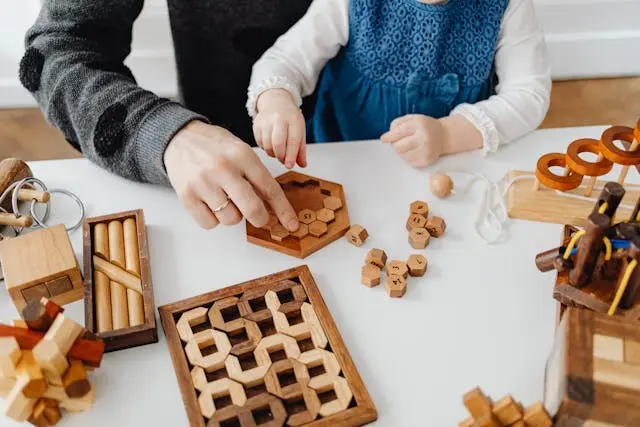
Puzzles, threading beads, lacing cards, sorting boards, and pegboards fall into this vital category. In early childhood, the muscles of the hand and wrist are highly immature.
Manipulating small physical pieces, rotating a puzzle piece to find the correct orientation, and threading a string through a narrow hole forces the brain to coordinate binocular vision with fine-motor dexterity. This precise control is the critical biological precursor required for proper pencil grip, fluid handwriting, and independent self-care skills like buttoning clothes and tying shoes.
3. Imaginative and Socio-Emotional Objects (The Storytellers)
Simple silk scarves, plain wooden human figurines, basic animal models, and realistic kitchen utensils are the foundations of dramatic play. Unlike a commercial plastic superhero toy that comes with a rigid, pre-packaged television plotline, open-ended figurines allow the child to project their own internal psychological world onto the play script.
Through dramatic play, children process complex real-world social scenarios, rehearse emotional empathy, and develop advanced narrative language skills. They learn to speak for multiple characters, build abstract storylines, and make sense of their daily life experiences.
The Physical Medium Matters: Choosing Sustainable, Non-Toxic Toy Ecosystems
As an educational leader, I always encourage parents to bridge their choices of toys with their broader sustainable eco-parenting choices. The physical material a toy is crafted from does not just dictate its environmental footprint; it alters the biological safety of your home.
When selecting toys for young children—who naturally explore their world by placing objects directly into their mouths—prioritize natural, unpainted hardwoods (like beech, maple, or rubberwood), certified non-toxic organic cotton fabrics, and pure food-grade silicone.
Natural wood possesses innate antimicrobial properties that inhibit bacterial growth far better than synthetic plastic. Furthermore, high-quality wooden toys are highly durable; they resist fracturing into sharp edges, do not contain chemical phthalates or bisphenols, and can be passed down through generations, breaking the destructive cycle of disposable consumerism.
The Toy Rotation Strategy: Maximizing Focus and Preventing Sensory Fatigue
Even if you purchase the most advanced open-ended educational toys in the world, dumping them all into a giant single toy bin will result in what we call “choice paralysis.” When a child is confronted with an overwhelming mountain of options, their attention span fractures. They dump the bin out, look at the chaos for two minutes, feel overstimulated, and declare, “I’m bored!”
To eliminate this behavioral pattern, implement the professional Toy Rotation System used in top-tier early childhood educational centers:
- The Great Purge: Gather every single toy in your home. Remove any broken items, toys with missing parts, and any electronic toys that require batteries to operate. Group the remaining open-ended toys into functional categories.
- The Low-Shelf Display: Select only 6 to 8 toys to be visible at any given time. Display them beautifully on a low, open, accessible shelf at your child’s eye level. Utilize open woven baskets or small wooden trays so each toy has a designated “home.”
- The Hidden Reservoir: Pack the remaining toys into plastic bins and store them completely out of sight in a closet or storage space.
- The Weekly Exchange: Every Sunday night, evaluate your child’s play patterns. If they have lost interest in a specific puzzle or block set, remove it from the shelf and replace it with a fresh toy from your hidden reservoir. To your child’s brain, these rotated toys will feel brand-new, re-igniting deep focus and imaginative curiosity without spending a single penny.
Cultivating Lifelong Curious Minds
Investing in authentic educational toys is not about buying products that promise to turn your toddler into a genius before kindergarten. It is about honoring the natural, evolutionary design of childhood. By filling your home with open-ended, natural, and thoughtful play tools, you are offering your child the greatest gift a parent can provide: the space to think, the freedom to fail, and the silence required to create.
Step back, resist the urge to direct their play scripts, and utilize proactive gentle parenting methods to watch their minds unfold naturally. The cognitive foundation you build today through mindful play will serve them for the rest of their human lives.
About the Expert
Younes Kehal is a Professional Educational Director and School Coach with over 20 years of experience working directly with children, families, and educational institutions. The guidance published on Parenting Assist is rooted in real field experience and evidence-based developmental science, dedicated to helping parents build deeper, calmer connections with their children.