The Garden Is the Best Classroom Your Child Will Ever Have
A colleague of mine — a primary school teacher with thirty years in the classroom — told me something once that I have never forgotten.
She said that the children who struggled most with abstract concepts in school were almost always the ones who had the least experience with the physical, material world. Not the children with learning difficulties, necessarily. The ones who had simply spent their childhoods in environments that were clean and managed and mostly indoors. Whose interaction with the world was primarily through screens and surfaces. Who had never, to the best of anyone’s knowledge, planted something and watched it grow.
I think about this observation often. Because what she was describing is not really about gardening. It is about something deeper: the difference between knowledge that is received and knowledge that is built. Between information that arrives through a screen and understanding that emerges from a child’s hands in soil, watching a seed split open and send something green toward light.
Gardening with children is one of those activities that sounds wholesome and slightly optional — a nice weekend thing, if you have the space and the inclination. I want to make a case that it is something more than that. That the garden — a back yard, a balcony pot, a single grow-bag on a windowsill — is doing something that very few other childhood experiences do as completely or as naturally. And that the case for it is not primarily environmental, though the environmental dimension is real and significant.
The case is developmental. Cognitive, emotional, scientific, relational. The garden teaches things that do not get taught anywhere else, in ways that stick.
Table of Contents
What Happens When a Child Grows Something
Let me start with what is actually going on developmentally when a child plants a seed and tends to it over weeks and months.
The first thing is time. Gardening introduces children to a category of time that almost nothing else in contemporary childhood does: biological time. The time it takes a seed to germinate. The time a plant takes to flower. The weeks between planting and harvest. This time cannot be accelerated. It cannot be optimised. It simply passes, and the plant either grows or it does not, on its own schedule, regardless of how impatient the child is.
In an era when children’s experience of time is largely shaped by instant feedback — screens that respond immediately, games that deliver rewards on demand, communications that arrive in seconds — the garden offers something genuinely countercultural. The experience of waiting. Of checking every day and finding nothing yet. And then one day, finding something. That experience of delayed reward, repeated across a growing season, builds something in a child’s relationship with time and effort that no amount of instruction about patience produces.
The second thing is consequence. In the garden, actions have visible, tangible consequences. The seeds that are not watered do not grow. The plant that is overwatered dies. The weeds that are left unchecked take resources from the vegetables. The consequences are real, they are not reversible, and they are legible — a child can see exactly what happened and understand why. This is a rare quality in a child’s environment. Most consequence in children’s lives is either too abstract, too distant, or too managed by adults to produce genuine learning. The garden is immediate and honest.
The third thing is failure. Plants die. Seeds do not germinate. Slugs eat the seedlings overnight. The weather turns. A child who gardens long enough will experience failure — genuine, irreversible, disappointing failure — and will have to decide what to do about it. Try again. Plant differently. Accept the loss and move on. This is, as far as I can tell, one of the most important things a child can learn, and the garden offers it in a low-stakes but genuinely felt form.
The Science That Gardens Teach
When a child gardens regularly, they are doing science. Not the kind of science that happens in textbooks or in controlled classroom experiments, but the kind that actually produces scientific understanding: the observation of real phenomena, the formation of informal hypotheses, the testing of those hypotheses through action, and the revision of understanding based on what happens.
Why do roots grow downward even when you plant the seed upside down? Why does compost look nothing like the food scraps it came from? Why do some plants grow better in shade and others need full sun? Why does this plant attract bees and that one does not? These questions arise naturally in the garden, from actual observation, and they lead to genuine inquiry — the child’s own curiosity driving the investigation rather than a curriculum requirement.
The concepts that gardening makes concrete are also, it turns out, some of the most foundational in biology and earth science. Life cycles. Photosynthesis. Decomposition. Nutrient cycles. Ecosystems and interdependence. These are concepts that children are taught, usually somewhat abstractly, in school science. A child who has composted food scraps and dug the result into soil has an embodied understanding of decomposition and nutrient cycling that the textbook version rarely produces. A child who has watched a caterpillar turn into a butterfly on their plant has encountered metamorphosis as a real event rather than a concept.
The Royal Horticultural Society’s school gardening programme — one of the most extensively evaluated garden-based education initiatives in the world — has produced research showing that children who participate in school gardening show significantly improved science attainment, better understanding of where food comes from, and increased willingness to try new vegetables. These effects are not trivial. They represent changes in knowledge, attitude, and behaviour that persist beyond the garden.
What Gardens Do for the Body
Children who garden are doing something physical in a way that is genuinely different from sport or structured exercise.
Digging, carrying, watering, weeding, planting — these are full-body activities that develop strength, coordination, and endurance in a functional rather than performance-oriented context. The child is not exercising. They are doing something. The movement is purposeful and its purpose is visible, which changes the relationship to the physical effort entirely.
There is also the sensory dimension. Soil has a smell — petrichor, the scent produced by soil bacteria called geosmin when it contacts moisture — that is one of the most universally recognised and positively experienced human scents. Research has found that exposure to soil bacteria, including through skin contact and inhalation, is associated with reduced anxiety and increased serotonin production. The child who digs in soil with bare hands is not just getting dirty. They are experiencing a neurochemical environment that promotes wellbeing in ways that are beginning to be scientifically documented.
And then there is the food. A child who grows something and eats it has had an experience that changes their relationship to food in ways that are difficult to achieve through any other means. Research on children’s willingness to eat vegetables is fairly consistent: children who have grown vegetables eat more of them. Not because they have been lectured about nutrition. Because they have invested in this particular food, watched it develop, harvested it themselves. It is no longer an abstract vegetable on a plate. It is their tomato, their carrot, their pea. The pride and ownership of that experience makes it edible in a way that it simply was not before.
| Developmental Domain | What Gardening Builds | Evidence |
|---|---|---|
| Scientific thinking | Observation, hypothesis, experiment, revision — in a real-world context | Strong — RHS school gardening research; multiple educational studies |
| Mathematics | Measurement, estimation, counting, sequencing, pattern recognition | Moderate — particularly for structured garden projects with adult engagement |
| Emotional regulation | Patience, frustration tolerance, management of failure and loss | Moderate — consistent with broader nature-contact literature |
| Physical development | Gross and fine motor skills, strength, coordination, sensory integration | Strong — functional movement across multiple muscle groups |
| Nutrition and food relationship | Increased willingness to eat vegetables; understanding food origins | Strong — consistent across multiple controlled studies |
| Environmental values | Genuine connection to living systems; understanding of ecological relationships | Strong — nature connection research consistent with lasting value formation |
| Executive function | Planning, sequencing, responsibility, sustained attention over time | Moderate — particularly for children who take genuine ownership of plants |
The Environmental Education Argument
This is an eco parenting article, so I want to make the environmental case directly — but I want to make it carefully, because I think it is often made in the wrong order.
The conventional approach to environmental education is to start with the problem. Here is what is happening to the planet. Here is why it matters. Here is what you should do about it. This approach produces some knowledge and, in children who are already inclined toward environmental concern, some motivation. What it reliably does not produce is the deep, durable, value-based environmental commitment that actually changes behaviour across a lifetime.
What produces that is love. A genuine, personal, felt love for the natural world — built through direct experience, through relationship, through the accumulated hours of being in contact with living things that are interesting and beautiful and fragile and interconnected. A child who loves the natural world, who has had hundreds of hours of direct, engaged experience in it, is a child who will protect it — not because they have been informed of its importance, but because it matters to them personally.
The garden is one of the most accessible places to build that relationship, particularly for families in urban environments where wilder nature is not readily available. A garden is a small piece of the living world that is entirely available to the child — close, controllable, comprehensible at a child-sized scale. It is full of life: insects, birds, worms, microorganisms in the soil, the plants themselves. A child who knows their garden well knows dozens of species, dozens of relationships, dozens of small stories of predation and pollination and decomposition and growth.
That knowledge is not abstract. It is embodied and particular. And particular love — love for specific things that are known — is more durable than general values about the environment in the abstract.
This connects directly to what the research on environmental values consistently finds: that childhood nature contact is the strongest predictor of adult pro-environmental behaviour. Not environmental education in the formal sense. Contact — time, relationship, familiarity. A child who spent significant time in nature during childhood is significantly more likely to make environmentally conscious choices as an adult than one who received environmental education without the accompanying experience. The garden is a practical, accessible way to build that contact for families in any living situation.
How to Start — Especially When You Have No Garden
The word “garden” puts some parents off immediately, because they live in a flat, or they have a concrete yard, or they have never successfully kept a plant alive and do not consider themselves gardening people.
All of this is fine. The scale of the growing project does not determine its developmental value. What matters is the child’s genuine engagement with it — the ownership, the care, the observation over time. A single tomato plant in a pot on a balcony, tended daily by a child who chose it and waters it and watches it produce one or two tomatoes that they then eat, delivers most of what this article is describing. The harvest does not need to be large. The learning does not require a large garden.
Some practical entry points for different living situations:
For a balcony or small outdoor space: a grow bag or large pot is sufficient for tomatoes, herbs, salad leaves, or strawberries. These are all fast-growing, high-reward crops that produce visible results quickly enough to sustain a young child’s engagement. Herbs in particular — basil, mint, chives — produce immediate sensory reward (smell, taste) that engages young children powerfully.
For no outdoor space at all: a windowsill can accommodate sprouting jars (lentils, mung beans, chickpeas — ready in days), a small pot of herbs, or a propagation setup for starting seeds indoors before transferring them. The life cycle is visible even at this scale, and the child can still observe, water, and harvest.
For families with access to a communal garden or allotment: this is the richest environment, because it typically includes soil, more space, and often the community of other gardeners — which has its own educational dimension. Many allotment associations actively welcome children and offer reduced-rate plots for families.
For school-age children: many schools have garden projects, and for those that do not, a parent who wants to start one will generally find more support than resistance. The RHS Campaign for School Gardening has resources specifically for parents and teachers looking to establish or develop school gardens.
| Age Group | Best Crops | Why They Work | Setting Required |
|---|---|---|---|
| 2 to 4 years | Sunflowers, nasturtiums, radishes, sprouting seeds | Fast-growing, large seeds easy for small hands, dramatic visible results | Any — pot or windowsill |
| 4 to 6 years | Strawberries, peas, cherry tomatoes, herbs | Edible rewards; peas can be eaten straight from the pod; instant sensory engagement | Pot, grow bag, or small bed |
| 6 to 9 years | Carrots, courgettes, beans, potatoes | Underground harvest is exciting and surprising; large plants show dramatic growth | Garden bed or large container |
| 9 to 12 years | Pumpkins, sweetcorn, chillies, full salad garden | Can manage a more complex project; longer time horizon is manageable | Garden bed or allotment |
| 12 and above | Anything — including designed bed, composting system, seed saving | Can take genuine ownership; able to plan across a full growing season | Any — scale to interest and space |
The Insects: Do Not Skip This Part
I want to say something specific about insects, because they are the part of gardening that adults most often try to manage around rather than engage with — and they are, for most children, among the most compelling aspects of the experience.
A garden is full of insects. Bees, hoverflies, beetles, earwigs, ladybirds, aphids, caterpillars, ants, spiders. Each of them has a role in the garden ecosystem. Each of them is interesting, if a child is given permission and encouragement to be interested. And the interest children show in insects — the absorption, the close observation, the questions — is some of the most genuine scientific curiosity I observe in young people of any age.
The adult instinct to protect children from insects — to kill the aphids, brush off the earwig, wave away the bee — forecloses something important. A child who learns that most insects are harmless, who learns to observe rather than recoil, who understands that the bee on the flower is pollinating it and that without that bee there would be no fruit — that child has learned something about ecological relationship that no lesson delivers as effectively.
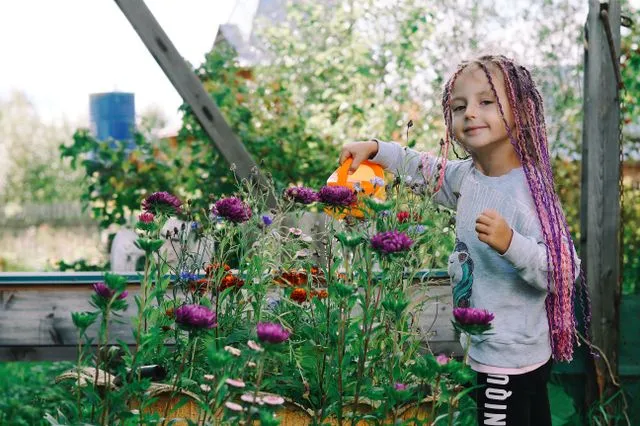
Let them look. Let them use a magnifying glass. Let them find the worm and put it back in the soil. Let them watch the bee on the flower for as long as they want. The time is not wasted. It is possibly the most concentrated science education they will receive all week.
What Gardening Teaches About Loss
I want to return to something I mentioned earlier, because I think it deserves more space.
Things die in gardens. Plants that were lovingly tended do not survive. Slugs are real. Frost comes. The tomato plant that a child has been watching for eight weeks gets a disease and collapses. These are genuinely disappointing events, and a child’s disappointment about them is real and should be acknowledged as such.
But they are also among the most valuable things the garden offers. Because they are the child’s first encounters with the irreversibility of natural processes — with the fact that living things are mortal, that care does not guarantee outcomes, that loss is part of the cycle of things — in a context that is meaningful but not devastating. The plant is not a person. The loss is real but survivable. And the response to it — the decision to plant again, to try differently, to understand what went wrong and adjust — is one of the most important responses a child can practice.
I have seen children cry over dead plants. I have never considered this disproportionate. They invested. The thing they invested in did not survive. Grief, proportionate to the investment, is the appropriate response. And the movement through that grief — toward understanding, toward trying again — is developmental in the most straightforward sense of that word.
For the broader connection between time in nature and children’s emotional wellbeing — including research on how outdoor environments and living systems support stress reduction and emotional development — the article on how nature contact supports children’s mental health provides the scientific context that complements what the garden offers experientially.
Starting With Children Who Are Not Interested
Not every child is immediately drawn to gardening. Some find it boring. Some do not like getting dirty. Some are impatient in ways that make the slow timescale of plant growth actively frustrating rather than educational.
None of this means gardening is not for them. It often means they have not yet found the entry point that connects with what they already care about.
A child who loves cooking can be drawn in through growing food — the herb they will use in a dish they choose. A child who is interested in insects can be drawn in through the wildlife dimension — planting for pollinators, setting up a bug hotel. A child who likes building things can be drawn in through garden construction — making raised beds, building plant supports, constructing a composting system. A child who is competitive can be drawn in through a growing contest — whose sunflower is tallest, whose pumpkin is biggest.
The garden is large enough to accommodate almost any existing interest. The adult’s job is to find the bridge rather than to demand that the child find their own way to enthusiasm for something they have not yet encountered in a way that speaks to them.
And for children who genuinely resist outdoor and nature-based activities, the question worth asking is not “how do I make them like gardening” but “what experiences do they have with the natural world at all?” A child who has almost no experience of being outdoors, of encountering living things in their environment, of having anything like a nature relationship — that child is missing something that is worth building gradually, starting wherever the child is willing to begin.
The garden is one entry point. But so is a window box. A bird feeder. A single plant on a desk. A walk where the parent points things out and shows genuine interest. The relationship with the natural world starts wherever it starts, and the starting point matters less than the consistency of the encounters that follow.
Frequently Asked Questions
At what age can children start gardening?
From the time they can hold a trowel, which is earlier than most parents assume — around two years old for simple activities like digging, pressing seeds into soil, and watering with a small can. The activities need to be matched to the child’s developmental stage: very young children enjoy the sensory aspects of soil and water and simple, fast-growing plants with dramatic results. Older children can manage more complex projects, longer timelines, and greater responsibility for the outcome.
What if I do not have any gardening knowledge myself?
This is, in some ways, an advantage. A parent who is also learning alongside their child is modeling something genuinely valuable: that it is fine not to know things, that finding out is part of the process, and that expertise is built through experience rather than arrived at fully formed. The basic knowledge required to grow a tomato plant or a pot of herbs is available in any gardening book or website and is genuinely not complicated. Start simple, accept that things will sometimes fail, and treat the failures as information rather than evidence of inadequacy.
How do I maintain a child’s interest across the whole growing season?
Match the plant selection to the child’s patience capacity. Very young children need fast-growing, immediately rewarding plants — radishes, cress, bean sprouts. Older children can manage longer timescales. Involvement in every stage helps: choosing what to grow, planting, watering, observing, harvesting, eating. When the child has genuine ownership — when it is their plant rather than the parent’s project — engagement sustains more naturally. Photographing growth over time gives children a record that makes the change visible and meaningful.
Is there any research on the mental health benefits of gardening for children?
Yes, and it is growing. Research on nature contact more broadly — including gardening — consistently finds associations with reduced anxiety, improved mood, lower cortisol levels, and better attentional capacity in children. The proposed mechanisms include exposure to soil microbiota (which appear to increase serotonin production), the restorative effect of natural environments on the stress response system, and the sense of agency and competence that producing something living provides. The research is not yet conclusive on all mechanisms, but the direction is consistent and the practical case is strong.
What do I do when a plant dies and my child is upset?
Acknowledge the feeling before moving to the practical response. “I know you’re sad about this — you worked hard on that plant and it mattered to you” is the right first move. Then, when the child is ready, help them understand what happened — not as a failure to feel bad about, but as information. Was it underwatering? Frost? A pest? What would we do differently next time? The movement from loss to learning is not rushed. But it is worth making, and the garden is a good place to practice it.
How much time does garden-based learning realistically require?
Much less than parents typically assume. A daily check-in of five minutes — looking at the plant, watering if needed, noting any change — is sufficient for most of the developmental work described in this article. The time investment is very low. What matters is the regularity and the child’s genuine engagement with it, not the number of hours spent. A child who looks at their tomato plant every morning for sixteen weeks has had significantly more developmental experience than one who spent a single afternoon in a garden activity.
Younes Kehal is an educational director, certified school coach, and certified life coach with 20 years of experience working with children, families, teachers, and schools. His guidance combines practical educational experience with carefully reviewed research.