
Play With Your Child: Why Twenty Minutes a Day Changes Everything
There is a kind of playing with children that most parents do regularly. Supervising play. Facilitating play. Being nearby while play is happening, available if something is needed. Occasionally redirecting or narrating. This is not nothing. It is genuinely useful. But it is not the same thing as actually playing — as being genuinely present in the activity, genuinely following the child’s direction, genuinely in the moment of the thing being created together rather than managing it from the outside.
The genuinely playing version is harder to achieve than it sounds. Not because parents do not love their children or do not want to play with them, but because the mental habits of adult life — the planning, the multitasking, the awareness of the next thing that needs to happen, the phone that is generating notifications in the pocket — make genuine absorption in a child’s play world difficult to sustain. And because there is a particular quality of self-consciousness in adult play with children that does not usually arise in adult life in other contexts: the feeling of performing an activity for the child rather than actually engaging with it.
Twenty minutes of actual play — undivided, genuinely present, following the child’s lead — produces effects that are significantly larger than twenty minutes of supervised play or facilitated play or nearby play. The research on this is specific and actionable, and it points toward a practice that most parents could implement without significant cost in time or resources, and that most parents are not doing in the specific way the research supports.
This article is about why it matters and how to actually do it.
Table of Contents
What the Research Shows About Parent-Child Play
The research on parent-child play and its effects on child development is one of the more consistent bodies of evidence in developmental psychology, and it converges on findings that are more specific than the general claim that playing with your children is good for them.
Secure attachment — the developmental outcome that most consistently predicts positive long-term outcomes across social, emotional, cognitive, and even physical health dimensions — is built through thousands of ordinary interactions between child and caregiver. The serve-and-return interactions that Harvard’s Center on the Developing Child identifies as central to early brain development — the child communicates something, the caregiver responds contingently, the child responds to the response — are precisely the structure of engaged, responsive parent-child play. Play is not a supplement to attachment-building. Play is one of the primary contexts in which attachment is built.
Language development is significantly accelerated by joint play in which the parent follows the child’s attention and provides contingent language input — naming what the child is looking at, describing what the child is doing, extending and expanding the child’s own language. The quality of language input in play is different from the quality of language input in instruction or management, because play-based language is grounded in the child’s immediate interest and attention in a way that produces better retention and faster vocabulary growth.
Executive function — the cognitive capacities of working memory, impulse control, and cognitive flexibility — is built and strengthened through play, particularly through the kind of collaborative, imaginative play that requires the child to maintain a character or a scenario, to manage the impulse to change the story when it is the other person’s turn to develop it, and to flexibly update the shared world as the play develops. Parent-child play that is collaborative and imaginative provides the executive function practice that solo play and supervised play do not.
Emotional regulation — the child’s ability to manage strong feelings without being overwhelmed by them — is supported by play that includes genuine emotional experience within a safe relational context. Play that involves excitement, frustration, disappointment, and resolution — and a parent who can hold all of this with the child without closing it down prematurely — is providing the regulatory experience that builds the neural infrastructure of emotional self-management.
What Genuinely Following the Child’s Lead Actually Means
The research on parent-child play consistently identifies “following the child’s lead” as the parental behaviour most predictive of positive outcomes. This phrase is used so often that it has nearly lost its meaning. It is worth unpacking what it specifically does and does not mean.
Following the child’s lead means the child decides what the play is, how it develops, what happens next, and when it ends. Not the parent. Not a compromise between what the parent thinks would be educational and what the child wants. The child’s agenda governs the play, entirely, for the duration of the play session.
This is different from being passive. The parent is actively engaged — following the scenario, contributing responses that are consistent with the child’s direction, providing language and narration and emotional presence. But the direction is the child’s. The parent is not steering, not redirecting toward more educational content, not introducing new elements that change the nature of the activity toward something the parent prefers. They are following.
What this looks like in practice: the child says the dolls are going to the moon. The parent does not say “let’s also make it about science.” The parent says “what will they find when they get there?” The child says the moon is made of cheese. The parent does not correct this. The parent says “what kind of cheese?” The child describes an elaborate moon cheese environment. The parent follows. That is following the child’s lead.
What it does not mean: letting the child do things that are genuinely unsafe or unkind. The child can lead the play without leading toward hurting themselves, hurting others, or breaking things. Within the space of what is safe and reasonable, the child’s direction is absolute.
What it does not mean: pretending to follow while actually steering. The parent who lets the child choose the activity but then gradually introduces their own preferences, who joins the imaginative play but slowly redirects it toward something more educational or more organised, who says “yes, and” but adds things that shift the play’s direction — this parent is not following the child’s lead. They are managing the play with a lighter hand. The difference is real and the child feels it.
Why This Is Hard for Most Adults
The specific quality of attention that genuinely following the child’s lead requires is one that adults have typically become less good at over time. Children in play are absorbed. They are completely in the thing they are doing. Their attention is fully present in a way that adults, trained by decades of multitasking and interrupted attention, often find genuinely difficult to match.
There is also a particular discomfort in adult imaginative play that is worth naming honestly, because it is a real barrier that most parenting resources do not acknowledge. Most adults feel somewhat self-conscious doing imaginative play. Giving voices to figurines, playing out a scenario with dolls, being a character in a story — these activities involve a loss of the self-monitoring that adult social life requires and that most adults find difficult to genuinely suspend. The parent who is half-playing and half-aware of how they look, who is giving the character a voice but with one part of their attention on the absurdity of the activity, is not fully in the play. The child experiences the half-presence. The child benefits significantly less.
The phone is the most immediate and most visible barrier. A parent whose phone is in the room during play — even face-down, even silenced — is a parent who is managing their attention between the child and the device. The research on smartphone-adjacent parenting is increasingly specific about the cost: children whose parents are frequently distracted by phones during interaction show reduced attachment security, reduced language development in younger children, and increased bids for attention — more demanding behaviour — compared to children whose parents are genuinely present. The twenty-minute play session works best when the phone is not in the room.
The Specific Practice: What It Looks Like
The research on parent-child play has been translated into a specific clinical intervention — Child-Directed Play, also called Special Time or Descriptive Play — that has been used in family therapy and parent-child relationship work for decades and that has a strong evidence base. The principle is simple enough to be described in a few sentences. The practice is simple enough to begin today. The consistency required is the part that most families find challenging.
The practice: once daily, for approximately fifteen to twenty minutes, the parent gives the child undivided attention and genuinely follows the child’s lead in whatever play the child chooses. The phone is elsewhere. There are no instructions to do homework instead or to tidy up first. For twenty minutes, the child’s agenda governs. The parent observes, describes what they see, reflects what the child seems to be feeling, and follows without directing.
During this time, the parent specifically does not: give instructions, ask testing questions (“what colour is that?”), teach, redirect toward more productive activity, praise performance (“good job!”), or criticise. The relationship between parent and child during this time is play partner, not teacher, not evaluator, not manager.
The parent specifically does: narrate (“you’re building a really tall tower”), describe (“that one is going on the very top”), reflect emotion (“it fell — that looked so frustrating”), and follow interest wherever it leads.
This practice, implemented consistently for three to four weeks, produces measurable changes in children’s behaviour — specifically, reductions in the attention-seeking behaviour and defiance that are the most common presenting complaints in early childhood — and measurable changes in parents’ experience of the relationship. Both the child and the parent report feeling more connected. The child’s demanding behaviour in other contexts typically reduces, because the demand for parental attention has been met at a level that carries across the day.
What It Changes — The Mechanism
Understanding why twenty minutes of genuine play produces effects that extend across the rest of the day and across the relationship helps with the motivation to maintain the practice when life makes it difficult.
The child who receives twenty minutes of genuine, undivided, child-directed parental attention every day is a child whose attachment needs are being met in a specific and reliable way. Attachment anxiety — the child’s implicit worry about whether the parent is available, attentive, and responsive — is reduced. The child who is not worried about whether they have the parent’s attention does not need to work as hard to obtain it through behaviour. This is the mechanism by which consistent special play time reduces the demanding behaviour that most parents find exhausting: not by addressing the behaviour directly, but by addressing the underlying need that the behaviour was meeting.
The quality of the parental attention during child-directed play is also the quality of attention that builds secure attachment — the kind that says “I see you, I’m with you, your experience matters to me.” This is different from the attention that monitors, manages, or evaluates. A child who experiences twenty minutes of being seen, without being managed, is a child who has had their fundamental relational needs met in the most direct way available. This carries forward.
The parent who has spent twenty minutes genuinely present with their child also experiences a shift. The relationship, experienced from the inside of it rather than the outside, feels different. The child who was demanding and frustrating an hour ago becomes visible as a person who is navigating a world they are still learning to navigate, who is working out how to be in relationship with other people, who is doing the genuinely hard work of development. The parent’s emotional response to the child shifts, in ways that are real and that change the quality of interaction across the rest of the day.
| During the Play Session | Does This | Avoids This |
|---|---|---|
| Directing attention | Follows child’s attention: “you’re looking at the red one” | Directs to something more interesting or educational: “let’s do this piece next” |
| Describing and narrating | Describes what child is doing: “you’re putting the small one inside the big one” | Testing questions: “what shape is that?” / “what colour is this?” |
| Responding to emotion | Reflects feeling: “that fell — you look disappointed” | Fixing: “it’s okay, let’s try again a different way” |
| Following imaginative direction | Accepts and extends child’s fiction: “what happens next?” | Corrects or redirects: “that’s not how that works — let’s do it this way” |
| Praising | Acknowledges: “you worked really hard on that” | Performance praise: “amazing! that’s perfect! genius!” |
| Presence | Phone is elsewhere; full attention on the child | Phone nearby; half-attention; mental planning while playing |
Play With Older Children: How It Changes
The principle of following the child’s lead and providing genuinely present, undivided attention remains valuable across childhood and into adolescence, but the form of the play changes significantly.
With children in middle childhood — roughly six to eleven — the play often shifts toward games with rules, collaborative projects, shared physical activity, or conversation about the child’s interests. The child-directed play principle adapts: the parent still follows the child’s lead, still engages with what the child is genuinely interested in rather than steering toward something the parent thinks is more valuable, and still brings genuine presence rather than managed participation.
With adolescents, what looks like “play” from the outside often looks different: a walk together, watching something the teenager has chosen, talking about something the teenager cares about, driving somewhere together with the kind of car conversation that adolescents often find less threatening than face-to-face conversation. The same principles apply. Genuine presence. The teenager’s agenda. Curiosity without evaluation. No phone. Twenty minutes that belong to the relationship rather than to anything else.
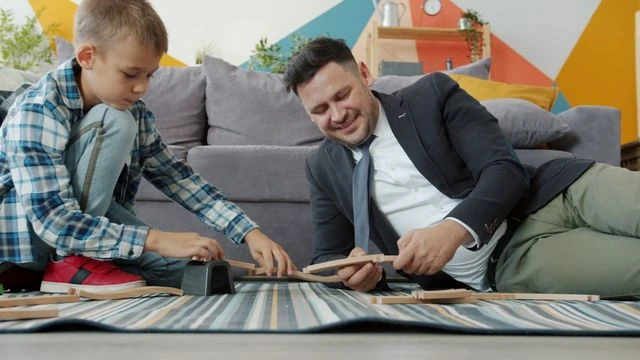
Research on adolescent wellbeing and the parent-child relationship consistently identifies daily positive interaction — even brief, even informal, even apparently trivial — as one of the strongest predictors of adolescent mental health and of whether the teenager feels they can bring the difficult things to the parent. The relationship bank is filled by the small ordinary deposits, not the rare significant ones. Twenty minutes of genuinely being with the child or teenager, every day, is one of the highest-return investments in the relationship available to most parents.
The Guilt About Not Playing
Parental guilt about not playing enough with children is extremely common and rarely useful. It produces either avoidance — finding ways not to think about it — or compensatory overreach — sudden intense play sessions that are driven by the guilt rather than by genuine presence. Neither of these serves anyone.
The honest account is simpler: most parents play less genuinely with their children than they imagine and less genuinely than their children benefit from. Not because they are bad parents, but because the specific quality of play described in this article is different from the everyday management of children’s activities and is genuinely hard to maintain. Acknowledging this without turning it into a source of shame is the starting point for actually changing something.
The practice described here — twenty minutes, once daily, phone elsewhere, child’s agenda — is achievable by most parents. Not easily, and not without effort, but achievable. And the research on what it produces — in the child’s behaviour, in the child’s development, in the parent’s experience of the relationship — justifies the effort.
It is genuinely one of the highest-return things available in a family’s daily life. Not because playing is magical. Because being genuinely seen by the person you most need to be seen by is one of the most significant experiences available to a child. And twenty minutes of that, daily, accumulates into something.
For the broader context of what play does for child development — including the specific cognitive, emotional, and language benefits of different types of play that this article has described in the context of parent-child interaction — the article on why boredom and unstructured time are more valuable than most parents assume provides the complementary perspective on what child-directed play produces even when no parent is present. And for the specific research on how the quality of caregiver-child interaction shapes early brain development — including the serve-and-return dynamic that is essentially the structure of the twenty-minute play practice described here — the article on why the first three years are not primarily about teaching covers the neuroscience that underpins everything described in this article.
| Domain | What Consistent Child-Directed Play Builds | Evidence Strength |
|---|---|---|
| Attachment security | Reduces attachment anxiety; builds felt sense of being seen and available | Very strong — core mechanism of attachment-based interventions |
| Language development | Vocabulary; complex syntax; narrative language; serve-and-return conversational patterns | Very strong — contingent play language is the highest-quality language input |
| Executive function | Impulse control; working memory; cognitive flexibility through collaborative play | Strong |
| Emotional regulation | Emotional experience within safe relational context; co-regulation with present caregiver | Strong — particularly for children with regulatory difficulties |
| Behavioural outcomes | Reduced demanding behaviour; reduced defiance; reduced attention-seeking | Strong — consistently found in child-directed play intervention research |
| Creativity and imagination | Sustained imaginative play; narrative elaboration; creative problem-solving | Moderate to strong — adult co-play extends imaginative capacity |
Frequently Asked Questions
My child is very young — does play with me matter at this age?
It matters most at the youngest ages, precisely because the foundations of attachment, language, and brain development are being built most rapidly. A parent who engages in genuine serve-and-return play with an infant — following the baby’s gaze, responding to sounds and movements, making eye contact and sustaining it, allowing the baby to set the pace — is providing the most impactful developmental input available at this stage. The twenty-minute practice applies even to infants, though the form of play is simpler and more sensory at this age.
My child says they don’t want to play with me and prefers playing with friends or alone. What should I do?
Respect the stated preference while remaining genuinely available. A child who says they do not want to play with a parent is sometimes accurately reporting a preference, sometimes testing availability (will you stay interested if I push you away?), and sometimes communicating something about the quality of previous parent-child play experiences that is worth reflecting on. Making yourself available, genuinely and without pressure, and following the child’s lead when they do choose to engage, is more productive than insisting on structured play time. The twenty-minute practice does not require the child to be enthusiastic. It requires the parent to be genuinely present and truly following.
I find playing with children genuinely boring. Is that normal?
Extremely common and worth being honest about. Many adults find the specific demands of child-directed play — the repetition, the pace, the content — genuinely difficult to sustain. This does not mean you love your child less. It means you are an adult who has been shaped by adult pace and adult concerns, and that child play is genuinely different from adult activities. The self-consciousness described earlier in this article is also very common. The practice of genuinely following the child’s lead, rather than performing participation, often makes the experience less boring, because you are actually in the child’s imaginative world rather than observing it from outside. But it is worth being honest: for most parents, this practice takes discipline rather than enthusiasm, at least at first.
How important is it that I do this every day rather than just a few times per week?
The consistency is significant. The mechanism by which child-directed play reduces demanding behaviour and builds secure attachment involves the child’s implicit understanding that parental attention is reliably available — that the special time will happen, that it is a reliable feature of the day. An occasional intensive play session produces less of this regulatory effect than a consistent daily practice, because the child’s nervous system learns through repetition rather than through single events. That said, some is better than none, and a pattern of most days is more realistic and more sustainable than an all-or-nothing standard.
My teenager would think this was weird. Can the same principle apply to older children?
Yes, with very different form. A teenager does not need twenty minutes of imaginative play. They need twenty minutes of genuine, undivided parental attention doing something they have chosen — driving somewhere together, watching a programme they like, talking about something they are interested in — without the parent’s phone, without the parent’s agenda, without evaluation or instruction. The principle is identical. The application is different. The research on adolescent wellbeing supports the daily positive interaction as strongly as the early childhood research supports the play session — it just looks like a conversation rather than playing with figurines.
Both my children want to play with me at the same time. What do I do?
Ideally, brief individual sessions with each child, at different times of day. The one-to-one quality is important — the child who is sharing the parent’s attention with a sibling during special time is not receiving the undivided attention that produces the attachment and regulatory benefits. This is a logistical challenge that requires some creative scheduling, and it is not always possible to maintain individual sessions every day. When only joint play is available, it is still valuable — genuinely present, child-led, phone-free play with multiple children is significantly better than supervised or managed play. But the individual session is worth protecting where possible.
Younes Kehal is an educational director, certified school coach, and certified life coach with 20 years of experience working with children, families, teachers, and schools. His guidance combines practical educational experience with carefully reviewed research.