Puzzles and What They Are Actually Teaching Your Child: A Developmental Guide
Puzzles give children opportunities to compare shapes, turn pieces, try strategies, and talk through a shared problem. The most useful choice is a safe puzzle your child wants to explore, with enough support to keep the experience manageable.
Research suggests a relationship between early puzzle play and later spatial skills, but it does not prove that puzzles alone improve intelligence, school results, or lifelong resilience. Their everyday value also includes enjoyment, conversation, and time together.
To get started, choose a manageable puzzle, let your child try, and offer a small hint when needed. A familiar puzzle is still worthwhile, and a break is always an option. This guide explains the benefits of puzzles for kids without turning play into a test.
Table of Contents
Puzzles and Spatial Reasoning: What the Research Shows
Spatial reasoning involves thinking about shapes, positions, and how objects relate to one another. A jigsaw provides a concrete opportunity to explore these relationships: a child can compare a gap with a piece, rotate it, and check the result.
In a study described by the University of Chicago, researchers observed 53 parent–child pairs during home visits. Children observed playing with puzzles between 26 and 46 months performed better on a spatial transformation task at 54 months, after accounting for factors including parental income, education, and overall language input.
This was an observational study, so it cannot establish that puzzle play caused the difference. The finding also does not show that other kinds of play lack value or that a particular puzzle routine guarantees later success in mathematics.
For parents, the practical opportunity is straightforward: offer puzzles alongside other enjoyable activities and notice how your child approaches them. Avoid using puzzle performance to label a child as clever, behind, or unsuited to a subject.
What Children Practise While Solving a Puzzle
During a puzzle, you can observe several kinds of activity. A child may remember a feature they are looking for, compare colors, turn a piece, or switch to a different part of the picture. These observations describe what the task involves; they do not establish broad improvements in the same skills outside the task.
Keep the reference picture available. Looking back at it is a useful strategy, not a failure of memory. A child can also experiment by physically turning a piece rather than having to imagine the rotation first.
Simple planning can become part of play: “Shall we look for the animal first, or find the straight edges?” Let the child try a strategy and change it when it is not useful.
Harvard’s Center on the Developing Child offers an activities guide for practising executive function and self-regulation through varied games and interaction. It provides a broader set of options; puzzles are one possible activity, not a substitute for a varied play experience.
The Frustration Tolerance Dimension
A piece that will not fit offers a chance to practise handling a small difficulty. The aim is to keep that difficulty manageable, not to produce frustration or test how long your child will tolerate it.
Watch the child rather than the piece count. A frown followed by another attempt is different from escalating distress, tears, or throwing pieces. Tiredness, hunger, sensory discomfort, and an unclear picture can all make the same puzzle feel harder on a different day.
Pause when needed. Help your child settle, then offer a choice: try together, use a simpler puzzle, or stop for now. One puzzle session does not determine whether a child will become persistent or resilient.
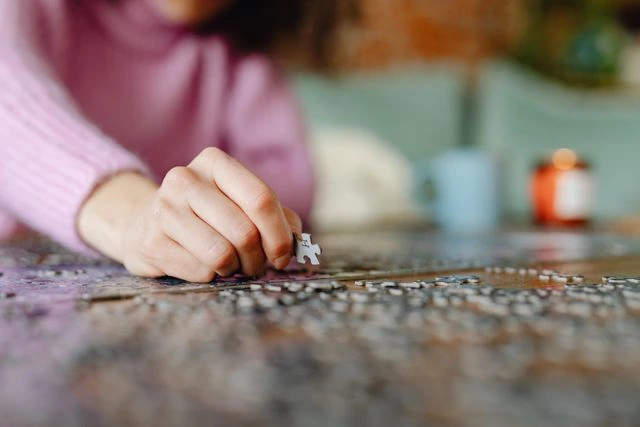
Use the smallest amount of help that is useful. You might point to the relevant part of the picture, reduce the choice to two pieces, demonstrate one turn, or place a piece together. Then offer the child another turn.
For example: “That piece isn’t fitting, and it’s frustrating. Would you like a hint or a break?” Helping does not erase learning. Leaving a child overwhelmed in order to preserve a challenge is not necessary.
Puzzles and Language Development
Puzzles provide an easy setting for using words about position and shape. Describe what you are actually doing: “This goes beside the tree,” “Let’s turn it,” or “The corner has two straight edges.”
Match the language to the child. With a young beginner, one clear word and a gesture may be enough. With an older child, ask how they chose a piece or what they want to try next. Leave space for their explanation instead of narrating every move.
This creates opportunities to hear and use spatial vocabulary. It should not be presented as proof that puzzle conversations contain more spatial language than every other form of play, or that they will automatically improve reading and mathematics.
Use the language your family is comfortable speaking. You can point, gesture, or take turns demonstrating; participation does not depend on the child giving a verbal answer.
How to Choose Puzzles for Different Ages
Begin with the manufacturer’s age and safety guidance, then adjust for your child’s experience, interests, vision, and ability to handle the pieces. Piece count is only one aspect of difficulty: clear pictures, contrasting colors, the shape of the pieces, and a visible outline can matter just as much.
Keep small pieces away from children under three and from children who still mouth objects. The U.S. Consumer Product Safety Commission explains small-parts choking hazards. Check for loose or damaged components, and consider younger siblings who may reach an older child’s puzzle.
| Starting point | What to try | How to adjust |
|---|---|---|
| Toddler beginning to match shapes | An age-rated inset puzzle with large, securely made pieces | Begin with a few pieces and show one example. |
| Preschooler new to jigsaws | A simple puzzle with an appealing picture and clear visual cues | Offer fewer loose pieces or work on one recognizable section. |
| Child comfortable with simple jigsaws | A somewhat larger puzzle with a reference picture | Increase one challenge at a time and watch enjoyment. |
| Experienced school-age child | A larger or three-dimensional puzzle they choose | Use a tray or safe workspace so it can continue across sessions. |
These are starting ideas, not developmental milestones. A child does not need to complete a set number of pieces by a birthday. If they enjoy an easier puzzle, keep it available while offering alternatives.
For children who find gripping, seeing, or organizing pieces difficult, try larger pieces, stronger contrast, a stable surface, or fewer pieces at once. Adapt the activity to the child instead of treating difficulty with one puzzle as a measure of ability.
The Social Dimension: Puzzles Together
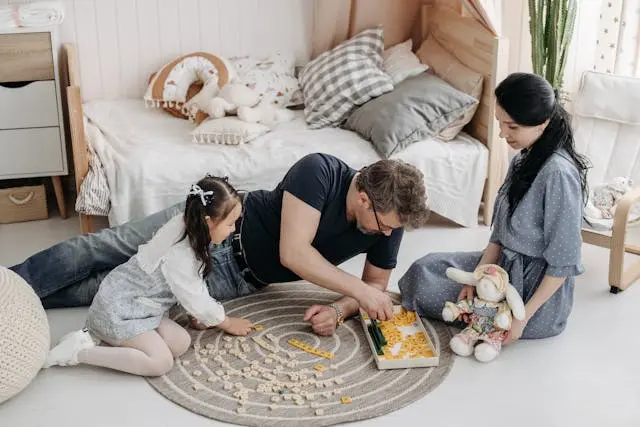
Doing a puzzle together creates a shared task. Agree on a simple arrangement: one person looks for the sky, another for an animal, or each takes a turn choosing a piece.
If two children want the same piece, help them work out a turn or shared action. Avoid assigning one child the role of doing all the easy pieces unless that is what they want. A shared puzzle can be cooperative without becoming a competition.
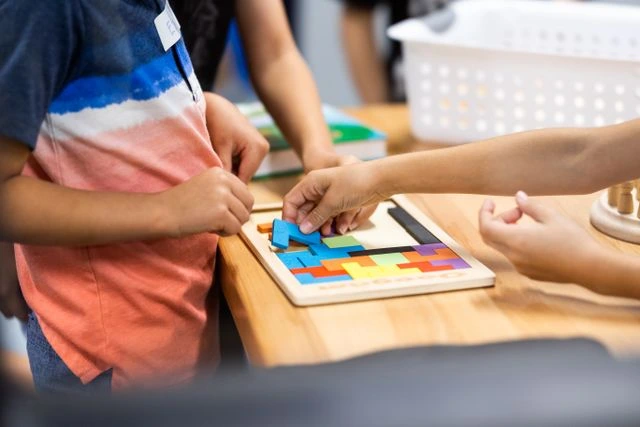
Explain what you are looking for so others can join: “Has anyone seen a piece with a yellow line?” Invite help without taking over. Some children prefer quiet parallel play, and that can be enjoyable too.
For another shared activity, our guide to family game nights includes ways to respond when a child is upset about losing. In both settings, calm support comes before a discussion about trying again.
Puzzles and Screens: A Direct Comparison
Physical and digital puzzles offer different experiences. A physical piece can be held and turned in the hand; an app may offer adjustable size, audio instructions, or other accessibility features. The value depends on the child, the activity, and how it is used.
It is too broad to say that every physical puzzle produces greater developmental benefits than every digital puzzle. The observational preschool study discussed earlier did not test that comparison.
| Format | What to consider |
|---|---|
| Physical puzzle | Handling pieces and sharing a workspace; storage, missing pieces, and small-parts safety. |
| Digital puzzle | Accessibility and adjustable difficulty; ads, in-app purchases, distractions, and screen routines. |
| Either format | Whether the child enjoys it, has room to think, and gets useful support. |
Choose the format that fits the purpose and the child. Check how much automatic help a game provides and whether it allows a child to make choices. Hints can support participation; their presence alone does not make an activity dishonest or unhelpful.
What Parents Should — and Shouldn’t — Do
A helpful puzzle session leaves room for the child to act and for the adult to support. Try the following sequence as an example, not a required lesson plan.
1. Invite a choice. Offer two safe options: “Would you like the animals or the vehicles?” Clear enough space to see and move the pieces.
2. Notice the approach. Ask, “Where would you like to start?” If the child is unsure, demonstrate one useful action and offer them the next turn.
3. Give specific feedback. “You turned it and checked again” describes an action the child can recognize. It is also fine to share their excitement when a piece fits; encouragement does not need to follow a perfect script.
4. Adjust or stop. Offer a hint, reduce the number of pieces, work together, or take a break. Finishing is optional. Put the puzzle somewhere safe if your child wants to return to it.
Before buying a harder puzzle, consider whether the current one is still enjoyed or whether a small change in how you play together would help. Our article on why children may ignore expensive toys explores choosing and enjoying toys with your child.
Frequently Asked Questions
My child gets frustrated and gives up. Should I be concerned?
Not from one activity alone. Check whether the puzzle is too difficult, whether the child is tired, and what help they want. Offer a simpler option or a break. If difficulties are persistent across everyday activities or you have broader developmental concerns, discuss them with an appropriate professional.
Should I do the puzzle for my child to show them how?
A brief demonstration can help. Show one technique, such as matching a color or turning a piece, then invite the child to try. You can also solve it together if that is enjoyable; the aim is participation, not a rule that adults must never place a piece.
My child only wants to do the same puzzle over and over. Is this okay?
Yes. Repetition and familiarity can be enjoyable. Keep offering choices without removing a favorite simply because it has become easy. There is no need to make every play session harder than the last.
Are 3D puzzles worth buying?
They may suit a child who wants to try them, but they are not necessary. Follow the product’s age and safety guidance and consider handling difficulty, small parts, and interest. A borrowed or familiar flat puzzle can be just as suitable for a relaxed shared activity.
My child’s school does puzzles in class. Do I need to do them at home too?
Only if your child enjoys it and it fits family life. There is no established puzzle quota that parents must add to school activities. Offer a variety of play opportunities; building, drawing, movement, and conversation also deserve space.
Younes Kehal is an educational director, certified school coach, and certified life coach with 20 years of experience working with children, families, teachers, and schools. His guidance combines practical educational experience with carefully reviewed research.