Why Every Child Needs Art — And It Has Nothing to Do With Being Talented
At some point — usually around age eight or nine — something happens in most children’s relationship with art. The fearless, joyful drawing that characterized their early years begins to slow. They look at what they have made and compare it with what they wanted it to be. They look at what other children make. They start to say the words that follow them for the rest of their lives: I can’t draw. I’m not artistic. I’m not creative.
And in most households, those words go largely unchallenged. Because the assumption behind them — that art is something you either have a gift for or you do not — feels intuitively correct. We do not question it. We accept it, file our child under “not the artistic one,” and move on.
In over twenty years of working in educational settings, I have watched this happen hundreds of times. And I have watched what it costs children — not in terms of artistic potential, which is genuinely not the point — but in terms of the cognitive skills, emotional vocabulary, and creative thinking capacity that regular engagement with art builds, regardless of how good the resulting drawing looks.
Because here is what the research shows, and what most parents do not know: art is not primarily about artistic ability. It is about brain development. And every child — not the gifted ones, not the creative ones, every single child — needs it.
Table of Contents
What Happens in the Brain During Creative Activity
When a child picks up a paintbrush, rolls a piece of clay, cuts a shape from paper, or builds a collage from whatever is on the kitchen table — something specific and remarkable happens in the brain that does not happen in almost any other activity available to them.
Research consistently demonstrates that creative arts and crafts activities stimulate multiple areas of the brain simultaneously, creating neural connections that support learning across all subjects. The visual cortex is processing what the child sees. The motor cortex is managing the hand movements. The prefrontal cortex is planning and making decisions. The emotional processing centers are engaged with the meaning of what is being created. And all of these regions are in active communication with each other — building the neural connections that underpin learning in domains far beyond art itself.
In the first few years of life, more than one million neural connections are made per second in the brain. This process is most efficient when a child’s senses are fully activated — and art, which engages sight, touch, proprioception, and sometimes smell and hearing simultaneously, is one of the most reliably complete sensory activators available. The child painting at the kitchen table is not just making a picture. They are building a brain.
Comparing children who engage regularly in artistic activities with those who do not, research found that art-involved children exhibited greater creativity, evidenced by higher scores on measures of fluency, flexibility, and originality of ideas, alongside better problem-solving skills and enhanced abilities in identifying and working through challenges. These are not artistic skills. They are cognitive skills — the kind that transfer directly into academic performance, professional life, and the capacity to navigate an uncertain future.
The Six Things Art Builds That Have Nothing to Do With Art
1. Fine Motor Skills and Hand-Eye Coordination
Every time a child cuts with scissors, holds a pencil to draw a careful line, squeezes glue from a bottle, or presses clay into a shape — they are building the fine motor control and hand-eye coordination that underpins handwriting, keyboarding, and dozens of practical daily tasks. Art activities naturally strengthen the muscles in a child’s hands and fingers, developing the precise motor control that no amount of gross motor play can replicate.
For children who struggle with handwriting — including those with dysgraphia or developmental coordination difficulties, as we discussed in our article on supporting children with learning disabilities — regular, enjoyable art activities are one of the most effective and least resistive routes to improving the fine motor foundations that writing requires. A child who finds handwriting painful and frustrating will often happily spend an hour sculpting, cutting, or painting — and the skills transfer.
2. Spatial Reasoning and Mathematical Thinking
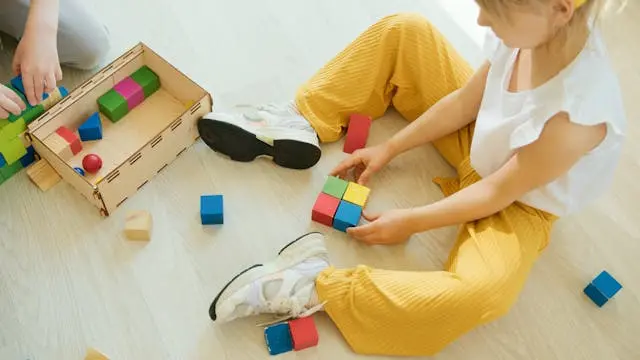
Art significantly boosts spatial reasoning — the ability to comprehend and manipulate shapes, dimensions, and spatial relationships. Children learn to understand how a three-dimensional object translates into a two-dimensional representation. They explore symmetry, pattern, proportion, and geometry in a context that is engaging and tactile rather than abstract.
The connection to mathematical thinking is direct and well-documented. The child who has spent years playing with clay and building structures has an intuitive grasp of volume, proportion, and spatial relationships that the child who has not engaged with these materials simply lacks. When that child encounters geometry in school, the concepts land on neural groundwork that art has been building for years.
3. Emotional Expression and Self-Regulation
Art gives children a language for experiences they cannot yet put into words. The child who cannot articulate that they are anxious about starting a new school may be able to express it in a drawing. The child who cannot explain the grief of losing a pet may work it through in a piece of clay. The child who is overwhelmed by the complexity of a difficult social experience may find in painting a processing space that words do not yet provide.
This is not just anecdotal. Research confirms that sensitive children in particular see an increase in self-worth and emotional processing through participation in the arts. The art-making process — especially when it is free and non-directed, when the child is making choices rather than following instructions — builds the capacity for emotional expression and self-regulation that is foundational to mental health.
For children who struggle with emotional regulation — including those with ADHD, sensory processing differences, or anxiety — art offers something genuinely valuable: a regulated, absorbing, low-stakes activity that provides sensory input, requires focused attention, and produces a sense of mastery and completion. As we noted in our article on understanding sensory processing disorder, art activities are frequently used by occupational therapists as part of a sensory diet for exactly this reason.
4. Problem-Solving and Creative Thinking
Every creative project involves a series of decisions, challenges, and revisions. The paint is not the color you expected. The glue is not holding the way you planned. The shape you cut is not quite right. What do you do? You adapt. You experiment. You try something different. You discover that the accident actually looks interesting. You learn, at a deep neurological level, that problems have multiple possible solutions and that failure is frequently the first step toward something better.
When children are given the opportunity to create something with their hands, they are forced to think critically about what they are doing and how to go about completing the task. This process of problem-solving and decision-making strengthens cognitive skills in ways that transfer directly into academic and real-world settings. The child who has learned through years of creative projects that unexpected results are opportunities rather than failures brings a fundamentally different relationship to challenge — in school, in work, and in life.
5. Focus, Persistence, and the Ability to Tolerate Frustration
A child absorbed in a creative project demonstrates something that is increasingly rare in an environment of instant gratification and constant stimulation: sustained, voluntary attention to a single task over an extended period. The focus required to complete a detailed drawing, a collage, or a sculpture is genuine executive function practice — and it is practiced in a context the child finds intrinsically rewarding, which makes it significantly more effective than most formal attention exercises.
Art also teaches persistence in a uniquely low-stakes environment. The drawing that does not look right can be drawn again. The clay shape that collapses can be rebuilt. There is no wrong answer, no failed test, no grade. This makes art one of the safest environments in which children can practice the tolerance for frustration and the willingness to try again that underpin genuine learning in every domain. As we explored in our article on why family game night matters for development, learning to manage frustration in low-stakes contexts is one of the most important developmental skills available — and art provides this just as powerfully as play.
6. Identity, Confidence, and a Sense of Personal Voice
When a child creates something — genuinely creates it, from their own imagination, with their own choices, in their own way — they produce something that is uniquely theirs. Not a correct answer that any other student could have produced. Not a test score that places them in a percentile. Something that reflects who they are, what they notice, what matters to them.
This experience of authorship — of having a voice that expresses something real and unique — is profoundly important for developing identity and self-worth. Children gain self-esteem and confidence as they express themselves through various artistic media. For children who struggle in academic settings — who have learned to associate school with failure and inadequacy — art can be one of the rare contexts where they experience genuine competence and pride in something they have made.
That experience does not stay in the art room. It becomes part of how the child understands themselves.
The Mistake Most Parents Make: Focusing on the Product
Here is the most important practical insight in this entire article — and the one that makes the biggest difference in whether art actually delivers its developmental benefits for your child.
When a parent watches their child draw or paint and says “That’s beautiful — what is it?” they are, without realizing it, evaluating the product. When a parent says “Wow, I can see you spent a long time on that — tell me about what you were making,” they are acknowledging the process. These two responses seem similar. They produce very different outcomes.
The developmental benefits of art come almost entirely from the process — the thinking, the deciding, the problem-solving, the experimenting, the persistence, the emotional engagement with what is being made. The product is simply the artifact of the process. A child whose parent consistently focuses on the product — whether it is beautiful, whether it is recognizable, whether it is better than last time — gradually learns to create for external approval rather than internal expression. And when the product does not meet expectations, the child stops creating.
Open-ended play that allows imagination and little to no restriction has been shown to be particularly beneficial for young children and can help to foster a lifelong love of creativity and self-expression. The operative words are “open-ended” and “little to no restriction.” Art that is done to a template, that must follow prescribed steps and produce a recognizable result, that is evaluated on how closely it matches an adult’s standard — that art loses most of its developmental power. The mess, the unexpected result, the “wrong” color choice, the collage that looks nothing like what you expected — these are not problems. They are the process itself.
The Talent Myth — and Why It Matters
Let us return to that moment at age eight or nine when children begin to say “I’m not artistic.” What is actually happening there is not a discovery of genuine limitation. It is the convergence of two things: the development of self-evaluation skills, and the persistent cultural message that art is for the talented.
This message does significant damage — not primarily to future artists, but to every child who internalizes it and stops engaging with creative activity as a result. Because what they are giving up is not a career path. It is all of the cognitive, emotional, and social development that regular creative engagement produces. They are not deciding they will not be artists. They are deciding, without knowing it, to stop building a significant portion of their brain’s capacity.
The research on this is unambiguous: art is a developmental tool, not a performance. A child’s drawing does not need to look like anything in particular to be building spatial reasoning. Their sculpture does not need to be beautiful to be building fine motor skills. Their painting does not need to impress anyone to be building emotional expression and self-regulation. The quality of the product is entirely irrelevant to the quality of the developmental process.
When you tell your child — or allow them to believe — that they are “not the artistic one,” you are not protecting them from disappointment. You are removing from their daily life a developmental activity that their brain genuinely needs. And you are doing it based on a criterion — artistic talent — that has nothing to do with why art matters for development.
How to Bring More Art Into Your Family’s Life: Practical Strategies
1. Keep Materials Accessible — Always
The single most effective thing you can do to increase your child’s creative engagement is to make art materials constantly available without requiring any special setup or parental involvement. A low shelf or box with paper, crayons, scissors, glue, and basic craft materials that your child can access independently — whenever the impulse strikes, without asking permission, without a designated “art time” — produces dramatically more creative activity than materials stored in a cupboard that require adult supervision to access.
Children create most freely and most developmentally richly when the impulse and the materials meet without friction. Remove the friction.
2. Prioritize Process Over Product — Consistently
Practice asking process-focused questions instead of product-focused ones:
- Instead of “What is that?” try “Tell me about what you were thinking when you made this.”
- Instead of “That’s beautiful!” try “I can see you worked really hard on this. What was the trickiest part?”
- Instead of “Why did you use that color?” try “What made you choose that?”
- Instead of comparing to previous work, notice what is present: “I see you tried something new here with the texture.”
These questions communicate that the thinking and the making matter — not the result. And that communication, repeated over years, shapes how your child relates to creative activity for the rest of their life.
3. Create Alongside Them — Without Being Better
When parents create alongside their children — drawing, painting, or building something of their own, without directing the child’s work — two things happen. The child sees a model of an adult who values creative activity enough to engage in it themselves. And the parent’s presence communicates that this matters, that it is worth the time, that creativity is something adults do too.
The important qualifier is “without being better.” A parent who produces an impressive drawing while their child struggles creates an unspoken comparison that is discouraging. A parent who draws something simple and imperfect, who says “I’m not sure how to make this look right — I’ll try something else,” who engages with the creative process with genuine curiosity and tolerance for imperfection — that parent is modeling exactly the relationship with creative activity you want your child to develop.
4. Go Beyond Drawing and Painting
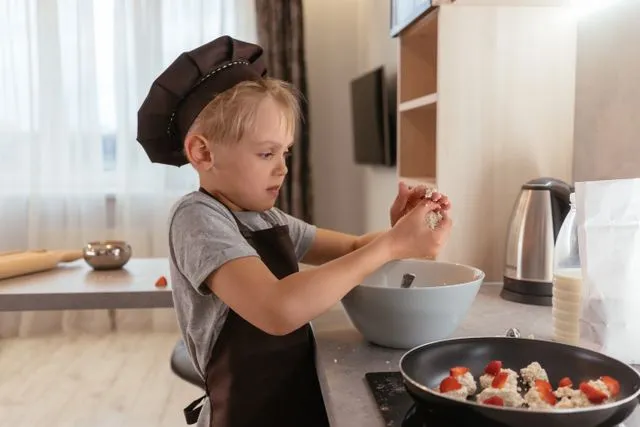
For children who have decided they “can’t draw,” it is worth remembering that art extends far beyond drawing and painting. Clay and sculpture. Collage and paper craft. Textile art — weaving, sewing, printing with fabric. Photography. Making music. Cooking as creative expression. Woodwork. Garden design. Digital art. Architecture with cardboard and tape.
Every one of these engages the creative process and builds the developmental skills that art provides — often in different combinations. A child who finds drawing frustrating may lose themselves completely in clay, or in collage, or in building miniature worlds from cardboard. Finding the artistic medium that resonates with your specific child’s particular sensory and creative preferences is often all that stands between “I’m not artistic” and genuine, sustained creative engagement.
5. Resist the Urge to Fix or Guide
This is the hardest one for parents who care about the quality of what their child produces — and it is the most important. When your child’s drawing does not look right, when the proportions are off, when the color choices seem strange, when the structure is clearly going to fall over — resist the urge to correct, to suggest, to guide toward a better result.
The child who figures out themselves why the structure fell and how to build it differently has learned something that will serve them for life. The child whose parent stepped in and fixed it has learned that their own judgment is insufficient and that adults know better. The first lesson builds an inventor. The second builds someone who waits to be told what to do.
Step back. Let it be imperfect. Trust the process.
Art at Different Ages: What Developmental Stage Looks Like
| Age | What Creative Activity Looks Like | What It Is Building |
|---|---|---|
| 1–2 | Finger painting, smearing, tearing paper, banging and squeezing materials — pure sensory exploration | Sensory integration, cause and effect, early fine motor control |
| 2–4 | Scribbling, beginning to name what they have drawn after making it, simple collage, playdough, large-brush painting | Fine motor development, symbolic thinking, beginning emotional expression |
| 4–7 | Drawing with clear intention, beginning to plan before making, cutting and gluing, clay sculpture, detailed collage | Planning, spatial reasoning, hand-eye coordination, persistence |
| 7–12 | More complex projects, interest in technique, beginning to develop personal style, collaborative art projects | Identity, mastery, sustained attention, creative problem-solving |
| 12+ | Art as identity and self-expression, exploring specific media, often intensely invested in particular forms | Self-knowledge, emotional processing, creative confidence, personal voice |
A Note for Parents Who “Aren’t Creative”
Some parents reading this are thinking: I’m not creative either. I never was. How can I nurture something in my child that I never had myself?
This thought is itself a product of the same myth we have been examining throughout this article — the idea that creativity is something you either have or you do not. Research does not support this. Creativity is not a fixed trait. It is a capacity that develops through practice and diminishes through disuse. Most adults who believe they are “not creative” were simply told so at some point, stopped engaging with creative activity, and had their capacity diminish accordingly.
You do not need to be a good artist to support your child’s creative development. You need to provide the materials, protect the time, stay curious about the process, and resist the urge to judge the product. You can do all of that regardless of whether you can draw a straight line.
And if you sit down and try — if you pick up the crayons alongside your child and draw something imperfect and find that it is actually absorbing and slightly enjoyable — you may discover that the creativity you thought you lost is not as gone as you believed.
Summary: What To Remember
- Art is a developmental tool, not a performance. The quality of the product is entirely irrelevant to its developmental value — what matters is the process.
- Regular creative engagement builds fine motor skills, spatial reasoning, emotional expression, problem-solving, focus, persistence, and identity — regardless of artistic talent.
- Creative arts stimulate multiple brain regions simultaneously, building neural connections that support learning across all subjects.
- The talent myth causes real harm — children who decide they are “not artistic” give up a significant developmental activity based on a criterion that has nothing to do with why art matters.
- Focus on process, not product — ask what your child was thinking and feeling, not what the result looks like.
- Keep materials accessible without friction — the impulse to create must be able to meet the materials without effort or permission.
- Create alongside your child — imperfectly, without directing, with genuine curiosity.
- Explore beyond drawing and painting — clay, collage, textiles, photography, woodwork, cooking — find the medium that resonates with your specific child.
- Resist the urge to fix or guide — the learning is in the figuring out, not in the correct result.
- You do not need to be creative yourself to support your child’s creative development. You need to provide the space, the materials, and the freedom.
Younes Kehal is an educational director, certified school coach, and certified life coach with 20 years of experience working with children, families, teachers, and schools. His guidance combines practical educational experience with carefully reviewed research.