Second-Hand Isn’t Second Best — What Your Child’s Wardrobe Is Teaching Them Without You Realising It
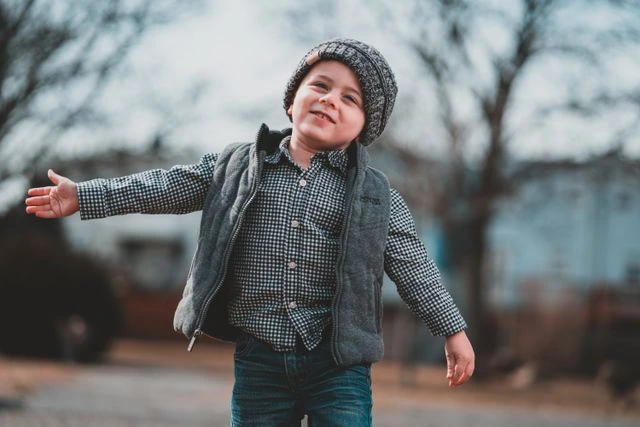
There was a jacket. Dark blue, a little worn at the elbows, bought for three euros at a market stall when my eldest was seven. He wore it for two years, then his brother wore it for another two, and then it went back to the same market — different stall, different three euros — and presumably carried on.
My mother was horrified. Not by the jacket itself, which was perfectly nice. By the origin of it. Second-hand meant something specific to her generation — poverty, necessity, the absence of choice. It did not mean what I was making it mean: a deliberate decision, a small act of refusal, a lesson I was trying to teach my children without quite having the words for it yet.
I’ve been thinking about that jacket a lot lately, because the numbers around children’s clothing have gotten genuinely alarming, and because I think the way families respond to those numbers is one of the more interesting parenting decisions of this particular moment in history.
Table of Contents
The Numbers First, Because They’re Worth Sitting With
Eighty-five percent of children’s clothes end up in landfill within one year. Not eventually. Within one year of purchase.
One year.
This is partly because children grow fast — a pair of trousers bought in September may be unwearable by February, which feels like an unavoidable biological fact rather than an environmental catastrophe. But it is also because the clothing available to most families in 2026 is not designed to last more than a season. A six-euro t-shirt from a fast-fashion brand is not designed to survive two children, several growth spurts, and the particular violence that boys aged four to eight inflict on fabric. It is designed to be cheap enough that replacing it feels like less effort than repairing it.
The fashion industry is the second largest consumer of the world’s water supply. Producing a single cotton t-shirt requires approximately 700 gallons of water — enough for one person to drink for two and a half years. Twenty percent of global water pollution comes from textile dyeing and treatment. And textile dyeing is one of the most toxic industrial processes on Earth, happening predominantly in countries where labour and environmental regulations are weakest, and where the people dealing with the consequences are not the people buying the six-euro t-shirts.
I’m not writing this to generate guilt. Guilt about consumption tends to produce the same two responses: brief, expensive overcorrection followed by a return to previous behavior, or a kind of defensive numbness where the numbers become so large they stop meaning anything at all. Neither of these is useful.
What I am writing this for is the conversation that happens between parents and children in the moments when clothing gets bought, worn, outgrown, and replaced. Because that conversation — or the absence of it — is teaching children something about the relationship between what we own and what it costs the world. And right now, in most families, that conversation is not happening.
What Children Currently Learn About Clothes
Watch a child absorbing the culture around clothing and you see a fairly consistent picture. New is better. More is normal. Cheap is good. Worn is embarrassing. The TikTok haul video — person on screen showing bags of new clothing, item by item, dozens of pieces for a price that doesn’t make financial sense unless the workers were paid almost nothing — has been watched billions of times, including by children who are twelve and thirteen and forming their first independent ideas about consumption.
National Geographic reported that between July and December of one year, the fast-fashion brand Shein added between 2,000 and 10,000 new styles to its app each day. Each day. The message this sends to anyone watching — especially young people for whom this is the first consumer environment they have ever known — is that clothing is essentially disposable, that novelty is the whole point, and that the appropriate emotional response to a shirt you wore last month is mild embarrassment.
Children learn what they live. If the family treats clothing as something to be replaced cheaply and frequently, children learn that clothing is cheap and replaceable. If the family treats clothing as something to be chosen with care, maintained, repaired, passed on when outgrown, and sourced second-hand where possible — children learn something entirely different. Not as a lecture. As an atmosphere. As the unremarkable fabric of daily life.
The Case for Second-Hand — and It’s Not the One You Think
The environmental case for buying children’s clothing second-hand is obvious enough that I won’t labour it: a garment that already exists requires no new resources, no new water, no new toxic dye process. Every month it stays in use rather than landfill is a month of resource extraction that didn’t happen. This is the argument most sustainable fashion advocates lead with, and it’s correct.
But it’s not actually the argument I find most compelling when I’m thinking about children specifically. The argument I find most compelling is educational.
A child who has grown up going to charity shops, secondhand markets, clothing swaps, and online resale platforms has developed a relationship with objects that is fundamentally different from one who has grown up clicking “add to cart” for new items that arrive in plastic packaging and are outgrown in three months. The first child has learned, through lived experience, that things have history. That the jumper they’re buying was someone else’s first. That value is not the same as newness. That objects can move between people without losing worth — can gain worth, even, accumulating the particular character that worn-in things carry.
These are not small lessons. They are the foundation of a relationship with material things that will serve a person — and serve the planet — across an entire lifetime of consumption decisions.
There is also the practicality, which I don’t want to be too high-minded about. Children grow constantly. Clothes get stained, torn, lost at school, outgrown before they are barely worn. Spending significant money on a pair of trousers that will fit for four months is a choice that many families cannot afford and that many others make only out of habit or social pressure. Second-hand children’s clothing is almost always substantially cheaper, frequently better quality — because items that have survived one child are demonstrably more durable than ones that haven’t — and increasingly easy to find in good condition across most countries.
How to Actually Talk to Children About This
The mistake most parents make when they try to have sustainability conversations is starting with the planet. The planet is abstract. The planet is far away. The planet does not feel urgently relevant to a nine-year-old who wants the same trainers as their friend.
Start with the object instead. Start with the story.
Charity shops and secondhand markets are actually fascinating to children when someone takes the time to frame them correctly. Every item has a previous life. Who wore this before? Where has it been? Why did it end up here? Children who are natural storytellers — and most of them are — find this genuinely engaging in a way that “this generates less carbon” simply does not.
For younger children, the approach is simpler. Buying second-hand and donating outgrown things can be framed entirely around the idea that items continue — that the jacket doesn’t disappear when you outgrow it, it goes on to someone else who needs it, and that’s a nice thing. The concept of circularity — that resources move around rather than ending up in the ground — is actually not difficult for young children to grasp when it’s presented in concrete terms rather than environmental abstractions.
For older children and teenagers, the conversation can be more honest. Fast fashion’s environmental costs are real and documentable. The workers who make six-euro t-shirts are paid wages that would not sustain a family in most of the countries where those wages are paid. The clothing in the haul video did not appear from nowhere — it came from somewhere, made by someone, at a cost that the price tag doesn’t reflect. These are not comfortable things to discuss, and they should not be.
But the conversation needs to happen alongside genuine acknowledgment of the social pressures teenagers face. A teenager who wants specific clothing because their social world values it is not being frivolous or shallow. They are navigating a genuine social reality. The goal is not to make them feel guilty for having normal teenage desires. It is to give them the information that allows those desires to be balanced against other values they also hold — about fairness, about the planet, about the people who make the things they wear. As we explored in the article on talking to children about environmental issues without causing anxiety, guilt is not a useful emotion to cultivate. Critical thinking is. There’s a difference.
The Repair Question
Somewhere in the cultural shift toward fast fashion, repair became embarrassing. A visible patch on a pair of jeans once meant resourcefulness. Now it means, in many children’s social environments, that your parents can’t afford new ones.
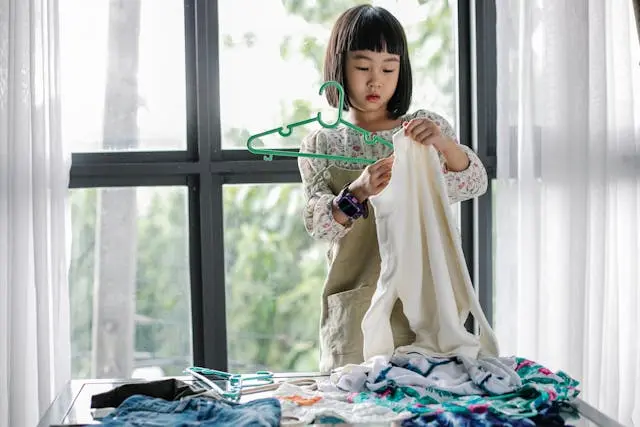
I think this is one of the more interesting cultural reversals to push back against, and one of the places where parental modeling matters most. A parent who repairs things — who sews a button back on rather than replacing the shirt, who mends a tear rather than discarding the garment, who treats objects as worthy of maintenance — is communicating something specific about the relationship between people and things. Objects are not disposable. Care extends their life. Skills have value. Not everything that is broken should be thrown away.
Involving children in simple repairs — watching, then helping, then doing — builds craft skills that are increasingly rare and, in my view, increasingly valuable. The ability to fix a basic garment is practical knowledge that makes a person more self-sufficient and less dependent on the constant cycle of buy, discard, buy. And it teaches a relationship with material things that is the opposite of disposable: one of care, attention, and the particular satisfaction of something restored.
It also, incidentally, tends to produce garments that children are more attached to. The jacket with the patch is more interesting than the unpatched one. It has a history now. My son’s friends used to ask about the elbow patches on his blue jacket and he had, over time, developed an increasingly elaborate story about their origin. None of it was true. All of it was better than “my mum sewed them on because the jacket was wearing out.”
What About Peer Pressure and Looking Different?
This is the question parents usually have by this point in the conversation, so let me address it directly.
Yes, children care about what they wear. Yes, teenagers especially care. Yes, second-hand clothing sometimes looks different from brand-new fast-fashion items, and children are not wrong to notice that social environments attach meaning to this difference.
The honest answer is that the degree of social difficulty varies enormously by age, by specific social environment, and by how the conversation has been framed at home. A family that has always bought second-hand, and has always talked about it openly and positively — as a choice rather than a necessity — tends to produce children who are less socially uncomfortable about it than families where second-hand is introduced suddenly as a money-saving measure or a sustainability lecture.
And second-hand is not what it was. The online resale market for children’s and teenage clothing has grown substantially. Brand-name items in good condition are routinely available for a fraction of their original price. The child or teenager who understands how to navigate these platforms has access to a wider range of clothing at better prices than the one who only shops new. That’s a practical argument that tends to land well with older children who are cost-aware.
The goal is not to produce children who are indifferent to their appearance or immune to peer pressure — that’s not achievable and probably not desirable. The goal is to produce children who have the context to make informed choices: who know what fast fashion costs, who have experienced the value of things that last, and who have enough confidence in their own values to make decisions that reflect them even when those decisions aren’t what everyone around them is doing.
Building a Different Kind of Relationship With Clothes
The Sustainable Business Magazine put it well: when parents choose quality garments and participate in circular systems, they model a different relationship with clothing — one grounded in care, responsibility, and longevity. Kids learn early that garments have value, that repair and reuse are normal, and that sustainability is an everyday practice rather than an abstract concept.
That’s what the blue jacket was doing, I think. Not saving the planet — no single jacket does that. Building, very slowly, over the years both boys wore it, an understanding that things are worth caring for. That objects have value beyond newness. That choosing not to buy something that already exists somewhere cheaper and better is a reasonable thing to do. That the person who made whatever you’re wearing is a real person whose labour deserves more consideration than a price tag usually reflects.
These are values. They don’t come from lectures. They come from habits, and choices, and the daily texture of how a family lives. The clothing conversation is, like most things in parenting, not really about clothing at all. It’s about what kind of relationship with the material world you’re building for your child — one of disposability and novelty, or one of care and continuity.
The jacket is still out there somewhere, probably. Whatever it’s doing, it’s doing it.
A Few Practical Starting Points
If this is new territory for your family, starting is simpler than it might seem. The next time your child outgrows something, take them with you to donate it. Let them hand it over. Talk about where it might go next. This is the circularity concept in its most accessible form.
Before buying something new, spend five minutes looking for it second-hand first. Not every time, not with rigid rules — just as a habit of checking. Sometimes you won’t find it. Often, especially for children’s items, you will.
When something wears out, pause before replacing it. Can it be repaired? Is the repair within your skills or worth learning? For children, even watching a basic repair is something — it introduces the idea that damaged doesn’t automatically mean discarded.
And talk about it, not as an environmental lecture but as a family position: this is how we think about things we own. This connects directly to the broader approach we explored in raising children to think about waste and building sustainable habits as a family — the most durable environmental values are those that become unremarkable, embedded in the daily habits that families barely notice anymore. The goal is for second-hand to stop feeling like a sacrifice and start feeling like just how things are. That shift takes longer than a conversation. It takes practice, and time, and a willingness to hold the line when it would be easier not to.
But it happens. Ask my son about his jacket. He’ll tell you a story.
Younes Kehal is an Educational Director and School Coach with over twenty years of experience working with children, families, and schools. He writes about the small, everyday decisions that shape the people children become.