How to Build Eco-Friendly Habits as a Family — One Small Change at a Time
It usually starts with a moment of clarity. A documentary you watched. A news headline you could not shake. A question your child asked about where rubbish goes that you could not answer well. Something shifts, and you find yourself thinking: our family should be doing things differently. We should be living more sustainably.
And then the overwhelm arrives.
Because when you start looking at what “living sustainably” actually entails — the plastic, the packaging
, the energy use, the food miles, the fast fashion, the carbon footprint of every flight and car journey and online delivery — the gap between where your family is and where you want to be feels so vast that doing anything feels pointless. So most families do nothing. They feel guilty, they feel helpless, and eventually they quietly file sustainable living under “things other, more organized people do.”
In over twenty years of working with families, I have watched this cycle repeat. And what I have learned — both from the research and from the families who actually manage to change — is that the cycle breaks not with a dramatic overhaul, but with one small, concrete, repeated change. Then another. Then another.
This guide is about what those changes look like, why they work, and how to build them into the fabric of your family’s life in a way that sticks — without guilt, without perfection, and without turning your home into a source of constant environmental stress.
Table of Contents
Why “Everything at Once” Never Works
The research on habit formation is unambiguous on this point: the most effective behavioral changes are small, specific, and attached to existing routines. Attempting to change everything simultaneously — diet, shopping habits, energy use, transportation, waste management, and consumption patterns all at once — produces the cognitive and emotional overload that leads to abandonment.
Eco parenting in 2026 has become more practical than ever. Improved product designs, thriving community networks, and greater mainstream availability have lowered the barriers considerably. What remains is the simple choice to begin, one small adjustment at a time. The effects gather momentum more quickly than most families expect.
This is the approach that works: choose one area, make one specific change, repeat it until it is automatic, then add the next. The family that has been composting food scraps for six months and now does it without thinking is in a far better position to add a second habit than the family that attempted ten changes simultaneously and abandoned all of them within a fortnight.
Start small. Start specific. Start now.
The Kitchen: Where the Biggest Wins Are
The family kitchen is the single most impactful area for reducing a household’s environmental footprint — and the area where the most accessible changes are available. Food production, food waste, packaging, and energy use all converge here, making it the natural starting point for any family building more sustainable habits.
1. Tackle Food Waste First
Food waste is one of the largest contributors to household carbon emissions. When food goes to landfill rather than compost, it decomposes anaerobically and produces methane — a greenhouse gas significantly more potent than carbon dioxide. Globally, food waste accounts for approximately 8 to 10 percent of total greenhouse gas emissions.
For families, the most impactful first step is starting a compost system. This does not require a garden. Countertop composters, worm bins, and municipal collection programs make composting possible in apartments and urban homes. A small bin on the kitchen counter, emptied regularly into a larger outdoor bin or a community collection point, is sufficient to divert a significant portion of a family’s organic waste from landfill.
Beyond composting, simple meal planning — deciding what the family will eat for the week before shopping, and shopping specifically for those meals — reduces both the quantity of food purchased and the amount that goes unused. Cooking with what is already in the fridge before buying more. Using vegetable scraps for stock. These are not radical changes. They are small habits that, practiced consistently, have a measurable environmental impact and typically reduce grocery spending as well.
2. Move Toward Seasonal and Local Produce
The environmental cost of food is not just in its production — it is in how far it has traveled to reach your table. A tomato grown locally and bought in season has a fundamentally different carbon footprint from a tomato imported out of season from another continent. Building weekly meals around seasonal, locally grown produce trims both spending and transport emissions while exposing children to flavors that change with the calendar.
Involving children in shopping for seasonal produce — letting them choose an unfamiliar vegetable each week, learning together what grows when and where — turns this into an education in food systems and environmental awareness that no classroom lesson can replicate. As we explored in our article on raising children who love real food, the habit of thinking about where food comes from is built through experience, not instruction.
3. Introduce One Plant-Based Family Meal Per Week
The research on food and environmental impact is consistent: plant-based diets have significantly lower environmental footprints than diets centered on animal products, particularly beef and dairy. This does not mean families need to become vegetarian overnight — or at all. But introducing one fully plant-based family meal per week is a manageable, evidence-based step toward reducing the household’s dietary carbon footprint.
In 2026, plant-based cooking has become far more approachable than it was even five years ago. The range of recipes, the quality of ingredients, and the mainstream availability of plant-based alternatives have all improved substantially. “Meatless Monday” is not a sacrifice — it is a weekly opportunity to experiment with new ingredients and cooking approaches, which itself builds the food curiosity and flexibility that supports a healthier, more sustainable diet over time.
Reducing Single-Use Plastics: The Changes That Matter Most
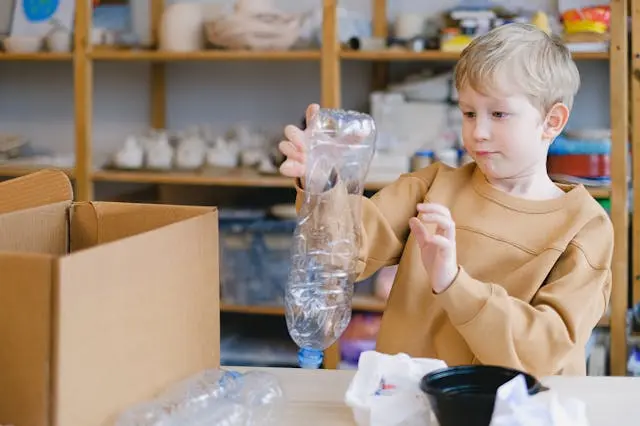
Single-use plastics remain one of the most visible and most tractable environmental problems that families can address through purchasing decisions. The key is not to try to eliminate all plastic simultaneously — which is neither achievable nor necessary — but to identify the highest-volume single-use items in your household and replace them with durable alternatives.
The changes with the greatest impact per household are consistently the same:
- Reusable water bottles — one per family member, kept where they are always accessible. This single change eliminates hundreds or thousands of plastic bottles per family per year.
- Reusable shopping bags — kept by the door, in bags, in the car — wherever they need to be to ensure they are always available when needed. The bag that is left at home does not reduce plastic use.
- Reusable containers for school lunches — replacing cling film, sandwich bags, and single-use packaging. The upfront cost of good-quality containers is recovered within months through reduced packaging spend.
- Beeswax wraps or silicone covers — replacing cling film in the kitchen for covering bowls and wrapping food.
UNICEF‘s sustainability guidance is clear: begin by replacing single-use plastic items in your home with reusable versions — disposable dining ware, cutlery, straws, plastic bags, to-go cups, take-out containers and water bottles. These replacements require an upfront investment and an adjustment period. Once they become the household default, they require no ongoing effort — and no ongoing spending.
The key principle, as with all habit formation, is environmental design: make the sustainable option the easy option. Reusable bags hanging by the front door require no decision. Reusable water bottles on the kitchen counter require no decision. The decision happened once, when the system was set up. After that, sustainability becomes the path of least resistance.
Energy and Water: The Changes Children Can Own
Energy and water conservation habits are among the easiest to build with children — because they are simple, immediate, and entirely within a child’s control. A 4-year-old can turn off a light switch. A 6-year-old can turn off the tap while brushing their teeth. A 10-year-old can unplug devices that are not in use.
The research on teaching sustainability to children consistently emphasizes that habits formed through repeated action become genuinely automatic. A child who grows up turning off lights when leaving a room does not decide to do so as an adult — they simply do it, because it is part of who they are and how they were raised. The environmental impact of that single habit, repeated over a lifetime, is not trivial.
Energy-saving habits worth building into family routines:
- Switching off lights whenever leaving a room — made into a family game for young children, where spotting a light left on earns a point
- Unplugging devices rather than leaving them on standby — phantom power from standby devices accounts for a meaningful percentage of household energy use
- Shorter showers — a timer in the bathroom makes this concrete and achievable for children who respond well to clear targets
- Full loads in the washing machine and dishwasher — and washing at lower temperatures where possible
- Turning the heating down by one or two degrees and using an extra layer — a change that is barely noticeable in comfort terms but meaningful in energy terms over a year
The framing you use with children matters enormously. As we explored in our article on raising zero-waste kids, habits framed as expressions of care — “we turn off the lights because we only use what we need” — build values beneath the behavior. Habits framed as restrictions produce compliance while the adult is watching, and abandonment when they are not.
Sustainable Shopping: Rethinking What “New” Means
Consumer culture has normalized the assumption that new is better — that the latest version, the fresh packaging, the unopened item is inherently superior to its secondhand equivalent. This assumption is both environmentally costly and financially irrational, and one of the most valuable things eco parenting can do is gently, consistently, over years, build a different assumption in its place.
Secondhand First
Children outgrow clothing, shoes, toys, and books rapidly — sometimes within months. Buying these items secondhand wherever possible reduces the demand for new production, keeps usable items out of landfill, and saves substantial amounts of money. In 2026, the range and quality of secondhand children’s items available — through charity shops, dedicated resale platforms, neighborhood exchange groups, and school uniform swaps — has never been better.
Framing secondhand shopping as a treasure hunt rather than a deprivation transforms the experience for children. A child who finds something they love in a secondhand shop and knows they found it rather than simply received it has a relationship with that item that is genuinely different from one that arrived in new packaging. And a child who regularly donates outgrown items understands, in a lived way, that the things they no longer need have value for someone else — a lesson in both generosity and circular economy that no formal lesson can teach as effectively.
Rethinking Gifts
Birthdays and holidays generate an extraordinary volume of new, often short-lived, often plastic-heavy items. Before these occasions, a simple, honest conversation with grandparents and relatives about what your child actually needs and what kinds of gifts align with your family’s values is worth having. Most people are genuinely willing to give experiences rather than things — a trip, an activity, a class — or to contribute to a savings account, or to choose a high-quality item that will last years rather than a cheaper one that will not, when they understand that this is what the family actually wants.
As we noted in our article on why children ignore expensive toys, the most developmentally valuable toys are also often the most durable and the least environmentally impactful — wooden toys, open-ended materials, quality items that last years. The environmental and developmental arguments point in the same direction: fewer, better, more durable things.
Repairing Before Replacing
One of the most quietly radical habits an eco-conscious family can build is the habit of repairing things rather than automatically replacing them. A broken zip, a torn seam, a toy with a loose part, a scratched piece of furniture — the default response in most households is to replace. The eco-conscious response is to ask first: can this be fixed?
Involving children in simple repairs — watching something being mended, helping where they can — teaches them that objects have value beyond their immediate perfection, that skills and care can extend the life of things, and that the throwaway mentality is a choice rather than an inevitability. These are not small lessons. They are foundational to a sustainable relationship with the material world.
Transportation: The Choices That Add Up
Transportation is one of the largest components of most families’ carbon footprints — and one of the areas where individual choices are genuinely constrained by infrastructure, geography, and circumstance. Not every family can cycle to school or walk to work. But within the constraints of your specific situation, there are almost always choices that reduce the environmental impact of getting around.
Walking or cycling for short journeys — where it is safe and practical — is the most impactful single transportation change most families can make. It eliminates emissions entirely for those journeys, provides physical activity, and builds in the children the habit of not automatically reaching for the car for every movement.
Public transit over private car use where available and practical. Combining errands into single trips rather than multiple separate journeys. Carpooling with other families for school runs and activities. These are not dramatic changes. They are small, consistent choices that reduce emissions and, often, reduce stress as well.
For holidays and travel, the environmental cost of flying is significantly higher than surface travel. This does not mean families should never fly — but it is worth making the choice consciously rather than automatically, and exploring whether train travel or other lower-carbon alternatives are practical for any given trip. A family that takes one fewer flight per year and replaces it with a train journey has made a meaningful environmental choice.
Building an Eco-Conscious Home: Room by Room
| Room / Area | High-Impact Changes | What Children Can Do |
|---|---|---|
| Kitchen | Composting, meal planning, seasonal shopping, reusable containers, less meat | Add scraps to the compost bin, help plan meals, choose a seasonal vegetable at the shop |
| Bathroom | Shorter showers, tap off while brushing teeth, bar soap over plastic bottles, bamboo toothbrushes | Time their own shower, turn off the tap, choose their own bamboo toothbrush |
| Bedroom / playroom | Secondhand toys and books, donate outgrown items, unplug devices, quality over quantity | Choose items to donate, unplug their own devices, visit secondhand shops to choose items |
| Living areas | Lights off when leaving, standby devices unplugged, natural cleaning products, reduced heating | Switch off lights, spot phantom power devices, help make natural cleaning spray |
| Garden / outdoor | Composting, growing food, rainwater collection, wildlife-friendly planting, no pesticides | Plant seeds, water plants, fill the bird feeder, add scraps to the compost |
How to Make It Stick: The Psychology of Sustainable Family Habits
Understanding why habits form and why they fail is as important as knowing which habits to build. The research on behavior change offers clear guidance that is directly applicable to building sustainable family practices.
Attach New Habits to Existing Ones
The most reliable way to build a new habit is to attach it to something you already do reliably. This is called habit stacking. “After I clear the dinner table, I add the food scraps to the compost bin.” “When I pack school bags in the morning, I check that reusable bottles are filled.” “When we walk to the car, we take our reusable bags.” The existing behavior becomes the trigger for the new one — and because the trigger is reliable, the new habit becomes reliable too.
Make the Sustainable Choice the Easy Choice
Environmental design beats willpower every time. The compost bin on the kitchen counter requires no decision — it is simply where food scraps go. The reusable bags by the front door require no decision — they are simply what you take. The water bottle on the kitchen counter requires no decision — it is simply what you fill. Design your home so that sustainable choices require the least possible effort, and unsustainable ones require more.
Celebrate Progress Without Demanding Perfection
Eco-perfectionism — the pressure to do everything right, to have no environmental impact, to live a fully sustainable life — is one of the fastest routes to burnout and abandonment. As the research on sustainable behavior consistently shows, the families who sustain environmental habits over the long term are not those who aim for perfection. They are those who aim for progress — who celebrate what they have changed without dwelling on what remains imperfect, who approach new habits with curiosity rather than guilt, and who understand that sustainable living is a direction rather than a destination.
Model this attitude explicitly with your children. “We’re not perfect at this, and that’s okay. We’re doing more than we were last year, and that matters.” This framing — progress over perfection — is itself one of the most valuable things you can teach your child about how to engage with difficult problems without being paralyzed by their scale.
Talk About Why — Not Just What
Teaching sustainability works best when it becomes part of your family’s everyday life rather than a special lesson. But the habits are more durable when children understand the reason behind them — not as a lecture, but as a quiet, consistent thread in family conversation. “We compost because food scraps are valuable — they become soil that grows more food.” “We buy secondhand because making new things uses resources and energy.” “We turn off the lights because we only use what we need.” These brief, honest explanations build understanding beneath the habit — and understanding produces values that persist even when the parent is no longer watching.
A Month of Small Changes: A Practical Starting Plan
For families who want a concrete starting point rather than a general framework, here is a month-by-month plan that builds sustainable habits gradually without overwhelming anyone.
- Week 1: Start a compost system. Choose the right size for your home — countertop bin for apartments, outdoor bin for houses. Establish the routine of adding food scraps daily.
- Week 2: Replace the highest-volume single-use plastic item in your home. For most families this is either plastic shopping bags or plastic water bottles. Buy reusable alternatives and put them where they will be used automatically.
- Week 3: Do a household energy audit with your children. Walk through each room together and identify what is using energy unnecessarily. Establish three specific energy-saving habits as a family — and make them the new normal.
- Week 4: Plan one fully plant-based family meal this week. Cook it together. Let the children choose the recipe. Make it an experiment rather than a statement.
At the end of the month, look back at what has changed. One composting system. One fewer plastic item in regular use. Three energy habits. One plant-based meal. None of this is dramatic. Together, it represents a genuine shift in the direction of how your family lives — and a foundation on which the next month’s changes can be built.
What You Are Building Beyond the Habits Themselves
Every sustainable habit you build into your family’s daily life is doing two things simultaneously. It is reducing your household’s environmental impact in a small but real way. And it is building something in your children that will outlast any individual behavior — a set of values, instincts, and assumptions about how to live in the world that they will carry forward into their own households and their own choices for decades to come.
The child who grows up composting does not need to be convinced as an adult that food waste matters. The child who grows up reaching for a reusable bag does not need to make a conscious decision about it at twenty-five. The child who grows up understanding that objects are worth repairing, that secondhand is as good as new, that resources have value and should not be wasted — that child has a relationship with the material world that is fundamentally different from one built on unconsidered consumption.
You are not just managing your household’s carbon footprint. You are shaping the values of a human being who will make choices about consumption, energy, food, and waste for the next seventy or eighty years. The cumulative environmental impact of those choices — made thoughtfully rather than automatically, from values rather than habit — is genuinely significant.
Start with one small change. Make it reliable. Add the next. Trust that small, consistent, joyful changes, repeated over years, add up to something that matters.
Summary: What To Remember
- Start small and specific — one change at a time, made automatic before adding the next. Attempting everything simultaneously produces overwhelm and abandonment.
- The kitchen offers the biggest wins: composting food waste, seasonal and local shopping, reducing meat, and eliminating packaging are all high-impact, accessible changes.
- Replace single-use plastics with durable alternatives — reusable bottles, bags, and containers eliminate thousands of items of waste per year per family.
- Energy and water habits are ideal for children — simple, immediate, and entirely within a child’s control from a young age.
- Secondhand first — especially for children’s items they outgrow quickly. Buy less, buy better, repair before replacing.
- Design your environment so sustainable choices are the easy default — the compost bin on the counter, the bags by the door, the water bottle where it will be filled.
- Celebrate progress, not perfection — sustainable living is a direction, not a destination. Eco-perfectionism produces burnout, not values.
- Talk about the why — brief, honest explanations build understanding beneath the habit, producing values that persist.
- The long-term impact is in your children — the habits you build now will shape their choices for decades. That is the real investment.
Younes Kehal is an educational director, certified school coach, and certified life coach with 20 years of experience working with children, families, teachers, and schools. His guidance combines practical educational experience with carefully reviewed research.