What Your Child Is Actually Learning When They Play Pretend
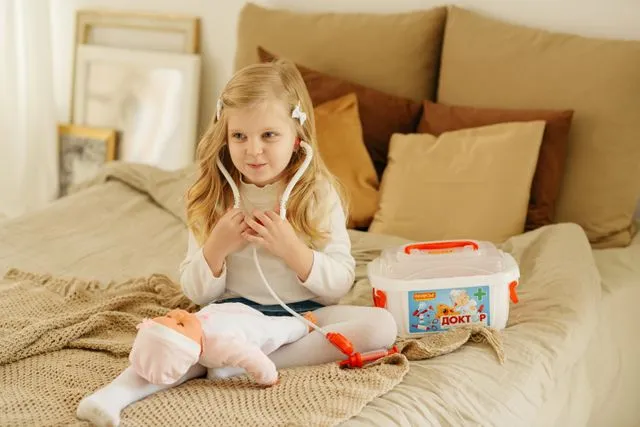
I once watched a five-year-old spend an entire afternoon running a hospital. He had recruited three stuffed animals as patients, a wooden spoon as a stethoscope, and his little sister — who was two and had no idea what was happening — as a nurse. The consultation fees were paid in imaginary coins. The surgery was serious. At one point he paused, looked at his patient, shook his head slowly, and said: “I’m sorry. We’re going to need the specialist.”
His mother was watching from the doorway. She leaned over and whispered to me: “Is this okay? Should I be giving him something more… educational?”
I told her what I’m going to tell you: that what she was watching was probably the most educational thing he would do all day.
We have a strange relationship with pretend play. We know children love it. We know it keeps them busy. But we have somehow arrived at a place where parents feel guilty watching their child play — as if play without visible learning outcomes is time that could be better spent. So the plastic doctor set gets replaced by a phonics app. The dress-up box gets put away in favour of something that comes with a certificate of educational value.
And the research, frankly, does not support this trade.
Table of Contents
What Happened When Researchers Actually Looked at This
A study published in April 2026 by Neuroscience News traced children’s pretend play ability at ages two and three and then followed up with those same children between four and seven. What they found was that strong pretend play at two and three predicted significantly fewer mental health problems at four through seven. Not marginally fewer. Significantly.
Here is the part that surprised even the researchers: emotional regulation — which everyone assumed was the mechanism — didn’t actually explain the link. The children who played well imaginatively were doing better mentally not because they had better regulated emotions. Something else was happening. The researchers point to what they call embodied cognition — the idea that when children act out scenarios physically, moving their bodies through imaginary worlds, they are engaging motor brain regions that influence attention and anxiety in ways we don’t yet fully understand.
Which is a scientific way of saying: we don’t entirely know why it works. We just know it does.
The same study flagged something worth noting. Screen time and highly structured schedules are, the researchers wrote, crowding out the very type of free imaginative play children need for healthy development. Not because screens are evil. Because when every hour of a child’s day is accounted for — scheduled, productive, visible — there is no room left for the kind of unstructured, child-led, make-believe world where this development actually happens.
What They’re Doing When They’re “Just Playing”
Watch a child in the middle of a serious pretend game and you will see something that looks, from the outside, like pure chaos. But look more carefully.
The child running the imaginary hospital is managing multiple narratives at once. He has to remember who each patient is, what is wrong with them, what has been done and what comes next. That is working memory — the same cognitive skill that predicts academic performance more reliably than almost any other measure.
He is also inhibiting his own impulses. He wants to play the exciting surgery part, but first there has to be the consultation. And the paperwork — he definitely added paperwork at some point, which delighted me. The ability to do the less exciting part before the more exciting part: that is inhibitory control. Also, incidentally, one of the building blocks of everything from doing homework to managing finances in adulthood.
When he enlisted his sister and then had to adapt his game to include someone who couldn’t follow instructions yet — that was cognitive flexibility. His plan wasn’t working. He adjusted. He gave her a simpler role. He worked around the obstacle rather than abandoning the whole enterprise.
Planning, working memory, inhibitory control, cognitive flexibility. These are what neuroscientists call executive functions. They are the cognitive skills that most consistently predict how a person will do — in school, in work, in relationships. And a five-year-old was building all of them, with a wooden spoon and three stuffed bears, while his mother wondered if he should be doing something more educational.
The Language That Happens Inside the Game
One thing I have noticed across years of working with young children is how different a child’s language is when they are playing versus when they are being taught. In a lesson, they use the words they already have. In pretend play — especially when they are narrating, negotiating, or building a shared scenario with another child — they reach for words they are not entirely sure of yet. They try them out. They see if they work. They use language as an instrument rather than a product.
This matters because language development is not just about knowing words. It is about having the confidence and the context to use them. Pretend play — especially the kind that involves storytelling, role-playing, and collaborative scenario-building — is one of the richest language environments available to a young child. The Child Mind Institute’s research confirms that pretend play provides a powerful context for children to experiment with vocabulary and communication styles in a way that structured lessons simply don’t.
There’s also the narrative element. When children make up stories — when they build a sequence of events, cause and effect, beginning and middle and something-like-an-end — they are doing the same cognitive work that underlies reading comprehension. Understanding a story. Predicting what happens next. Holding the earlier parts in mind while processing the later parts. These skills don’t emerge from reading worksheets. They emerge from building stories, over and over, in the sandbox and the bedroom and the back garden, with whoever will play along.
The Emotional Education That Comes Free With Every Game
I want to say something about the hospital game that I haven’t mentioned yet. At one point, the five-year-old’s surgery went badly. The patient — a particularly battered bear — did not make it. He stood there for a moment, genuinely processing this. Then he announced a funeral. A proper one, with flowers he picked from his mother’s garden and a speech he improvised on the spot about what a good bear the bear had been.
His mother looked at me again. “Is this morbid?”
No. It was something rather extraordinary. It was a child rehearsing grief in a space where the grief was entirely manageable — where he was in complete control of the narrative, where the bear was fine and could be restored to life for tomorrow’s game, where he could experience the feeling of loss and the rituals we build around loss without any of the stakes being real.
Pretend play is, among other things, an emotional rehearsal space. Children act out scenarios that frighten them — monsters, doctors, getting lost, the death of beloved things — and in doing so, they develop a relationship with those fears that makes them more manageable. They try on emotional states that belong to characters rather than themselves, which is how empathy gets built: not through being told to consider other people’s feelings, but through inhabiting other people’s situations, over and over, in play.
This connects to something we know about children who are struggling emotionally. As we explored in our article on childhood anxiety and what helps, one of the most protective things for a child’s mental health is having access to safe contexts for processing difficult emotions. Pretend play is one of the oldest and most available of those contexts. It’s been doing this work since before anyone had a word for it.
What Parents Get Wrong — and One Thing They Often Get Right Without Knowing It
The biggest mistake I see is interruption. Not malicious interruption — the loving kind. The parent who sits down with their child in the middle of a game and says “Oh, is that a doctor? What does a doctor do? Can you count how many patients you have?” This is a parent trying to add educational value to play. What they are actually doing is ending the play. The moment the adult introduces a lesson, the child shifts mode from player to student. The executive function workout, the narrative construction, the emotional rehearsal — it all stops.
The 2026 research from Neuroscience News is explicit about this. Letting play unfold for its own sake, rather than turning it into a teaching moment, is one of the key recommendations. If a child makes a mistake during play — miscounts, mispronounces, gets something wrong — the priority is to keep the play going rather than interrupting to correct. The play IS the learning. Correcting the play stops the learning.
Joining pretend play as a participant — following the child’s lead, asking questions that advance the narrative rather than evaluate it, playing the role assigned rather than directing the game — is genuinely wonderful for both the child and the relationship. But the key phrase is “following the child’s lead.” You are a guest in their world, not a teacher in your own.
The thing parents often get right without knowing it is providing props. Not expensive ones. Just things. A cardboard box. Old clothes. Scarves. Kitchen utensils. Empty containers. These are the raw materials of imaginative play, and they are more valuable than almost anything that comes in dedicated toy packaging. The toy that does one thing leaves little room for imagination. The cardboard box becomes whatever the child needs it to be. As we explored in our piece on why children ignore expensive toys, the best play materials are those that require the most from the child, not the most from the manufacturer.
When Pretend Play Should Make You Pay Attention
Most of the time, pretend play — however dark the themes — is healthy processing. The child who repeatedly plays out scenes of conflict, loss, or fear is doing important emotional work. This is normal. It is good.
But occasionally, the themes of a child’s play are worth paying attention to more carefully. Persistent reenactment of scenarios involving violence directed at family members, detailed knowledge of adult situations that the child should not have access to, or play scenarios that seem to be replaying rather than processing a specific real event — these warrant a conversation with a child psychologist. Not because play-acting difficult things is a problem, but because sometimes pretend play is the only language a child has for something that has actually happened to them.
The vast majority of the time, you will not be in that territory. The vast majority of the time, the monster game is a monster game, the death-of-the-bear is a death-of-the-bear, and the child running the hospital is just a child who watched too many medical dramas with you and is working through the interesting parts.
On Screens and Imaginative Play
I’m going to say something that will not surprise anyone but is worth saying anyway: screens are not pretend play. Watching imaginative content is not the same thing as producing it. A child watching a cartoon about a hospital is consuming someone else’s imagination. A child running their own hospital is producing their own.
Both have value. But they are not interchangeable, and the developmental benefits — the executive function development, the language construction, the emotional rehearsal — belong to the producing, not the consuming. This is not an argument for banning screens. It is an argument for protecting the unstructured time in which imaginative play actually happens, because that time has been quietly shrinking for a generation now, and the research is starting to catch up with what that means.
A child who has two hours of unstructured time and a box of random household props will almost inevitably end up in some version of pretend play. This is what children do when they have time and materials and no adult directing them toward something else. It is not a behaviour that needs to be taught. It just needs to be allowed.
What the Wooden Spoon Was Really Doing
I’ve thought about that hospital game a lot over the years. What strikes me most, looking back, is how complete the world was. The five-year-old had built something with rules and stakes and characters and consequences. He had taken what he knew about hospitals — which was not very much, really — and extrapolated a fully functioning imaginary institution from it. He had solved the problem of his sister’s inability to participate by giving her a role within her competence. He had processed something about mortality in the funeral scene that I doubt he had the words to discuss directly at that age.
None of this required a specialist toy. None of it required a curriculum or a certificate or an adult telling him what the learning objectives were. It required time, space, some random objects, and the freedom to follow wherever his imagination led.
That mother at the doorway worried that it wasn’t educational enough. I think about that sometimes when I hear parents describe their child’s play as “just playing.” There is no such thing as just playing. There is play — which is where a great deal of the most important learning in childhood happens — and there are other things. What we call “educational” toys and apps and structured activities produce some things. But they don’t produce what the wooden spoon and the stuffed bear and the improvised funeral produce.
Protect your child’s time for pretend play. Not because there’s a study that says you should, though there is. But because the child who runs the hospital, negotiates with the nurse, performs the surgery, and then holds the funeral — that child is doing something ancient and necessary and irreplaceable. Something that no screen can substitute for and no lesson can replicate.
The wooden spoon was doing more work than it looked like. It usually is.
A Few Practical Notes for Parents
Because I know some people prefer a bit of concrete guidance alongside the argument:
The best thing you can do is protect unstructured time in your child’s day — time with no programme, no screen, and no adult directing what happens. Even thirty minutes is enough to see imaginative play emerge, especially if the materials are available.
Keep a box of “loose parts” — random objects, old clothes, scarves, containers, cardboard — accessible and low-stakes. Nothing precious. Things they can use, break, repurpose, combine.
If your child invites you to play, accept. But follow. Ask questions that open the story rather than closing it. “What happens next?” is better than “What colour is that?” Let them cast you. Play your role.
Don’t correct the play. A bear who gets surgery from a wooden spoon is learning things that a correctly labelled toy stethoscope cannot teach.
And if the scenarios are dark — death, monsters, scary things — that’s okay. That’s usually the most important play of all.
Younes Kehal is an educational director, certified school coach, and certified life coach with over twenty years working directly with children and families. He writes about what actually happens in the space between children and the adults who are trying to raise them well.